IEC 62305 vs NFPA 780: Which Lightning Protection Standard Applies in the US
By Site Safe Lightning Protection 9 min read
IEC 62305 is the international lightning protection standard, published by the International Electrotechnical Commission in four parts. In the US, the standard that building codes, inspectors and certification programs point to is NFPA 780. The International Building Code says lightning protection systems “shall be installed in accordance with NFPA 780 or UL 96A” (UL Solutions), and IEC 62305 isn’t on that list. IEC 62305 still turns up on US projects, for example in specs from multinational owners and in detailed risk assessments.
This guide is for engineers, specifiers and facility managers with a US project whose spec names IEC 62305.
What IEC 62305 covers: the four parts
The series is called Protection against lightning. The current third edition of all four parts was published on September 12, 2024, replacing the 2010 second edition (IEC 62305-1).
| Part | Title | What it does |
|---|---|---|
| IEC 62305-1 | General principles | Lightning current parameters, protection levels, and the framework the other parts use |
| IEC 62305-2 | Risk management | A procedure to calculate lightning risk and pick protection measures that bring it below a tolerable limit |
| IEC 62305-3 | Physical damage to structures and life hazard | Design, installation, inspection and maintenance of the external lightning protection system (LPS), plus touch and step voltages |
| IEC 62305-4 | Electrical and electronic systems within structures | Surge protection measures that limit damage from the lightning electromagnetic impulse (LEMP) |
Part 1 lists what the series does not cover: railway systems, vehicles, ships, aircraft, offshore installations, underground high-pressure pipelines, lines separated from a structure, and nuclear power plants (IEC 62305-1). Part 3 applies to structures of any height (IEC 62305-3).
What changed in the 2024 edition
The IEC webstore lists the main technical changes. The ones a US reader is most likely to run into:
- Part 1 now points to the IEC 62561 series for component requirements, risk management adds “types of loss with public relevance,” and surge currents for sizing SPDs are specified more precisely (Part 1).
- In Part 2, a single risk now combines loss of human life and loss due to fire. The lightning ground strike-point density, NSG, replaces flash density NG in the count of dangerous events. Thunderstorm warning systems that comply with IEC 62793 can count toward reducing some risk components. The risk of direct strikes to people in open areas is new (Part 2).
- Part 3 adds minimum metal thicknesses for air terminations that must avoid hot spots, a clearer separation distance calculation, revised rules for using steel reinforcement, three accepted methods for placing air-termination conductors, and new guidance on green roofs and on parts that stick out from the facades of tall buildings (Part 3).
- Part 4 adds new informative annexes on current sharing (including PV installations), system-level testing and induced voltages in SPD-protected installations (Part 4).
If a spec cites “IEC 62305” with no year, ask which edition it means. The 2010 and 2024 risk methods can give different answers.
IEC 62305 protection levels and the rolling sphere radius
IEC 62305 sets four lightning protection levels (LPL I to IV), each matched by a class of LPS and built around a minimum lightning current. The table uses the second-edition values as summarized in nVent’s IEC 62305 design handbook (nVent). Check them against the 2024 text before you design.
| LPL I | LPL II | LPL III | LPL IV | |
|---|---|---|---|---|
| Minimum current | 3 kA | 5 kA | 10 kA | 16 kA |
| Share of flashes above that current | 99% | 97% | 91% | 84% |
| Maximum peak current (10/350 µs) | 200 kA | 150 kA | 100 kA | 100 kA |
| Rolling sphere radius | 20 m (66 ft) | 30 m (98 ft) | 45 m (148 ft) | 60 m (197 ft) |
| Mesh size | 5 x 5 m | 10 x 10 m | 15 x 15 m | 20 x 20 m |
| Typical down-conductor spacing | 10 m | 10 m | 15 m | 20 m |
Air terminations can be placed with the rolling sphere, the mesh method or the protection angle method. nVent recommends the rolling sphere as the most universal; the mesh method suits flat roofs (nVent).
How NFPA 780 handles the same decisions
NFPA 780 has a single protection level. The 2022 ATIS presentation by Mitchell Guthrie, Bud VanSickle and Mark Morgan puts it plainly: “Only 1 LPL in NFPA 780” (Guthrie et al.). A few NFPA 780 numbers that correspond to the IEC table:
- The rolling sphere has a 150 ft (46 m) radius for ordinary structures (LPI). That is close to the 45 m sphere of LPL III.
- Air terminal tips stand at least 10 in above what they protect, placed along ridges, edges and corners. LPI says that layout has intercepted some 95% of recorded flashes over more than a century of practice (LPI).
- Class I materials are used for structures under 75 ft and Class II above 75 ft. Under IEC, conductor size doesn’t change with building height (Guthrie et al.).
- Down conductors have an average spacing of no more than 100 ft, with a preference for corners (Guthrie et al.).
- Vertical ground rods are driven to 10 ft depth (Guthrie et al.).
Our NFPA 780 explainer walks through the standard chapter by chapter, and the rolling sphere guide has worked examples of the 150 ft sphere.
IEC 62305 vs NFPA 780 side by side
| IEC 62305 (2024) | NFPA 780 | |
|---|---|---|
| Publisher | International Electrotechnical Commission | National Fire Protection Association |
| Structure | Four parts: principles, risk, physical damage, internal systems | One standard: Chapter 4 for ordinary structures, later chapters for special occupancies such as tanks, wind turbines and solar arrays |
| Protection levels | LPL I to IV | One level |
| Rolling sphere | 20, 30, 45 or 60 m by level | 150 ft (46 m) for ordinary structures |
| Components | IEC 62561 series | Listed components (UL 96) |
| Material sizing | Class H or N components, not tied to building height | Class I or II, split at 75 ft |
| Risk assessment | IEC 62305-2, a detailed quantitative method | Annex L, with a simplified method and a detailed method based on IEC 62305-2 |
| Named in US building code | No | Yes (IBC 2703.2, with UL 96A) |
The two standards overlap more than their tables suggest. Guthrie and his co-authors note that NFPA 780 has relied more on IEC 62305 over time. Annex L’s detailed risk assessment is based on IEC 62305-2. The smart-structures annex draws on IEC 62305-4, and all four IEC parts are cited as references in NFPA 780 (Guthrie et al.).
Lightning risk assessment: IEC 62305-2 vs Annex L
IEC 62305-2 sets a tolerable risk, calculates the actual risk for each type of loss, and adds protection until the risk falls below the limit. In the second edition the loss types were loss of human life (R1), loss of service to the public (R2) and loss of cultural heritage (R3). nVent lists the tolerable risk as 10⁻⁵ per year for loss of life and 10⁻³ per year for service and heritage (nVent). The 2024 edition reworks this with a combined life-and-fire risk and the new strike-point density, so older spreadsheets and software may need updating (Part 2).
In the US, the usual tool is NFPA 780 Annex L. Its simplified method compares expected strikes with a tolerable frequency, and its detailed method follows IEC 62305-2 (Guthrie et al.). Our lightning risk assessment guide works the simplified method for a Colorado building. Guthrie and his co-authors call the IEC 62305-2 assessment the most detailed one available, at 88 pages.
Can you design to IEC 62305 in the US?
You can, but plan for the code question first. The IBC names NFPA 780 or UL 96A for systems that are installed (UL Solutions). UL’s field inspections, which lead to a Master Label Certificate or a Letter of Findings, are done under UL 96A, so an IEC-designed system would still be inspected against that US document. See our explainer on UL 96A and the Master Label.
US participants in the IEC process have proposed country notes for IEC 62305-3 that bring it closer to US practice. The 2022 presentation lists notes such as these (Guthrie et al.):
- components certified to UL 96;
- no conductor bend with an included angle under 90 degrees or a bend radius under 200 mm;
- conductors fastened at intervals of no more than 1 m;
- only copper, copper-coated steel and stainless steel for direct burial;
- foundation rebar not the preferred grounding electrode, because the quality of its connections can’t be controlled.
Those were draft notes, so check whether they made it into the published edition before you rely on them.
Building codes are adopted city by city and county by county in Colorado, Texas and Oklahoma. Check with your local building department which IBC edition applies and whether it will accept an IEC-based design.
Checklist for a US project with an IEC 62305 spec
- Which edition of IEC 62305 does the spec mean, 2010 or 2024?
- Which LPL did the risk assessment select, and was it run under IEC 62305-2 or NFPA 780 Annex L?
- Does the local building department need the system to meet NFPA 780 or UL 96A as well?
- Is a UL Master Label or another third-party inspection required at the end?
- Are the components listed to UL 96, IEC 62561, or both?
- Who is the engineer of record for the lightning protection design?
Where the spec and the code pull in different directions, get the engineer of record and the authority having jurisdiction to agree in writing on which requirement governs each point.
Talk to Site Safe Lightning Protection
If you own or manage a commercial building or an oil and gas facility and have a spec, a quote or an existing system you want checked against the standard your project uses, contact Site Safe Lightning Protection. See our commercial lightning protection services for the kinds of buildings we work on.
FAQ
What is IEC 62305?
IEC 62305 is the International Electrotechnical Commission’s lightning protection series. Part 1 covers general principles, Part 2 risk management, Part 3 physical damage to structures and life hazard, and Part 4 electrical and electronic systems within structures. The current edition is from 2024.
Is IEC 62305 used in the US?
Not as the code standard. The IBC names NFPA 780 or UL 96A for installed systems. IEC 62305 shows up in specs from multinational owners, and NFPA 780’s detailed risk method in Annex L is based on IEC 62305-2.
What changed in IEC 62305-2:2024?
It combines loss of human life and loss due to fire into a single risk, replaces flash density NG with ground strike-point density NSG, adds credit for thunderstorm warning systems compliant with IEC 62793, and adds the risk of direct strikes to people in open areas.
Is IEC 62305 stricter than NFPA 780?
It depends on the level. LPL I and II use smaller rolling spheres than NFPA 780, while NFPA 780’s 150 ft sphere sits close to the 45 m sphere of LPL III. Compare the specific requirements for your project rather than the standards as a whole.
Talk to Site Safe Lightning Protection about your property.
Frequently asked questions
What is IEC 62305?
IEC 62305 is the International Electrotechnical Commission's lightning protection series. Part 1 covers general principles, Part 2 risk management, Part 3 physical damage to structures and life hazard, and Part 4 electrical and electronic systems within structures. The current edition is from 2024.
Is IEC 62305 used in the US?
Not as the code standard. The IBC names NFPA 780 or UL 96A for installed systems. IEC 62305 shows up in specs from multinational owners, and NFPA 780's detailed risk method in Annex L is based on IEC 62305-2.
What changed in IEC 62305-2:2024?
It combines loss of human life and loss due to fire into a single risk, replaces flash density NG with ground strike-point density NSG, adds credit for thunderstorm warning systems compliant with IEC 62793, and adds the risk of direct strikes to people in open areas.
Is IEC 62305 stricter than NFPA 780?
It depends on the level. LPL I and II use smaller rolling spheres than NFPA 780, while NFPA 780's 150 ft sphere sits close to the 45 m sphere of LPL III. Compare the specific requirements for your project rather than the standards as a whole.
Sources
- IEC 62305-1:2024, Protection against lightning, Part 1: General principles (IEC webstore)
- IEC 62305-2:2024, Protection against lightning, Part 2: Risk management (IEC webstore)
- IEC 62305-3:2024, Protection against lightning, Part 3: Physical damage to structures and life hazard (IEC webstore)
- IEC 62305-4:2024, Protection against lightning, Part 4: Electrical and electronic systems within structures (IEC webstore)
- Guthrie, VanSickle and Morgan: The Application of NFPA 780 and IEC 62305 in the United States (ATIS PEG conference, March 23, 2022)
- nVent ERICO Lightning Protection Handbook: Designing to the IEC 62305 Series of Lightning Protection Standards
- Lightning Protection Institute: Lightning Protection Overview
- NFPA 780, Standard for the Installation of Lightning Protection Systems (NFPA document page)
- UL Solutions: Lightning Protection Systems (IBC 2703.2)
Image credits
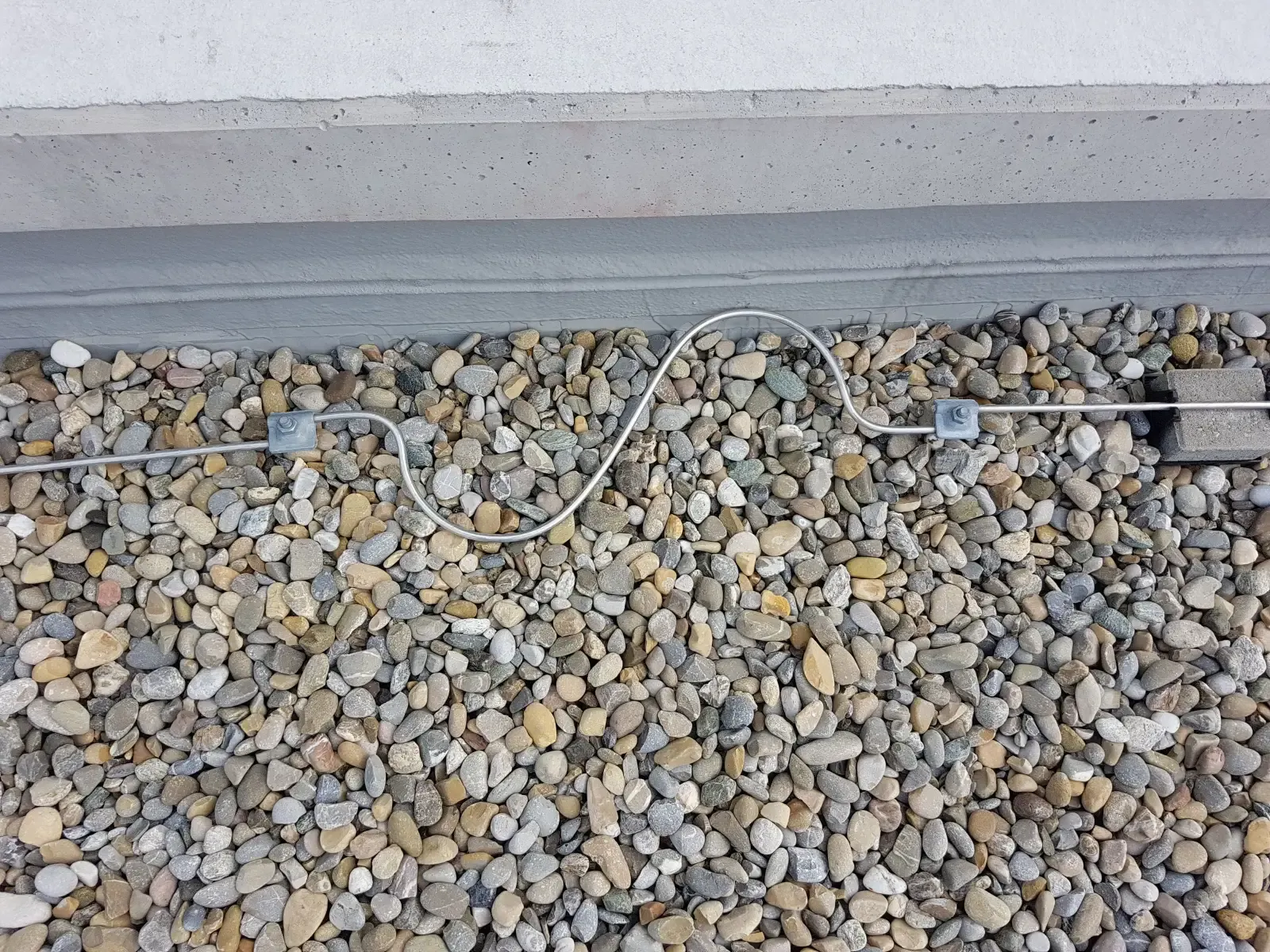
- Lightning protection roof conductor with an S-shaped expansion bend between two clips on a gravel flat roof. Photo: Asurnipal / Wikimedia Commons (source), CC BY-SA 4.0, resized.