The Rolling Sphere Method: How Lightning Protection Zones Are Mapped
By Site Safe Lightning Protection 6 min read
The rolling sphere method is a way of finding which parts of a building lightning can reach. You imagine a giant ball, 150 ft in radius under NFPA 780, rolled over, around and across the building in every possible direction. Anywhere the ball touches the building is a place lightning could strike, so it needs an air terminal or other strike termination device. Anywhere the ball can’t reach is inside a zone of protection.
It sounds abstract, but it’s the reason a lightning protection quote has the number of air terminals it does. This article explains where the 150 ft comes from, gives the formula, and works through two everyday buildings.
Where the 150 ft sphere comes from
As a lightning leader comes down from the cloud, the final jump to the ground or a building happens over a distance called the striking distance. ECLE describes the method as assuming that the electrically charged field ahead of a damaging bolt reaches about 150 ft. Any object within that distance of the leader’s tip can launch the connecting streamer.
The sphere’s radius is that striking distance. Roll it over the structure and you’ve mapped every point the final jump could land on.
What NFPA 780 says
In the 2023 edition of NFPA 780, Section 4.7.1 lists three ways to determine the zone of protection, which can be used alone or together:
- Air terminal placement rules (NFPA 780, 2023; spacing rules for ridges, edges and flat roofs)
- The angle method, Section 4.7.2
- The rolling sphere method, Section 4.7.3
The key rolling sphere rules:
- The zone of protection is the space not intruded by a sphere whose radius is the striking distance for the type of structure (NFPA 780, 2023).
- Where the sphere rests on the ground and touches a strike termination device, the space under the sphere between the two contact points is protected (NFPA 780, 2023).
- Where it rests on two or more strike termination devices, the space under it between them is protected (NFPA 780, 2023).
- Every possible placement of the sphere has to be considered (NFPA 780, 2023).
- The striking distance can’t exceed 150 ft (45 m) (NFPA 780, 2023).
- For structures taller than the striking distance, the sphere also rests against the vertical wall, so upper sides of tall buildings need protection too (NFPA 780, 2023).
The formula
Section 4.7.3.3 lets the designer calculate the horizontal protected distance instead of drawing it:
d = √(h₁ × (2R − h₁)) − √(h₂ × (2R − h₂))
where:
- d = horizontal distance protected from the edge of the higher roof
- h₁ = height of the higher roof (or strike termination device)
- h₂ = height of the lower roof or object
- R = rolling sphere radius (150 ft)
Units just need to be consistent (all feet or all meters).
Worked example 1: two-story house with an attached garage
A two-story house has a protected roof edge at 25 ft. An attached one-story garage has a roof at 10 ft.
- √(25 × 275) = √6,875 ≈ 82.92 ft
- √(10 × 290) = √2,900 ≈ 53.85 ft
- d ≈ 82.92 − 53.85 = 29.1 ft
So the part of the garage roof within about 29 ft of the house wall is inside the zone of protection created by the higher roof’s strike termination devices. If the garage roof runs 22 ft out from the house, it’s covered. If it runs 36 ft out, the outer section needs its own air terminals.
Worked example 2: warehouse with a loading dock canopy
A warehouse roof edge sits at 40 ft. A loading dock canopy along one wall is at 15 ft.
- √(40 × 260) = √10,400 ≈ 101.98 ft
- √(15 × 285) = √4,275 ≈ 65.38 ft
- d ≈ 101.98 − 65.38 = 36.6 ft
A canopy projecting 30 ft from the wall is protected by the main roof’s system. A 45 ft canopy isn’t, at least not all of it.
How the rolling sphere compares to the angle (cone) method
The angle method (Section 4.7.2) applies to multi-level roofs up to 50 ft. It treats the higher roof as protecting a cone below it:
- Structures up to 25 ft protect a one-to-two zone (two units out for every unit down).
- Structures up to 50 ft protect a one-to-one zone (one unit out for every unit down).
Run the same two examples through it:
| Example | Heights | Rolling sphere protected distance | Angle method protected distance |
|---|---|---|---|
| House + garage | 25 ft over 10 ft | ≈ 29.1 ft | (25 − 10) × 2 = 30 ft |
| Warehouse + canopy | 40 ft over 15 ft | ≈ 36.6 ft | (40 − 15) × 1 = 25 ft |
On the low house, both methods land in about the same place. On the taller warehouse, the rolling sphere shows more of the canopy is protected than the one-to-one cone does. A designer can choose the method that fits the geometry, which is why NFPA 780 allows more than one.
| Rolling sphere | Angle (cone) method | |
|---|---|---|
| NFPA 780 section | 4.7.3 | 4.7.2 |
| Height limit | Any height; sides of structures over 150 ft also need protection | Multi-level roofs up to 50 ft |
| Best for | Complex shapes, tall buildings, masts, towers, open structures | Simple stepped roofs |
| How it’s applied | Drawn to scale, modeled, or calculated with the 4.7.3.3 formula | Simple ratio from the height of the higher roof |
Where the sphere shows up on real roofs
Even if your designer never says “rolling sphere,” it’s behind several everyday rules. NFPA 780 (2023) says pitched roofs with eaves at or below 50 ft don’t need strike termination devices around their perimeters. For eaves between 50 and 150 ft above grade, it lets the designer skip eave terminals if the roof slope is at least as steep as the tangent of a 150 ft sphere at that height. In other words, on a steep enough roof, the sphere can’t touch the eave.
ECLE gives a nice real example: a rolling sphere analysis of the Smithsonian Arts and Industries Building showed a sculptural pediment didn’t need its own air terminals because it sat in the zone created by terminals on the flanking towers. On historic buildings, that kind of analysis can keep hardware off ornamental features.
Why it changes your quote
The method decides how many air terminals and how much conductor a building needs:
- Lower roofs, canopies and additions may be covered by the higher roof, or may need their own terminals, depending on the numbers above.
- Rooftop units, screens and penthouses can create their own zones, or sit outside the roof’s protection.
- Tall buildings need protection on upper side walls where the sphere touches.
Two contractors quoting the same building can legitimately use different methods and end up with different terminal counts. Ask each one which method they used and to show the zones on the drawing. Our article on choosing a commercial lightning protection company covers other questions for comparing bids.
A warning about “one terminal protects everything”
Some sellers claim a single “advanced” air terminal can protect a whole building regardless of its shape. These are usually early streamer emission (ESE) devices. ECLE’s rolling sphere page warns that such claims of exaggerated performance aren’t substantiated, and NFPA 780 (2023) excludes ESE systems from the standard. The rolling sphere method gives no credit for them.
Talk through your layout
If you’re comparing quotes or planning an addition, contact Site Safe Lightning Protection. We can show you how the zones of protection fall on your building, for commercial buildings and homes. Get in touch.
Talk to Site Safe Lightning Protection about your property.
Frequently asked questions
What is the rolling sphere method?
A way to map where lightning can strike a building by imagining a sphere, with a radius equal to the striking distance, rolled over and around the structure. Anywhere it touches needs strike termination; anywhere it can't reach is protected.
What radius does NFPA 780 use for the rolling sphere?
The striking distance can't exceed 150 ft (45 m), per the 2023 edition of NFPA 780.
What is the difference between the rolling sphere and the cone of protection?
The cone (angle) method uses a fixed ratio below a higher roof and is limited to structures up to 50 ft. The rolling sphere works at any height and on complex shapes, and it can be calculated with a formula in NFPA 780 Section 4.7.3.3.
Does the rolling sphere method apply to houses?
Yes. It can be used on any structure. On simple homes, designers often use the air terminal spacing rules, and the sphere is behind the rule that pitched roofs with eaves at or below 50 ft don't need eave terminals.
Can a single lightning rod protect a whole building?
Not under NFPA 780. Claims that one early streamer emission terminal protects an entire building aren't supported by the standard, which excludes ESE systems from its scope.
Sources
Image credits
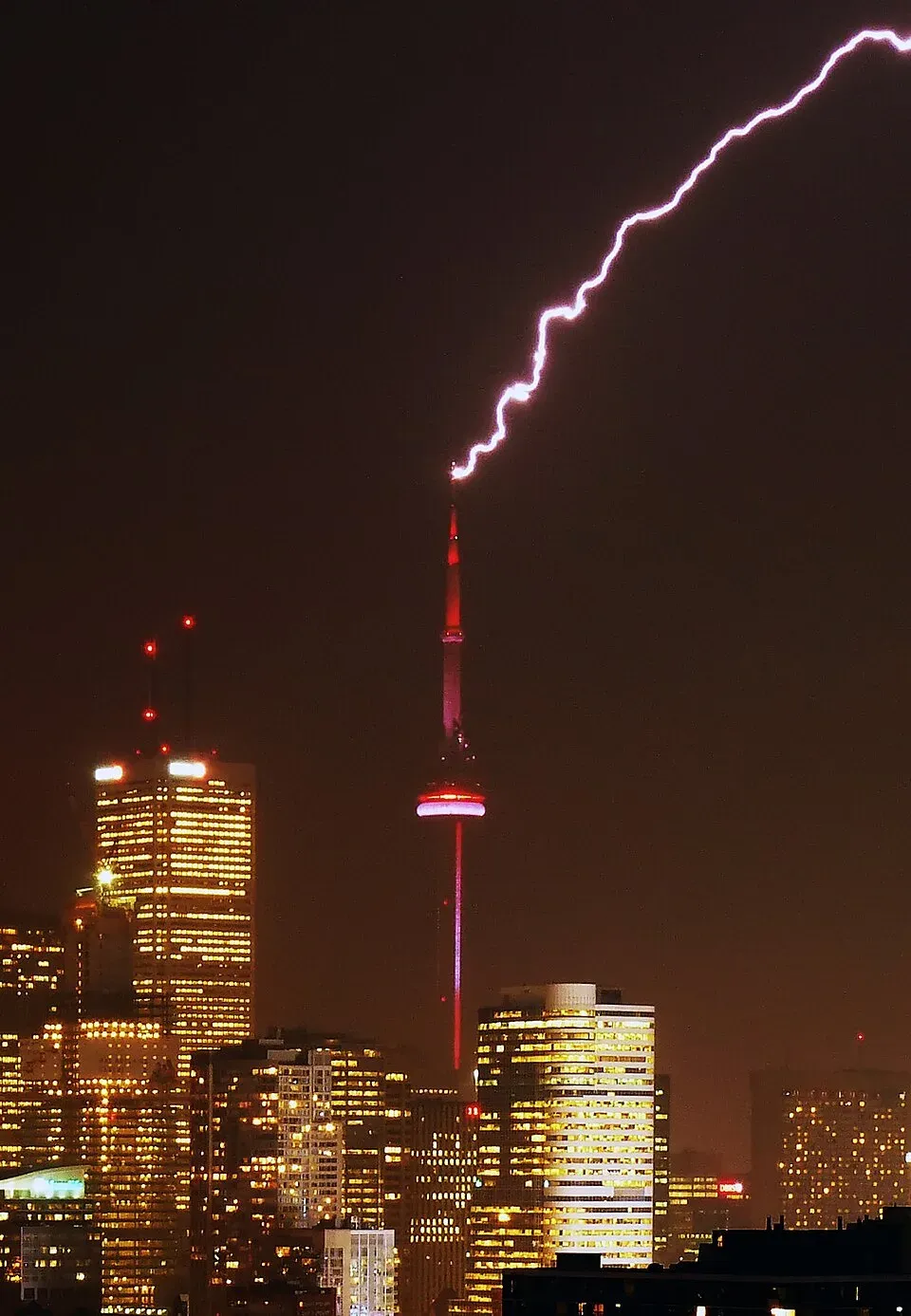
- Lightning striking the CN Tower in Toronto at night, a structure far taller than the 150 ft rolling sphere radius. Photo: Raul Heinrich / Wikimedia Commons (source), CC BY-SA 3.0, resized.