
Lightning Protection in Denver, CO
Site Safe Lightning Protection designs, installs and inspects lightning protection systems for homes, commercial buildings and industrial sites across the Denver metro, from Denver itself to Aurora, Lakewood, Littleton, Arvada and Westminster.
Lightning in the Denver area
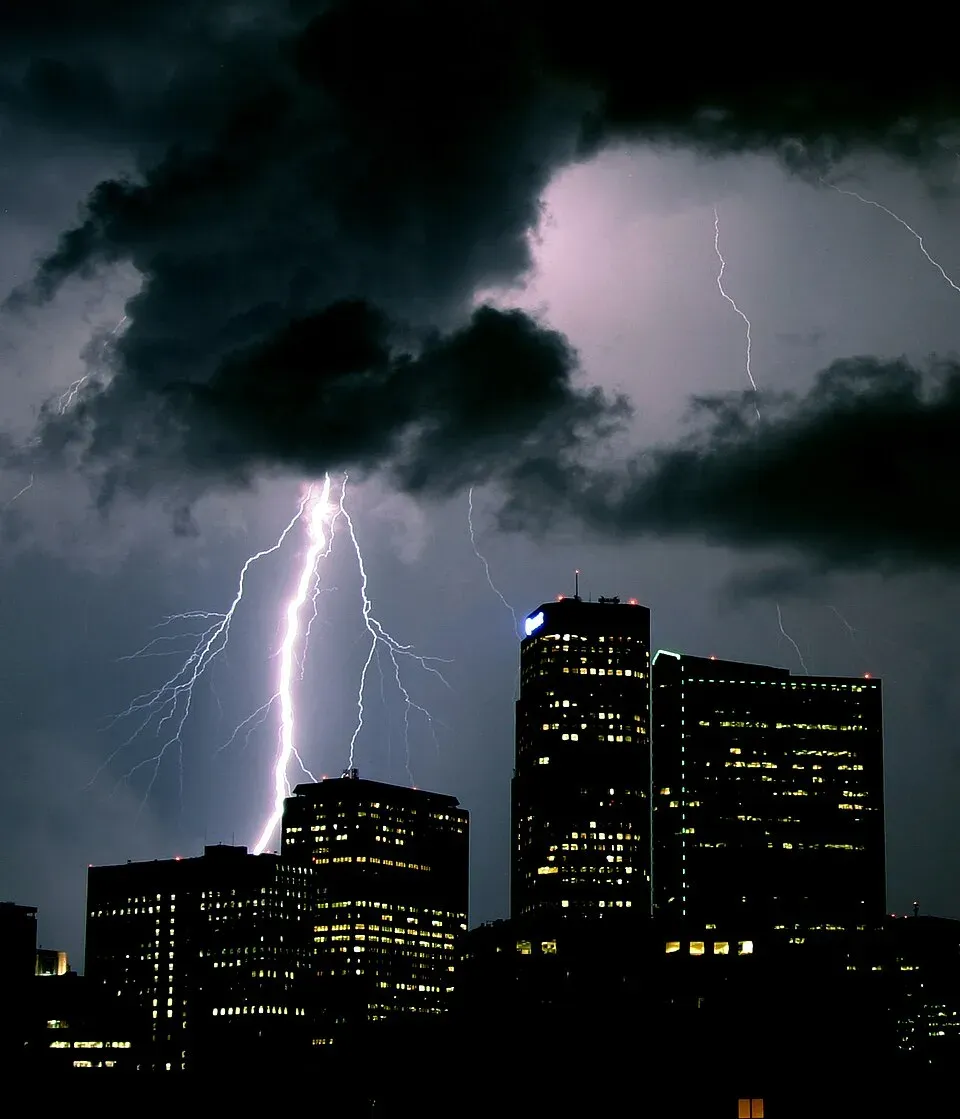
Denver gets regular summer lightning, and the metro is not hit evenly. Colorado averages about 500,000 cloud-to-ground flashes a year, according to the National Weather Service office in Pueblo. A 2019 study by NWS Pueblo forecasters, using 21 years of Vaisala lightning data, found a relative low on the plains north of Denver, between Denver, Greeley and Fort Collins, at 0.5 to 1.5 flashes per km² a year. South of the metro, the Palmer Divide and Pikes Peak area has some of the most lightning in the state.
Storms along the Front Range usually develop over the foothills in the late morning or early afternoon and move east onto the plains. Lightning peaks statewide in July and August, when monsoon moisture arrives. For the statewide picture, see lightning protection in Colorado.
Homes in Denver, Aurora and the metro
For most metro homes, lightning protection is a choice based on exposure, not a code requirement. A house on a ridge in the foothills, at the edge of open space, or standing taller than everything around it is more exposed than one among taller trees and buildings.
A residential system includes:
- Air terminals (lightning rods) on ridges, chimneys and dormers.
- Conductors connecting them, with at least two paths down to ground.
- Grounding electrodes at the base of each down conductor.
- Bonding to the electrical ground, gas and water piping, and metal on the roof.
- Surge protection for incoming power, data and communication lines.
For homes under an HOA, NFPA 780 allows concealed systems, with conductors run inside the attic and walls. See our residential lightning protection services and the guide to home lightning protection in Colorado.
Commercial buildings
Offices, warehouses, metal buildings, retail centers, healthcare and public buildings each get a system designed for the roof and the equipment on it. Rooftop HVAC units, solar arrays and antennas have to be bonded into the system. We work on new construction and existing buildings, including inspection, grounding and system testing. See commercial building lightning protection and choosing a commercial lightning protection company.
Industrial and oil & gas sites
For plants, storage tanks, tank batteries and oil and gas production sites, grounding and bonding do most of the work, because a spark near flammable vapor is the hazard. See oil & gas facility lightning protection.
NFPA 780 and UL 96A
NFPA 780 is the US standard for designing and installing lightning protection systems. It sets where air terminals go, how big conductors must be, and how a system is grounded and bonded. It becomes mandatory when a code, contract or authority having jurisdiction adopts it. UL 96A is UL's installation standard, and a complete system that passes UL's inspection can receive a UL Master Label Certificate.
When you compare quotes, ask which standard the system will follow and what documentation you will get. Read NFPA 780 explained and UL 96A and the Master Label.
Inspections
NFPA 780 and LPI-175 recommend a visual inspection every year and a full inspection with testing every 3 to 5 years (1 to 3 years for critical facilities). Also have it inspected after a lightning strike or any roof or building work: re-roofing, solar and new rooftop equipment can disconnect parts of a system. An inspection covers air terminals, conductors, bonding, grounding, surge protection and continuity. In Denver, spring is the best time, before the July and August peak. See our lightning protection inspection service and what is tested during an inspection.

Frequently asked questions
Do Denver homes need lightning protection?
Not by code in most cases. For a house it's a risk decision. Protection makes the most sense for exposed homes: on a ridge, in the foothills west of the city, next to open space, or the tallest roof nearby. Check your HOA's rules before you install.
How much lightning does Denver get?
Less than the Palmer Divide to the south, but plenty. Colorado averages about 500,000 cloud-to-ground flashes a year, and a 2019 NWS Pueblo study found a relative low on the plains north of Denver and one of the state's highest concentrations on the Palmer Divide south of the metro.
Do you provide lightning protection in Aurora and the rest of the metro?
Yes. Site Safe Lightning Protection serves Colorado, including Aurora, Lakewood, Littleton, Arvada, Westminster, Centennial and the rest of the Denver metro. Call (940) 641-0781 or request a free estimate with your address.
Can a lightning protection system be hidden for an HOA?
Often, yes. NFPA 780 includes requirements for concealed systems, so conductors can run inside the attic and walls. Air terminals stay on the roof, but they can be short and placed along the ridge where they are hard to see from the street.
Is lightning protection required for commercial buildings in Denver?
Usually not for ordinary commercial buildings. It becomes required when the local jurisdiction adopts NFPA 780 for that building type, or when an owner standard, insurer, lender or project specification calls for it. See is lightning protection required by code.
Sources
- Colorado Lightning Statistics as Compared to Other States (NWS Pueblo)
- Hodanish, Vogt and Wolyn: Colorado Lightning Climatology, Journal of Operational Meteorology, 2019 (Vaisala NLDN data, 1996–2016)
- Monsoon Season (Colorado Climate Center, Colorado State University)
- Lightning Rods and Lightning Protection Systems (National Weather Service)
- NFPA 780, Standard for the Installation of Lightning Protection Systems, Annex D: Inspection and Maintenance (NFPA)
- LPI-175, Standard for the Design, Installation and Inspection of Lightning Protection Systems (Lightning Protection Institute)
More areas we serve
-
Lightning protection in Colorado
Homes, commercial buildings and industrial sites across the state.
-
Lightning protection in Colorado Springs, CO
Colorado Springs and the Pikes Peak region, one of the state’s lightning hot spots.
-
Lightning protection in Texas
Homes, commercial buildings and oil & gas sites in the state with the most lightning.
-
Lightning protection in Dallas–Fort Worth, TX
Dallas, Fort Worth and the rest of the Metroplex, where spring storms start in March.
Site Safe Lightning Protection serves Colorado, Texas and Oklahoma. See all lightning protection services.
Connect with our experts
Submit the following form and our team will reach out! You may also call us anytime at (940) 641-0781