Lightning Risk Assessment: How NFPA 780 Annex L Decides If You Need Protection
By Site Safe Lightning Protection 6 min read
A lightning risk assessment compares two numbers: how many times a year lightning is expected to hit your building, and how many times a year you can tolerate it, given what the building is made of, what’s inside and who’s in it. If the expected strikes exceed the tolerable level, NFPA 780’s simplified method says a lightning protection system is recommended. If not, protection is optional.
That’s the whole idea. The rest is knowing what goes into each number, and that’s what owners, architects and insurers usually ask about. Below are the inputs in plain words, then a worked example using real Colorado data.
Where the method comes from
NFPA 780, the Standard for the Installation of Lightning Protection Systems, includes a risk assessment guide in Annex L. The Lightning Protection Institute points to Annex L as the method used in the US. The annex offers two levels:
- A simplified risk assessment: a short calculation that most owners and designers start with.
- A detailed risk assessment: a longer, component-by-component analysis that follows the same approach as the international standard IEC 62305-2. It’s used for complex or high-consequence facilities.
Annex material is guidance, not a mandatory requirement. A risk assessment helps an owner decide. It doesn’t by itself make protection required. The coefficients below come from the simplified method as published in earlier editions. NFPA 780 is now in its 2026 edition, so have whoever runs your assessment use the edition your project references.
The inputs, in plain words
1. Flash density (Ng)
This is how many cloud-to-ground lightning flashes hit each square kilometer per year where you are. It comes from lightning detection network data. For Colorado, NWS Pueblo gives a statewide average of 4.8 flashes per km² per year (2009–2018 data). Oklahoma’s Mesonet publishes a 1996–2016 cloud-to-ground density map from the national detection network. A designer should use local values, because density varies a lot within a state.
2. Equivalent collection area (Ae)
A taller building “collects” lightning from a wider area than its footprint. The method draws a 1:3 slope from the top of the building down to the ground all the way around. For a rectangular building of length L, width W and height H (in meters):
Ae = LW + 6H(L + W) + 9πH²
Height dominates. Doubling the height of a building increases its collection area far more than doubling its length.
3. Location factor (C1)
This adjusts for surroundings within three building heights (3H):
| Surroundings | C1 |
|---|---|
| Surrounded by taller structures or trees within 3H | 0.25 |
| Surrounded by structures of equal or lesser height within 3H | 0.5 |
| Isolated, nothing within 3H | 1 |
| Isolated on a hilltop | 2 |
A shop on a bare ridge counts eight times more heavily than the same shop tucked among taller buildings.
4. Expected strike frequency (Nd)
Nd = Ng × Ae × C1 × 10⁻⁶ strikes per year.
5. The building coefficients (C2–C5)
These describe what’s at stake:
| Coefficient | What it describes | Range of values |
|---|---|---|
| C2, construction | Structure and roof: metal, nonmetallic or combustible | 0.5 (metal/metal) to 3.0 (combustible/combustible) |
| C3, contents | Value and combustibility | 0.5 (low value, noncombustible) to 4.0 (irreplaceable cultural items). Flammable liquids, computers or electronics are 3.0 |
| C4, occupancy | People and evacuation | 0.5 (unoccupied), 1.0 (normally occupied), 3.0 (difficult to evacuate or risk of panic) |
| C5, consequence | What happens if it’s damaged | 1.0 (services can stop, no environmental impact), 5.0 (continuity of service required), 10.0 (consequences to the environment) |
6. Tolerable frequency (Nc)
Nc = 1.5 × 10⁻³ ÷ (C2 × C3 × C4 × C5)
The higher the stakes, the lower the number of strikes you can tolerate.
7. The decision
If Nd ≤ Nc, a lightning protection system is optional. If Nd > Nc, a system is recommended.
Worked example 1: a Colorado warehouse
Take a 200 ft × 100 ft warehouse, 30 ft tall (about 61 m × 30.5 m × 9.1 m), standing alone on an industrial lot. It has a steel frame with a nonmetallic roof membrane, holds stock of moderate combustibility, and is normally occupied.
- Ng = 4.8 (Colorado statewide average)
- Ae ≈ 9,240 m²
- C1 = 1 (isolated)
- Nd = 4.8 × 9,240 × 1 × 10⁻⁶ ≈ 0.044 strikes per year, or about one direct strike every 22–23 years
- C2 = 1.0 (metal structure, nonmetallic roof), C3 = 2.0, C4 = 1.0, C5 = 1.0, so C = 2.0
- Nc = 1.5 × 10⁻³ ÷ 2.0 = 0.00075
Nd (0.044) is many times higher than Nc (0.00075), so protection is recommended.
Worked example 2: a Colorado house
A 50 ft × 40 ft wood-frame house with a 25 ft ridge, on an open lot:
- Ae ≈ 3,080 m²
- With C1 = 1: Nd ≈ 0.015 strikes per year, roughly one in 68 years. Even with C1 = 0.5 (neighbors of similar height), Nd ≈ 0.0074.
- C2 = 2.5 (combustible structure, nonmetallic roof), C3 = 1.0, C4 = 1.0, C5 = 1.0, so C = 2.5
- Nc = 0.0006
Here too Nd is higher than Nc, so protection is recommended.
What the examples tell you
Run the simplified method on almost any occupied building in an area with Colorado-level flash density and it lands on “recommended.” The tolerable frequency is set low on purpose. That’s useful to know before you spend money on a formal report. The more useful questions are often these:
- How strong is the case? A ratio of Nd to Nc near 1 is a judgment call. A ratio of 50 is not.
- What drives it? Height and isolation usually move Nd the most. Contents and consequence (C3 and C5) move Nc the most. A data room, a fuel store or a building that can’t go down (C5 = 5) pushes the tolerable level very low.
- Does anyone else require it? An insurer, an owner’s design standard or a federal client may require protection whatever the calculation says.
For the cost side of the decision, see the cost of lightning damage vs installing commercial protection.
What to bring to a risk assessment
- Building dimensions, including the tallest roof feature (stacks, towers, rooftop units)
- Construction type for the frame and roof
- What’s inside and its value, including anything flammable or critical electronics
- Normal occupancy, and whether evacuation would be difficult
- What an outage would cost, and any environmental exposure (fuel, chemicals)
- Surroundings within about three building heights, and whether the site is on a rise
- Any insurer, lender or corporate requirement already on paper
From assessment to design
A risk assessment answers “should we?” The next step is “what exactly?”, which means a site survey, zones of protection, drawings and a bill of materials. Our article on how a commercial lightning protection system is designed walks through that.
Site Safe Lightning Protection works with commercial building owners, facility managers and oil and gas operators on lightning protection and inspections. If you’re weighing whether a building needs a system, contact Site Safe Lightning Protection and have the details above handy. Our commercial lightning protection page has more on what we do.
Talk to Site Safe Lightning Protection about your property.
Frequently asked questions
What is a lightning risk assessment?
A calculation that compares a building's expected yearly lightning strike frequency with a tolerable frequency, based on its construction, contents, occupancy and the consequences of damage. NFPA 780 Annex L provides simplified and detailed methods.
Is a lightning risk assessment required?
Not usually by itself. Annex L is guidance. Some owners, insurers and agencies require an assessment or require protection outright. Check your project specifications and with your local building department.
What is the formula for lightning strike frequency?
In the NFPA 780 simplified method, Nd = Ng × Ae × C1 × 10⁻⁶. Ng is flash density per km² per year, Ae is the equivalent collection area in m², and C1 is the location factor.
What flash density should I use for Colorado?
NWS Pueblo gives a statewide average of 4.8 cloud-to-ground flashes per km² per year (2009–2018). Local values vary, so a designer should use data for your site.
Is there a lightning risk assessment calculator?
Several manufacturers publish online calculators based on the simplified method. They're fine for a first look. Have a qualified designer confirm the inputs, especially the location factor and the consequence coefficient.
Sources
- Calculations of Risk Assessment Study as per NFPA 780 (Electrical Knowhow)
- Lightning and Lightning Protection: Measuring the Tolerable Risk (Lightning Protection Institute)
- Colorado Lightning Statistics as Compared to Other States (NWS Pueblo)
- Yearly Lightning Density 1996–2016 (Oklahoma Mesonet)
- NFPA 780, Standard for the Installation of Lightning Protection Systems, 2026 Edition (description)
- Lightning Risk Assessment Guide (Kuefler Lightning)
Image credits
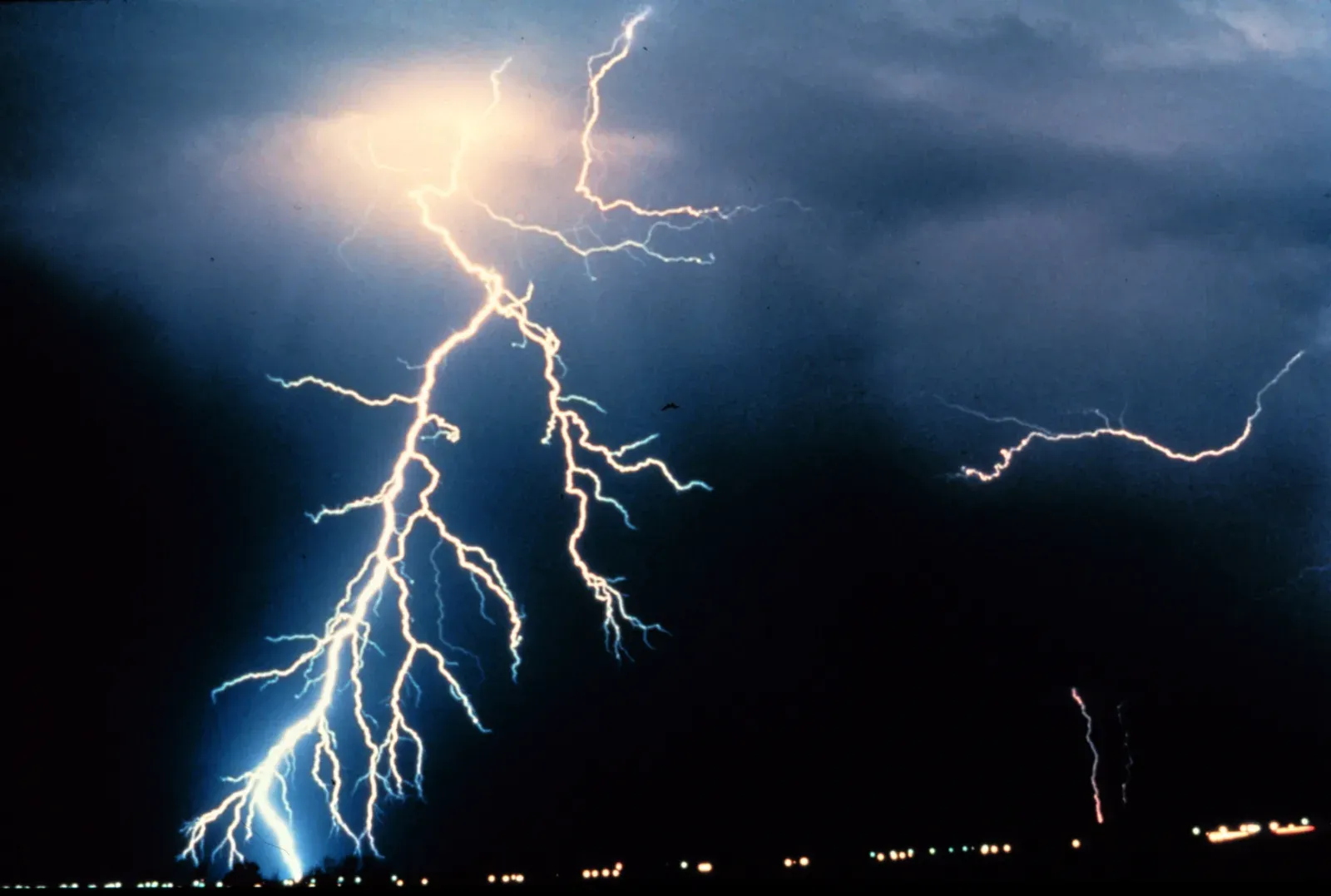
- Multiple cloud-to-ground and cloud-to-cloud lightning strokes during a night-time thunderstorm. Photo: C. Clark / NOAA Photo Library, NOAA Central Library; OAR/ERL/National Severe Storms Laboratory (NSSL) (source), Public domain (US gov).