ESE Lightning Protection: Why US Standards Don't Accept Early Streamer Emission Rods
By Site Safe Lightning Protection 7 min read
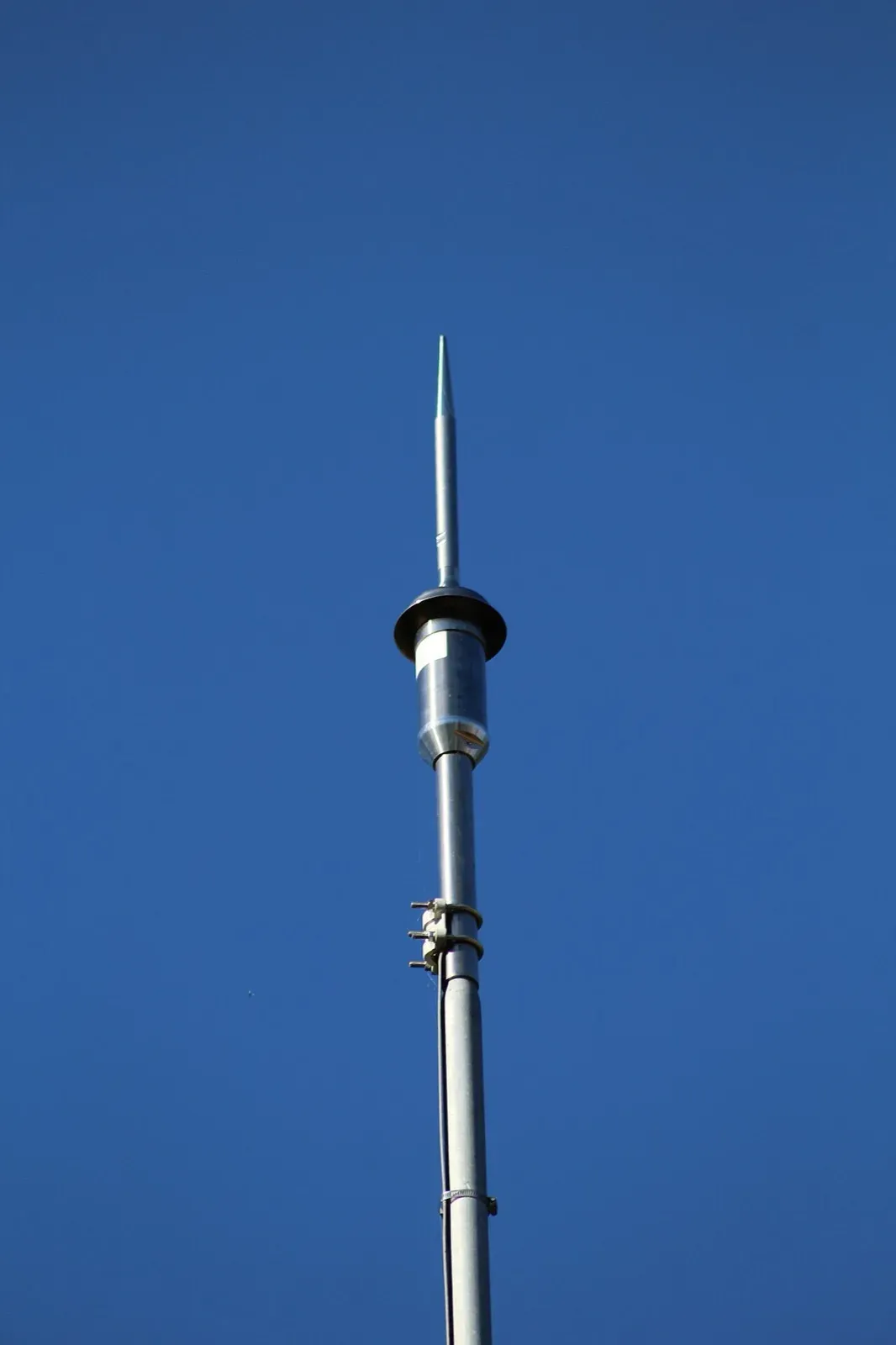
ESE stands for early streamer emission. An ESE lightning protection system uses one or a few special air terminals that are claimed to launch an upward streamer sooner than an ordinary rod, and so to catch lightning from farther away and protect a much larger area. In the United States, that claim hasn’t held up. NFPA 780 doesn’t cover ESE systems, the NFPA refused to issue a separate ESE standard, the Defense Department prohibits them, and a federal court barred some ESE advertising claims.
That history is worth knowing before you sign a quote for a single ESE mast to protect a plant, a school or a yard.
What an ESE terminal is supposed to do
Every air terminal works by the same basic process. As a lightning leader comes down, objects on the ground send up streamers to meet it, and the one that connects takes the strike. An ESE terminal adds a device at the head that is meant to start that upward streamer a few microseconds earlier than a plain rod. Vendors describe it as needing no outside power supply.
Vendors turn that head start into a protection radius. One ESE maker’s page, citing the French standard NF C 17-102:2011, says an ESE rod protects up to 107 m, against about 30 m for a conventional rod. It also says a product’s advance time has to fall between 10 and 60 microseconds to be marketed as ESE (Orbital, vendor page). Those figures come from the vendor and the French standard. No US standard uses them.
Where ESE stands in US standards
NFPA 780 doesn’t cover it
NFPA 780 is the US installation standard for lightning protection systems. Its scope leaves out early streamer emission and charge dissipation systems (NFPA 780). An ESE system can’t be “NFPA 780 compliant” because NFPA 780 has no rules for it. Our plain-English guide to NFPA 780 covers what the standard does include.
The NFPA turned down an ESE standard
The NFPA did try to write one. On or about April 24, 1990, its Standards Council formed a committee to study ESE systems and decide whether an ESE standard made sense. A draft, proposed NFPA 781, went out for comment in 1993 and drew about 269 comments (Heary Bros. v. LPI, D. Ariz. 2003).
The Standards Council held a hearing on July 18, 1995. Before deciding, it had the National Institute of Standards and Technology (NIST) carry out a third-party review. Citing the absence of reliable evidence that ESE terminals gave the extra coverage claimed, the Council voted not to issue NFPA 781 and discharged the committee (Harger, 1995). The same article quotes the NIST report as finding no indisputable evidence that one ESE terminal protects a range greater than, or even the same as, two or more conventional terminals of the same height.
What NIST said later
NIST researchers published an overview in 2000. They wrote that ESE systems may hold promise, but that the scientific basis for better performance “is far from certain” and that their efficacy remains open to question (NIST, 2000). Even that cautious view stops short of endorsing a larger protection zone.
The Defense Department prohibits ESE
UFC 3-575-01 sets lightning protection criteria for Defense Department facilities. Section 3-2 says nonconventional systems, including dissipation arrays, early streamer emission air terminals and air terminals with multiple points attached, are prohibited (UFC 3-575-01). Dissipation arrays, sometimes sold as charge transfer systems, claim to prevent strikes altogether. They fall under the same prohibition.
A federal court limited ESE advertising
Three ESE companies sued the Lightning Protection Institute and conventional system makers in federal court in Arizona. The district court ruled in 2003, and in 2005 it issued an injunction. A 2020 Ninth Circuit opinion in the same long-running case describes that injunction as barring one ESE company from advertising that its systems protect open areas, and from advertising that its air terminal product is accepted by Underwriters Laboratories (Ninth Circuit, 2020). The 2020 appeal itself was dismissed for lack of jurisdiction.
ESE vs an NFPA 780 system
| ESE system | NFPA 780 system | |
|---|---|---|
| Strike termination | One or a few ESE terminals, often on a tall mast | Air terminals at the high points, roof edges and corners, sized by the rolling sphere or similar method |
| Coverage claim | Large radius from one terminal (107 m in one vendor’s example) | Zone of protection worked out on drawings for each roof area |
| US installation standard | None; NFPA 781 was never issued | NFPA 780 |
| Federal facilities | Prohibited under UFC 3-575-01 | Referenced throughout UFC 3-575-01 |
| Open areas | Advertising that ESE protects open areas was barred by court order | Open areas are protected with masts or overhead wires laid out on a drawing |
Both kinds of system still need down conductors, grounding and bonding. A single ESE terminal doesn’t remove those parts. It replaces the network of terminals on the roof with one point, which is where the dispute lies.
Why the single-terminal layout worries designers
The practical risk is coverage. A conventional design places terminals so that any likely strike point on the roof is within reach of one. An ESE layout counts on a single terminal to reach corners and edges that may be a long way from it. If the extended radius isn’t real, those corners and edges are left without protection.
That risk is higher on large, flat commercial roofs and at sites with spread-out equipment, such as tank batteries or pump yards. Those are the places where a one-mast proposal sounds cheapest.
Questions to ask about an ESE quote
If a vendor or engineer proposes an ESE system, ask:
- Which standard is the design installed to? If the answer is NF C 17-102 or another foreign standard, NFPA 780 doesn’t apply.
- Will your insurer, your local building official and any customer specs accept a system outside NFPA 780? Check before you buy.
- Is the project federal, or does it serve a federal client? UFC 3-575-01 prohibits ESE on Defense Department work.
- Can the system get a UL Master Label certificate? Ask the vendor for that in writing. Our article on lightning protection certification explains what UL and LPI certificates cover.
- What does the drawing show for each corner and roof edge? Ask for the coverage on paper, not a radius from a brochure.
- What happens to the down conductors and grounding? An ESE head doesn’t reduce the grounding a strike needs.
If the answers are vague, get a second design based on NFPA 780 and compare the two on the same drawing.
What’s the best choice for most US buildings?
For most homes, commercial buildings and oil and gas sites in the US, the design reference is NFPA 780. The Arizona court noted that the NFPA has maintained its lightning protection installation standard since 1904 (Heary Bros. v. LPI, D. Ariz. 2003), and it is the document building officials, insurers and engineers check a design against. Masts and overhead wires can still protect open yards and equipment, laid out on a drawing under NFPA 780 rather than claimed by radius.
Talk to Site Safe Lightning Protection
Site Safe Lightning Protection installs lightning protection systems for homes, commercial buildings and oil and gas facilities, and inspects existing systems. If you’ve been quoted an ESE system, or you inherited one on a building you now own, contact Site Safe Lightning Protection to talk through it. For larger buildings, see our commercial lightning protection services.
Talk to Site Safe Lightning Protection about your property.
Frequently asked questions
What is ESE lightning protection?
ESE stands for early streamer emission. An ESE system uses special air terminals that are claimed to send up a streamer earlier than a plain rod, and so to protect a much larger area from one terminal.
Is ESE lightning protection allowed in the US?
NFPA 780, the US installation standard, doesn't cover ESE systems, and the NFPA declined to issue a separate ESE standard in 1995. Defense Department projects prohibit ESE under UFC 3-575-01. For other buildings, check with your building official and insurer before choosing one.
Does an ESE lightning rod protect a larger area than a conventional rod?
Vendors say yes, often quoting a radius of 100 m or more. NIST reviewers found no indisputable evidence that one ESE terminal covers more than two or more conventional terminals of the same height, and a federal court barred one ESE company from advertising that its systems protect open areas.
What is a lightning dissipation array?
A dissipation array, also sold as a charge transfer system, is a device claimed to prevent lightning strikes rather than intercept them. NFPA 780 doesn't cover these systems, and UFC 3-575-01 prohibits them on Defense Department projects.
Can an ESE system be converted to a conventional system?
Often parts of it can be reused, such as down conductors and grounding, if they meet NFPA 780 sizes and are in good condition. The roof usually needs additional air terminals placed by an NFPA 780 design. An inspection will show what can stay.
Sources
- UFC 3-575-01 Lightning and Static Electricity Protection Systems, with Change 1 (2021), section 3-2, WBDG
- NIST: Van Brunt, Nelson, Stricklett, Early streamer emission lightning protection systems: an overview (IEEE Electrical Insulation Magazine, 2000)
- Harger, Lightning Prevention Devices (November 1995, on the NFPA Standards Council decision on proposed NFPA 781), MSU Turfgrass Information Center archive
- Heary Bros. Lightning Protection Co. v. Lightning Protection Institute, 287 F. Supp. 2d 1038 (D. Ariz. 2003), vLex
- Heary Bros. Lightning Protection Co. v. Lightning Protection Institute, Ninth Circuit memorandum (May 19, 2020), FindLaw
- NFPA 780, Standard for the Installation of Lightning Protection Systems (NFPA document page)
- Orbital Lightning Protection Technologies: What is ESE? (vendor page, cited for vendor claims)
Image credits
- Single lightning rod on a tall metal mast with a cylindrical head below the tip, against a clear blue sky. Photo: Chabe01 / Wikimedia Commons (source), CC BY-SA 4.0, resized.