UL 96A Explained: Master Label, LPI-175 and What an Inspection Certifies
By Site Safe Lightning Protection 6 min read
UL 96A is UL’s Standard for Installation Requirements for Lightning Protection Systems. It’s the rulebook UL Solutions uses when it inspects a finished lightning protection system, and a complete system that passes can receive a UL Master Label Certificate (UL Solutions). It sits alongside NFPA 780, the main US installation standard, and LPI-175, the Lightning Protection Institute’s standard of practice.
Owners usually run into UL 96A when a spec, an insurer or a campus standard asks for “a UL Master Label system.” This guide explains what the paperwork means, how long it lasts, how to check it, and when it’s worth asking for.
UL 96 vs UL 96A
The two numbers are easy to confuse:
- UL 96 is the product standard for lightning protection components: air terminals, conductors and fittings. A part “listed to UL 96” has been evaluated by UL.
- UL 96A covers how those parts are installed as a system. UL says its installation requirements can apply to lightning protection systems on all types of structures, and UL field inspections of completed installations are done to UL 96A (UL Solutions).
NFPA 780 links the two by requiring listed components wherever listed versions exist (2023, 1.3.1) (NFPA 780). UL’s application guide notes that systems can be certified using UL 96A or NFPA 780, built from UL-listed components (UL guide). The 2024 International Building Code references both: section 2703.2 says lightning protection systems shall be installed in accordance with NFPA 780 or UL 96A (UL Solutions). For the standard itself, see our NFPA 780 explainer.
What a UL inspection checks
UL’s guide lists what its field staff look at on a completed system, starting with an overall visual check for neat and professional work (UL guide). Highlights:
- Air terminal layout, with at least two paths to ground
- Terminal tips at least 10 inches above the structure, no more than 20 feet apart around the perimeter (or up to 25 feet for taller, braced terminals)
- Protection on any rooftop object thinner than 3/16 inch, such as fan housings and camera masts
- All components listed, other than ordinary hardware
- Main-size bonds to water, heating, electrical, telephone and antenna systems and other large grounded metal
- Ground rods at least 8 feet long and 1/2 inch in diameter
- No copper on aluminum or galvanized surfaces, no aluminum in contact with earth, and bimetallic fittings within 18 inches of grade
- Cable bends of at least an 8-inch radius and fasteners no more than 3 feet apart
That list is a good preview of what any competent inspection should cover, whichever certificate you’re after. Our article on what’s tested during a lightning protection inspection goes further.
Master Label Certificate vs Letter of Findings
A UL inspection ends in one of two documents, depending on scope (UL Solutions):
- Master Label Certificate. Issued for a complete structure and shows full compliance. It’s available online through UL Solutions’ lightning protection system portal and is valid for five years from issue.
- Letter of Findings. Issued for partial structures or limited-scope installations, with the exceptions listed. It goes directly to the applicant, and you verify it by contacting UL’s lightning protection team.
UL also issues Engineering Inspection Reports for design or gap-analysis evaluations and ground witness testing.
The five-year limit is deliberate. UL’s guide says the re-inspection cycle accounts for possible damage from a strike, damage by maintenance crews walking on components, structural changes and remodeling (UL guide). After five years the system has to be re-inspected and a new certificate issued.
UL runs the Master Label through its Lightning Protection Installer program, so ask whether your contractor participates before you count on getting one.
LPI-175 and LPI-IP certificates
The Lightning Protection Institute runs a parallel path. LPI-175 is LPI’s standard of practice for design, installation and inspection. LPI describes it as based on NFPA 780, with extra explanatory material for installers and inspectors (LPI).
LPI-IP is the related inspection program. Its application instructions list four products (LPI-IP):
- Master Installation Certificate for a system protecting an entire independent structure
- Extended Master Installation Certificate, which adds witnessed ground resistance and continuity testing to selected military standards
- Reconditioned Master Installation Certificate for a previously certified system whose certificate has expired, where the structure’s square footage and footprint haven’t changed
- Limited Scope Inspection Report for part of a system, which doesn’t certify the whole structure
A typical LPI-IP job includes witness inspections at the grounding and rooftop stages, a design review by an LPI-IP engineer, and an on-site inspection. LPI-IP certificates expire three years from issue.
Side-by-side comparison
| Document | Issued by | Covers | Validity | How to verify |
|---|---|---|---|---|
| UL 96 listing | UL | Individual components | Ongoing listing | UL’s Online Certifications Directory (category OVTZ) |
| UL 96A | UL | Installation requirements (a standard, not a certificate) | n/a | n/a |
| UL Master Label Certificate | UL Solutions | Complete structure, inspected to UL 96A | 5 years | UL Solutions lightning protection portal |
| UL Letter of Findings | UL Solutions | Partial structure or limited scope, with listed exceptions | Not stated by UL | Contact UL’s lightning protection team |
| LPI-175 | Lightning Protection Institute | Standard of practice based on NFPA 780 | n/a | n/a |
| LPI-IP Master Installation Certificate | LPI-IP | Entire independent structure | 3 years | Ask LPI-IP; a copy is kept on file |
| LPI-IP Limited Scope Report | LPI-IP | Designated part of a system only | Not a full certification | Ask LPI-IP |
Sources: UL Solutions, UL guide (category codes in Appendix A), LPI-IP.
Installer credentials are a separate thing
A certificate covers a building. Credentials cover people and companies:
- LPI individual certifications include Journeyman Installer, Master Installer and Master Installer/Designer, plus a separate Designer Inspector series, all tested against industry standards with NFPA 780 as the foundation (LPI certifications).
- UL’s installer program covers contractors who participate in UL’s Lightning Protection Installer and Master Label Certificate Program.
- LPI-IP eligibility requires the installing contractor to employ or contract with an LPI Master Installer, among other conditions (LPI-IP).
NFPA 780 (2023) also allows the authority having jurisdiction to require that installers be certified. Our guide to choosing a commercial lightning protection company covers the hiring side.
When should an owner ask for a certificate?
- The spec or code calls for it. Architects often write “UL Master Label” or “LPI-IP certified” into commercial specs, and NFPA 780 (2023) lets the authority having jurisdiction require an on-site inspection by a qualified, impartial organization.
- Your insurer asks. Some carriers want proof of a third-party inspection. Ask what document they accept.
- Campuses and portfolios. Schools, hospitals, churches and multi-building owners benefit from a consistent, documented standard and a renewal schedule.
- After major work. A re-roof, an addition or rooftop solar on a certified building is a good time to re-inspect and re-certify.
- When buying a building. Ask the seller for the current certificate and check that it’s still valid.
How to check a certificate you’ve been handed
- Match the address and the structure. A certificate covers a specific structure, not a whole campus.
- Check the issue date against the validity period: 5 years for UL Master Label, 3 years for LPI-IP.
- Look up UL Master Labels through UL Solutions’ portal, and contact UL or LPI-IP for Letters of Findings and LPI-IP documents.
- If it’s a Letter of Findings or Limited Scope Report, read the exceptions. Those areas weren’t certified.
- Ask whether anything has changed since issue: roof work, additions, new rooftop equipment or a known strike.
Need an inspection or a second opinion?
If you have a certificate that’s about to expire, a system that’s never been inspected, or a spec that calls for third-party certification, contact Site Safe Lightning Protection. We can inspect your system against the applicable standard and explain what your paperwork does and doesn’t cover. See our commercial lightning protection services.
Talk to Site Safe Lightning Protection about your property.
Frequently asked questions
What is UL 96A?
UL 96A is UL's Standard for Installation Requirements for Lightning Protection Systems. UL Solutions uses it for field inspections of completed systems, which can lead to a Master Label Certificate or a Letter of Findings.
What is a UL Master Label for lightning protection?
It's a certificate UL Solutions issues for a complete structure whose lightning protection system passed inspection to UL 96A. It's valid for five years and can be checked online through UL's lightning protection portal.
What is the difference between UL 96 and UL 96A?
UL 96 is the product standard for lightning protection components. UL 96A covers how those components are installed as a complete system.
How long is a lightning protection certificate valid?
A UL Master Label Certificate is valid for five years from issue. An LPI-IP Master Installation Certificate expires after three years.
What is LPI-175?
LPI-175 is the Lightning Protection Institute's standard of practice for the design, installation and inspection of lightning protection systems. LPI describes it as based on NFPA 780, with extra explanatory material for installers and inspectors.
Sources
- UL Solutions: Lightning Protection Installer and Master Label Certificate Program
- UL: Lightning Protection Marking and Application Guide
- LPI-IP: Application Instructions
- Lightning Protection Institute: Certifications
- Lightning Protection Institute: Lightning Protection Overview
- NFPA 780, Standard for the Installation of Lightning Protection Systems, 2023 edition (NFPA document page, free read-only access)
Image credits
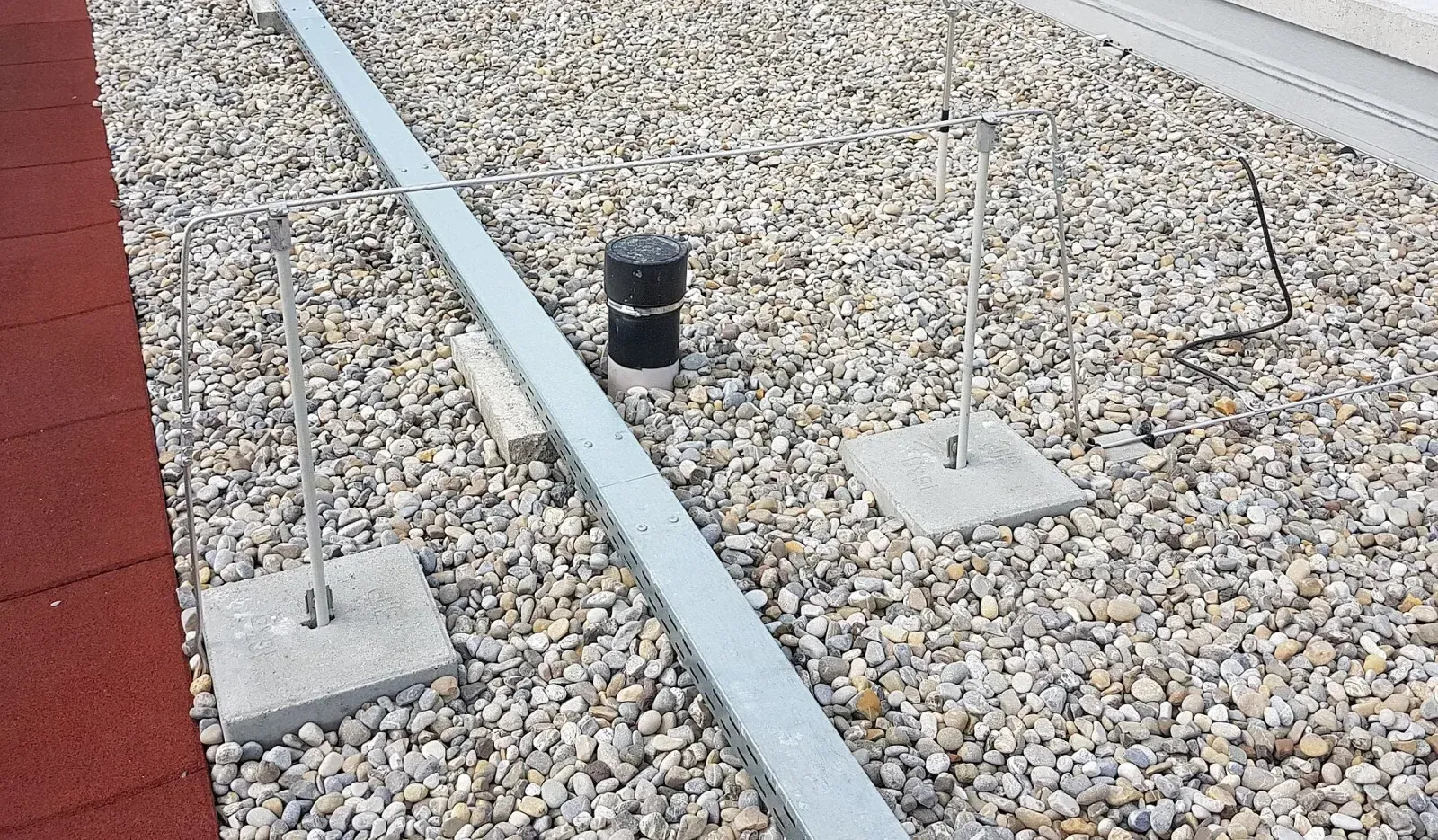
- Lightning protection conductor on supports bridging over a cable duct on a gravel flat roof. Photo: Asurnipal / Wikimedia Commons (source), CC BY-SA 4.0, resized.