Is Lightning Protection Required by Code? Where It's Mandatory and Where It's Your Call
By Site Safe Lightning Protection 5 min read
For most houses and ordinary commercial buildings, lightning protection is not required by the building code. It’s a decision for the owner. It becomes mandatory in four situations: a jurisdiction adopts or references NFPA 780 for certain buildings, a federal agency or owner standard requires it, an insurer or lender makes it a condition, or a project specification calls for it. Once a system is installed, it has to meet the standard it was specified to, whatever the reason it went in.
The confusion comes from treating “code” and “standard” as the same thing. They aren’t, and the difference decides whether you’re required to install a system.
Code vs standard: why the answer is “it depends”
NFPA 780, the Standard for the Installation of Lightning Protection Systems, is the main US document. It covers how to design and install a system on ordinary structures, special occupancies, heavy-duty stacks, structures with flammable vapors, gases or liquids, structures housing explosives, wind turbines, watercraft, airfield lighting and solar arrays. The current edition is 2026.
A standard tells you how to do something. On its own it doesn’t tell anyone they must. That happens when a code, a law, a contract or a policy points to it. UL’s lightning protection guide makes the same distinction when it describes the UL and NFPA installation standards as documents that “could be adopted by a jurisdiction.”
UL 96A is UL’s installation standard for lightning protection systems. LPI-175 is the Lightning Protection Institute’s standard based on NFPA 780. Like NFPA 780, they become binding when a contract or authority adopts them.
Where lightning protection is typically required
| Building or situation | Typically required? | What drives it |
|---|---|---|
| Department of Defense facilities | Yes, where the criteria call for it | UFC 3-575-01, Lightning and Static Electricity Protection Systems, built around NFPA 780 |
| Other federal facilities | Often | Agency design standards. For example, NWS’s NWSM 30-4106 binds contractors when it’s in the statement of work |
| Explosives storage and handling | Generally | Special-occupancy provisions in NFPA 780 plus agency and insurer rules |
| Flammable liquid and gas facilities (tank farms, terminals, some oil and gas sites) | Often | NFPA 780’s flammable vapors chapter, company standards, insurer requirements |
| Campus, hospital and institutional buildings | Often by owner policy | Owner design standards. The University of Alabama, for example, notes all its new campus buildings now include lightning protection |
| Projects whose specifications include a lightning protection section | Yes, for that project | The specification. The LPI model spec requires design and installation to NFPA 780, UL 96A and LPI-175 |
| Buildings where an insurer or lender requires it | Yes, as a condition | Policy terms. Often asks for UL Master Label or LPI certification |
| Ordinary homes | Rarely | Owner’s choice. Check with your local building department |
| Ordinary commercial buildings (offices, retail, warehouses) | Rarely by code | Owner’s choice, usually guided by a risk assessment |
Requirements vary by jurisdiction and change with code cycles. Before you rely on any row of this table, check with your local building department and read your own contracts and insurance documents.
“Recommended” is a separate question
Even when nothing requires protection, NFPA 780 gives owners a way to decide. Annex L contains a risk assessment that compares expected strikes with a tolerable level, adjusted for construction, contents, occupancy and the consequences of loss. The Lightning Protection Institute points owners to Annex L for this decision.
Annex L is guidance, so a “recommended” result doesn’t create a legal duty. In practice, a written risk assessment that recommends protection carries weight with insurers, lenders and boards, and it’s hard to explain away after a loss. We walk through the math in lightning risk assessment.
Colorado, Texas and Oklahoma: adoption is local
Building codes are largely adopted, amended and enforced locally, so the answer can change from one city or county to the next, and from one code cycle to the next. What that means for you:
- Your local building department is the authority on what’s required for a permit.
- Your contracts can be stricter than code. Federal work, school districts, healthcare systems, energy companies and large owners often write lightning protection into their design standards.
- Your insurer may be stricter still, especially for oil and gas sites and high-value or hard-to-replace contents.
If you install a system, the rules apply
Even when protection is optional, a system that’s going in should be designed and installed to a recognized standard. A partial or improvised system can create new problems. The essential points from UL’s guide and the LPI specification:
- The whole structure gets protected, not just a corner or a steeple.
- Listed components (UL 96) are used wherever a listing exists.
- The system is bonded to the building’s other grounds: electrical service, communications, antennas and metal piping, as UL’s guide requires.
- At least two paths to ground, with grounding electrodes sized and placed per the standard.
- Documentation at completion. The LPI specification calls for an as-built drawing and certification paperwork.
Electrical work involved, such as service bonding or surge protective devices, also falls under the electrical code your jurisdiction has adopted, which UL’s guide ties to NEC articles 230, 250, 280, 800 and 810.
How to find out what applies to your building
- Ask your local building department whether it has adopted or referenced NFPA 780 for your occupancy type.
- Read your project specifications for a lightning protection section.
- Check your insurance policy and any lender requirements.
- If you’re a federal contractor or tenant, ask which agency criteria apply.
- If nothing requires it, run a risk assessment and decide on the numbers.
For the standard itself, see NFPA 780 explained.
Talk to us about your project
Site Safe Lightning Protection works on lightning protection systems and inspections for homes, commercial buildings and oil and gas facilities. If you’re trying to work out what your project needs, or a spec or insurer is asking for lightning protection, contact Site Safe Lightning Protection. Our commercial services and services overview pages have more.
Talk to Site Safe Lightning Protection about your property.
Frequently asked questions
Is lightning protection required by the building code?
Usually not for ordinary homes and commercial buildings. It becomes required when a jurisdiction adopts NFPA 780 for a building type, or when a federal standard, owner policy, insurer or project specification calls for it. Check with your local building department.
Is NFPA 780 mandatory?
NFPA 780 is a standard. It's mandatory only where a law, code, contract or policy adopts or references it. Once you install a system, building it to NFPA 780 or UL 96A is how you show it was done properly.
What buildings require lightning protection?
Commonly DoD and other federal facilities under their design criteria, explosives and many flammable-liquid facilities, and buildings where an owner standard, project specification or insurer requires it.
Does OSHA require lightning protection?
OSHA rules focus on worker safety, and requirements depend on the operation. Ask your safety professional which standards apply to your site. NFPA 780, insurer requirements and company standards usually drive lightning protection at industrial sites.
Does a risk assessment make lightning protection required?
No. NFPA 780 Annex L is guidance. A result of "recommended" is strong evidence for the decision, and many owners and insurers act on it.
Sources
- Lightning Protection Marking and Application Guide (UL, 2016)
- Lightning Protection Systems Specification (Lightning Protection Institute)
- UFC 3-575-01 Lightning and Static Electricity Protection Systems (WBDG)
- NWSM 30-4106 Lightning Protection, Grounding, Bonding, Shielding, and Surge Protection Requirements (National Weather Service, 2017)
- NFPA 780, Standard for the Installation of Lightning Protection Systems, 2026 Edition (description)
- Lightning Protection (University of Alabama Environmental Health & Safety)
- Lightning and Lightning Protection: Measuring the Tolerable Risk (Lightning Protection Institute)
Image credits
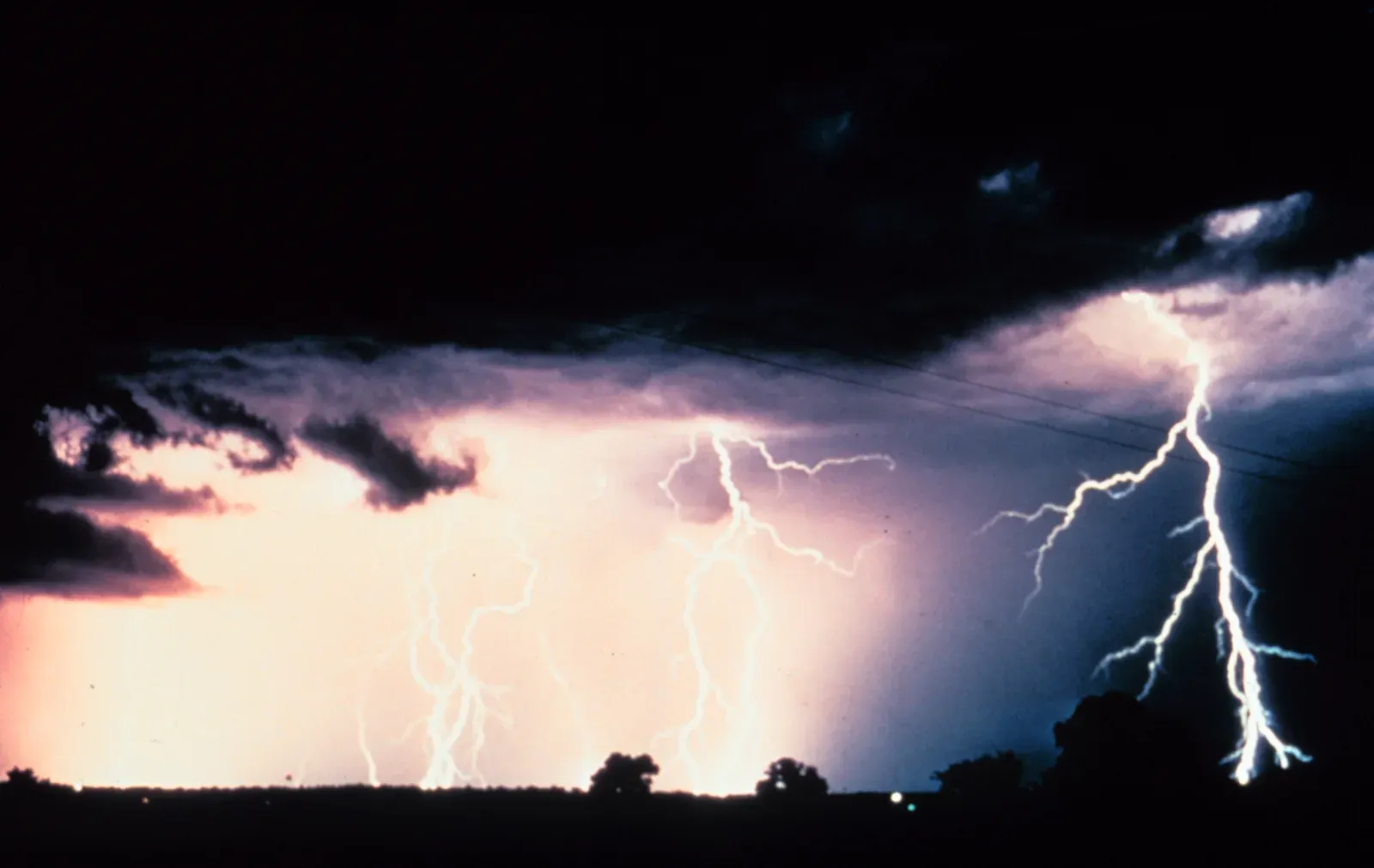
- Time-lapse photo of multiple cloud-to-ground and cloud-to-cloud lightning strokes at night. Photo: NOAA Photo Library, NOAA Central Library; OAR/ERL/National Severe Storms Laboratory (NSSL) (source), Public domain (US gov).