Exothermic Welding: How Grounding and Lightning Protection Connections Are Made
By Site Safe Lightning Protection 9 min read
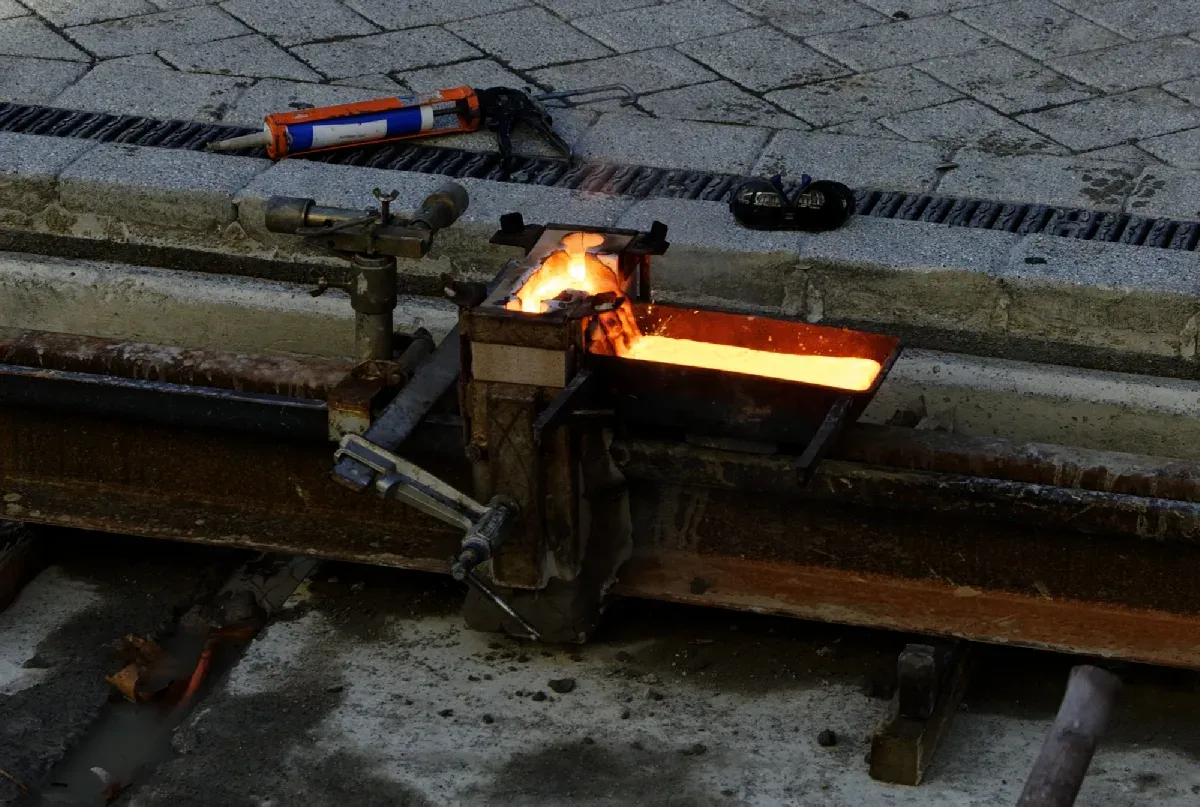
Exothermic welding joins grounding conductors by casting molten copper around them. A measured charge of copper oxide and aluminum powder is ignited inside a graphite mold, the reaction turns it into liquid copper, and the copper flows over the conductors and fuses them into one piece. It needs no outside source of heat or current (Wikipedia). In a lightning protection system it’s the usual way to make the connections nobody will see again: down conductors to ground rods, splices in a buried ground ring, and copper bonded to structural steel.
Electricians often call it a Cadweld, after the oldest brand. The process is the same whichever maker’s name is on the box.
What exothermic welding is
“Exothermic” means the reaction gives off heat. The mix is a thermite: aluminum powder strips the oxygen from a metal oxide and leaves pure metal and a great deal of heat behind. Railroads use iron oxide to cast steel into rail joints. Electrical work uses copper oxide instead, and the products are copper and an aluminum oxide slag that floats to the top (Wikipedia).
nVent ERICO’s installation guide says the weld metal reacts to produce molten material above 2,500°F (1,400°C) and doesn’t ignite until it passes 1,650°F (900°C). It also says the material is not explosive (nVent ERICO guide).
The finished joint is a solid lump of copper cast around the conductors. No bolt, spring or crimp holds it together, so there’s nothing to work loose. Wikipedia’s summary of the properties is that the weld is highly stable under repeated short-circuit pulses and doesn’t gain electrical resistance over the life of the installation.
Hans Goldschmidt developed thermite rail welding in the mid-1890s, and the first rail line was welded with it in Essen, Germany, in 1899 (Wikipedia). The copper version came out of railroad work too. Charles Cadwell patented his process in 1938 for bonding signal wires to rail, and it spread from there to cathodic protection, power transmission and grounding (nVent).
Is exothermic welding the same as Cadweld?
Yes. Cadweld is a brand name, taken from Charles Cadwell, and “cad weld” has become shop talk for any exothermic weld, the way people say Kleenex for a tissue. Other makers sell the same process under their own names. Each maker designs its molds and weld metal as a matched set, and the nVent guide warns against mixing one company’s molds with another’s weld metal.
What’s in an exothermic welding kit
The nVent guide lists what a typical connection takes:
- a graphite mold made for that exact connection and conductor size
- a handle clamp to hold the mold shut
- the weld metal, sold in tubes or sealed cups sized for the mold
- a wire brush for the conductors and a soft brush for the mold
- a flint igniter, or an electronic igniter on newer systems
- a propane torch for drying
Each connection type needs its own mold. A cable-to-ground-rod tee, a cable-to-cable splice and a cable-to-steel bond are three different molds. A graphite mold lasts about 50 connections on average before the cavity wears and starts to leak (nVent ERICO guide).
How an exothermic weld is made
These are the steps in the nVent guide for a standard weld. Other brands follow the same order.
- Check the tag on the mold against the conductor size and the weld metal it calls for.
- Dry the mold with the torch. Graphite absorbs moisture, and the guide says to heat the mold to about 250°F.
- Clean and dry the conductors, then wire-brush them to bright metal.
- Set the conductors in the mold and lock the clamp.
- Drop the steel disk into the crucible and pour the weld metal on top of it.
- Close the lid, add the starting powder and light it from the side.
- Wait about 30 seconds for the metal to set, then open the mold and knock off the slag.
The reaction melts through the steel disk and the copper runs down into the weld cavity. An experienced installer makes a connection in a few minutes. Most of that time goes into cleaning and drying.
Where exothermic welds go in a lightning protection system
A lightning protection system has three kinds of connection: the ones on the roof, the ones coming down the walls and the ones in the ground. Exothermic welding is used mostly on the buried ones. Federal specifications show how designers split them.
| Connection | Usual method | Source |
|---|---|---|
| Down conductor or ground ring to a buried ground rod | Exothermic weld | UFGS 26 41 00, 3.1.5 |
| Ground rod connection inside a test well | Exothermic weld or compression connector | UFGS 26 41 00, 3.1.5 |
| Underground connections between earth electrodes and counterpoise cable | Exothermic weld | NWSM 30-4106, 2.13.2.1 |
| Copper conductor to structural steel | Exothermic weld only | NWSM 30-4106, 2.13.2.3 |
| Roof conductor splices, air terminals and bonding plates | Bronze clamp-type connectors | VA 26 41 00 |
| Roof conductor to down conductor, and down conductor splices | Exothermic weld (VA); compression clamps or welds (UFGS 2.2.3) | VA 26 41 00, UFGS 26 41 00 |
The military guide specification says to attach each down conductor and ground ring to its ground rod “by exothermic weld for all buried connections” (UFGS 26 41 00, May 2026). The National Weather Service uses the same rule for its radar and forecast sites: exothermic welds for all underground connections, and only exothermic welding to bond copper permanently to steel (NWSM 30-4106). The Department of Veterans Affairs goes further and requires welds on down conductor splices as well (VA 26 41 00).
Those documents govern federal projects. On a private building the contract documents and the locally adopted code decide, so ask your installer which connections will be welded and which will be clamped. Our posts on the ground ring and on grounding vs bonding cover the parts these joints tie together.
What the codes say about exothermic welding for grounding
The National Electrical Code permits exothermic welding by name. Section 250.8(A) lists the “exothermic welding process” among the permitted ways to connect grounding conductors and bonding jumpers, next to listed pressure connectors and terminal bars. Section 250.8(B) bans fittings that depend solely on solder. The International Residential Code repeats both lists in E3406.14 (IRC E3406.14 on UpCodes).
For the connection to the electrode itself, NEC 250.70 says the conductor shall be connected “by exothermic welding, listed lugs, listed pressure connectors, listed clamps, or other listed means.” A clamp used on a buried rod or pipe also has to be listed for direct soil burial (IAEI Magazine). In that sentence “listed” is attached to the lugs, connectors and clamps but not to exothermic welding.
So the NEC allows a weld and doesn’t require one. The requirement usually comes from the project specification. The military spec, which is written around NFPA 780, allows mechanical clamps at accessible connections above ground and in test wells, and asks for welds on everything buried.
Power utilities have their own benchmark. IEEE 837 qualifies permanent connections for substation grounding. Its test sequence runs samples through 25 heating cycles to 350°C, freeze-thaw cycling, at least 500 hours of salt spray, a nitric acid bath and repeated fault currents. A connection passes if its final resistance is no more than 1.5 times where it started (ERICO presentation to ATIS). nVent says its welds exceed IEEE 837 and are listed to UL 467. That’s the maker’s claim, and it’s a reasonable thing to ask any supplier to back up with a test report.
Exothermic weld vs mechanical connector
| Exothermic weld | Mechanical connector (clamp, lug or compression fitting) | |
|---|---|---|
| What holds it | Copper cast around the conductors | Pressure from a bolt or a crimp |
| Loosening | Nothing to loosen | Bolted bonds depend on torque; the NWS manual sets torque values for them |
| Buried use | Called for on buried connections in federal specs | Allowed by NEC 250.70 if the clamp is listed for direct burial |
| Can be opened for testing | No | Yes |
| Weather | Mold and conductors must be dry | Can be installed in the wet |
| Tooling | A mold for each connection type, weld metal and a torch | A wrench or a crimping tool |
Welds have drawbacks. Wikipedia lists them: the process costs more than other methods, needs a supply of replaceable molds, is less repeatable and can be stopped by wet weather.
A weld also can’t be taken apart, and that’s the reason test wells exist. To measure one ground rod with a fall-of-potential test, the inspector has to disconnect it from the rest of the system. The military spec leaves a mechanically fastened bond inside each ground test well for that purpose. A sensible design welds what gets buried and clamps what has to be opened.
How to tell a good exothermic weld from a bad one
A weld can be judged by eye. The nVent guide tells inspectors to look at size, color, surface finish and porosity:
- No part of the conductor inside the weld should be exposed. Strands showing below the weld level are a reject.
- On a horizontal joint, the dip under the riser shouldn’t sit lower than the top of the conductor. A low fill points to too little weld metal, a leaking mold or a conductor that moved.
- After a light wire brushing, the weld should be gold to bronze in color.
- Heavy porosity points to moisture or dirt in the mold or on the conductor.
A tall riser on its own is fine. The guide says it means a bigger charge than needed, and the connection is still acceptable.
On steel, the NWS manual requires paint and galvanizing to be scraped off before welding and the area to be completely dry.
The practical problem for an owner is that the welds get buried the same day. The military spec handles that by requiring connections to be tested, with resistance and continuity readings recorded, before they’re covered. On a private job, ask for a photo of every buried weld before backfill and keep the photos with the as-built drawings. The next lightning protection inspection will go faster with them.
Safety, and where not to weld
The safety rules in the nVent guide are short. Wear safety glasses and gloves. Clear or shield anything that can burn. Warn people nearby, and don’t look at the flash. Keep the mold and conductors dry, because molten metal that meets moisture can spew out of the mold.
Three places call for a decision before anyone lights a weld:
- Pressurized or flammable service: the guide says to evaluate any connection to piping or vessels that are pressurized or have held flammable material, including the risk of melt-through. On a tank battery or a compressor site, check the operator’s hot work rules first. Our oil and gas lightning protection page covers how those sites are protected.
- Rebar: the guide warns that a weld can affect the bar’s structural strength and recommends welding near the bar end, where stress is lowest. Ask the structural engineer.
- Thin metal: the base metal has to be thick enough that the weld doesn’t burn through.
If you’re planning a new system, or you’ve inherited one and don’t know how its buried connections were made, contact Site Safe Lightning Protection. We design and install lightning protection systems for homes, commercial buildings and oil and gas facilities, and we inspect existing systems. You can contact Site Safe Lightning Protection to talk through your building.
Talk to Site Safe Lightning Protection about your property.
Frequently asked questions
What is exothermic welding used for?
Making permanent electrical connections, mostly in grounding, bonding, lightning protection and cathodic protection. In a lightning protection system it joins down conductors to ground rods, splices buried ground ring conductors and bonds copper to structural steel.
Is exothermic welding the same as Cadweld?
Yes. Cadweld is nVent ERICO's brand name for the process, taken from Charles Cadwell, who patented it in 1938. Electricians use the name for any exothermic weld, and other makers sell the same process under their own names.
Does the NEC require exothermic welds for grounding?
No. NEC 250.8 and 250.70 permit exothermic welding alongside listed lugs, listed pressure connectors and listed clamps. Project specifications often go further. Federal guide specs call for exothermic welds on all buried lightning protection connections.
Can you exothermic weld to stainless steel or galvanized steel?
Wikipedia's summary says the process suits a wide range of metals, including stainless steel, cast iron, common steel, brass and bronze, and is especially useful for joining dissimilar metals. Each combination needs the mold and weld metal the maker specifies, and the NWS manual requires galvanizing to be scraped off first.
How long does an exothermic weld last?
nVent says the life of an exothermic connection exceeds that of the conductors it joins, because the copper is fused and there is nothing to loosen. That is a maker's claim. Welds that pass IEEE 837 testing have been through heat cycling, freeze-thaw, corrosion and fault-current tests.
Sources
- Wikipedia: Exothermic welding
- nVent ERICO Cadweld Installation and Inspection Guide (E1294W, 2021)
- nVent: A Basic Overview of Exothermically Welded Connections (2019)
- UFGS 26 41 00, Lightning Protection System (USACE / NAVFAC / AFCEC, May 2026)
- National Weather Service Manual 30-4106: Lightning Protection, Grounding, Bonding, Shielding, and Surge Protection Requirements (2017)
- Department of Veterans Affairs master specification 26 41 00, Facility Lightning Protection (2022)
- IAEI Magazine: Clamps solve the NEC 250.70 compliance problem (2018, quotes NEC 250.70)
- International Residential Code E3406.14, Connection of Grounding and Bonding Equipment (reproduces NEC 250.8), on UpCodes
- Regan, Pentair ERICO: Modern Methods of Exothermic Welding, Standard IEEE 837-2014 (ATIS Protection Engineers Group)
Image credits
- Glowing molten metal pouring from a crucible into a mold clamped around a tram rail during a thermite weld. Photo: Iain Fergusson / Wikimedia Commons (source), CC BY-SA 3.0, resized.