Lightning Protection Services: What Each One Includes and What to Ask For
By Site Safe Lightning Protection 8 min read
Lightning protection services cover five jobs: deciding whether a building needs a system, designing it, installing it, inspecting and certifying it, and keeping it intact as the building changes. A complete system is more than rods on the roof. The National Weather Service describes it as air terminals, UL-listed copper or aluminum conductors, a grounding network, bonding between the pieces, and surge protection on incoming power, data and communication lines (NWS). A good contractor quotes all of it and tells you which parts someone else will handle.
What lightning protection services cover
| Service | What gets done | When you need it |
|---|---|---|
| Risk assessment | Strike frequency, building size, construction, contents and occupancy weighed against a tolerable level | Before deciding on a system, or when a spec, insurer or owner asks for one |
| Design | Air terminal layout, conductor routes, ground locations, bonding points, material class | New construction, additions, or a system being rebuilt |
| Installation | Roof work, down conductors, grounding electrodes, bonds to other building systems | Once the design is agreed |
| Inspection and certification | Visual check, continuity and ground testing, third-party certificate if the job calls for one | After installation, on a schedule, and after strikes or building work |
| Maintenance and repair | Re-fastening, replacing damaged parts, re-bonding new equipment, restoring after a reroof | Whenever the building or roof changes |
Risk assessment: does the building need a system?
In the US, the usual method is the risk assessment guide in Annex L of NFPA 780. The Lightning Protection Institute describes it as a simplified at-a-glance assessment plus a detailed calculation, and says it compares the expected direct strikes to the structure with its occupancy and contents to show whether protection should be applied or is optional (LPI). LPI adds that the Navy, VHA, GSA and USPS use the same method for new construction and renovation projects.
The math doesn’t always settle it. LPI notes that historic buildings, healthcare facilities, 911 and emergency centers, server farms, industrial plants, schools and churches are often treated as high risk because of what’s inside them (LPI). We work through the inputs with examples in lightning risk assessment.
Design: layout, class and materials
Design turns the roof plan into a drawing. It sets where each air terminal goes, how the conductors run to ground, where the grounding electrodes sit, and where the system bonds to water piping, electrical service and other metal.
Building height sets the material class. UL’s application guide defines a Class I ordinary building as one not more than 75 ft high and a Class II building as one more than 75 ft high, and Class II needs heavier air terminals, conductors and fittings (UL guide). The same guide says copper parts must not touch aluminum or exterior galvanized steel, and aluminum parts must not touch the earth.
LPI says protection specified during planning and design gives the most options for hiding conductors and grounds, and lets the lightning contractor coordinate chases, ground locations and roofing adhesives with the other trades (LPI FAQ).
Installation: what the crew actually does
On the roof, the crew mounts air terminals and runs the main conductor between them. Then they bring at least two down conductors to grade, drive or bury the grounding electrodes, and bond the system to the building’s other grounded metal. UL’s field inspectors check, among other things, that:
- air terminals stand at least 10 in above the structure and sit no more than 20 ft apart around the perimeter (larger terminals over 24 in may be spaced up to 25 ft);
- every terminal has at least two paths to ground;
- ground rods are at least 8 ft long and 1/2 in in diameter;
- main-size conductors bond the system to metal water piping, the electrical service, telephone and antenna grounds and other large metal masses;
- cable is fastened at least every 3 ft and bent around corners with at least an 8 in radius;
- any gas line bond is on the customer’s side of the meter.
Those items come from UL’s checklist for the Master Label inspection (UL guide).
Surge protection belongs in the scope conversation. LPI’s overview says surge protective devices must be installed at every service entrance to stop lightning coming in on utility lines (LPI overview), and LPI’s FAQ says surge protection alone isn’t enough without the grounding network (LPI FAQ). Ask the contractor whether the quote includes the service-entrance devices or whether your electrician will supply them.
As for who does the work, LPI says lightning protection is not a do-it-yourself project, and design and installation are usually outside the expertise of homeowners, electricians, general contractors and roofers (LPI FAQ).
Inspection, testing and certification
Parts loosen, roofs get replaced and new equipment goes up, so a system that passed on day one needs checking. NFPA 780 and LPI-175 recommend a visual inspection every year and a full inspection with testing every 3 to 5 years (1 to 3 years for critical facilities). You should also have the system inspected after a lightning strike or any roof or building work, and your insurer or contract may require more frequent inspections (NFPA 780; LPI-175). Our lightning protection inspection page explains what an inspection covers.
Two third-party certificates are common, and they expire on different clocks:
| Certificate | Who issues it | How long it lasts |
|---|---|---|
| UL Master Label Certificate | UL, after a site inspection of a system installed to UL 96A | Five years, then re-inspection and a new certificate (UL guide) |
| LPI-IP Master Installation Certificate | Lightning Protection Institute Inspection Program | Three years, matched to the NFPA 780 review cycle (LPI) |
UL’s guide says its five-year cycle accounts for strike damage, maintenance crews walking on parts, structural changes and remodeling. We cover the UL side in more detail in UL 96A and the Master Label.
Maintenance and repair after building changes
LPI lists the changes that should trigger a maintenance inspection: roof renovations, electrical updates, satellite dishes, HVAC alterations, and recent work on cable TV or telephone systems (LPI FAQ).
A reroof is the classic case. The roofer pulls the air terminals and cable to lay new membrane or shingles, and someone has to put them back with the right fasteners and bonds. A new rooftop unit or solar array may sit outside the old zone of protection, and that means new terminals and new bonds. Put the lightning contractor on the schedule before the roofer starts.
How services differ for homes, commercial buildings and oil and gas sites
| Property | What usually drives the job | What to watch for |
|---|---|---|
| Homes | Tall or isolated houses, chimneys, attached garages, owner peace of mind | Concealed conductors, bonding to gas piping and the electrical service ground, surge protection at the panel |
| Commercial buildings | Specs, insurers, occupancy, rooftop equipment | Flat-roof terminal spacing, Class II parts above 75 ft, recertification dates, coordination with roofing warranties |
| Oil and gas facilities | Flammable vapors, tanks, remote sites | Hazardous-materials storage is a specialty chapter of NFPA 780, not ordinary-building work |
LPI notes that NFPA 780 covers many special structures beyond ordinary buildings, from hazardous materials storage to boats and open picnic shelters (LPI overview). Our oil and gas facility lightning protection page lists the kinds of sites involved.
Why Texas, Oklahoma and Colorado owners ask for these services
Storms here are frequent and claims are expensive. AEM’s 2025 US lightning report put Oklahoma first in the country for lightning concentration, at 73 flashes per square mile, and counted 9,103 dangerous thunderstorm alerts in Texas, more than twice the next state, Oklahoma (AEM).
Insurance numbers point the same way. The Insurance Information Institute reports 61,986 lightning-caused homeowners claims in 2025, worth $1.65 billion. The national average was $26,616 per claim, and the Texas average was $60,382 (Triple-I). Those figures cover homeowners claims only.
What a written proposal should include
Before you sign, the scope should spell out:
- The standard the system is designed and installed to (NFPA 780, UL 96A, LPI-175, or more than one), and the edition.
- A roof plan or drawing showing terminals, conductor routes, down conductors and ground locations.
- Material class (Class I or II) and whether the parts are copper or aluminum.
- Every bond: electrical service ground, water piping, gas piping, antennas, rooftop units, solar racking.
- Who supplies surge protection at the service entrance.
- Who handles roof penetrations and adhesives, and how the roofing warranty is protected.
- Whether a UL Master Label or LPI-IP certificate is included, and who pays for that inspection.
- Ground resistance or continuity test results to be handed over at the end.
- A recommended inspection schedule and what triggers an earlier visit.
Questions to ask a lightning protection contractor
LPI certifies individuals at three installer levels, Journeyman Installer, Master Installer and Master Installer/Designer, and has accreditation from the ANSI National Accreditation Board for them (LPI certifications). UL arranges Master Label field inspections through installing contractors listed in its program (LPI overview). So ask who will design the system, who will be on the roof, and which certificate, if any, the finished job will carry.
On price, LPI says systems generally cost less than 1% of the structure’s value, with the price driven by size, location, construction, roof type and grounding conditions (LPI FAQ). Two quotes for the same building can differ because one includes bonding, surge protection and certification and the other doesn’t.
Talk to Site Safe Lightning Protection
Site Safe Lightning Protection designs and installs lightning protection systems for homes, commercial buildings and oil and gas facilities, and provides inspection and maintenance for existing systems. If you’re comparing proposals, planning a reroof, or not sure whether your building needs a system at all, contact Site Safe Lightning Protection and tell us about the property.
Talk to Site Safe Lightning Protection about your property.
Frequently asked questions
What do lightning protection services cost?
It depends on the building. LPI says lightning protection generally runs less than 1% of the structure's value, with size, location, construction, roof type and grounding conditions setting the price.
How often should a lightning protection system be inspected?
NFPA 780 and LPI-175 recommend a visual inspection every year and a full inspection with testing every 3 to 5 years (1 to 3 years for critical facilities). Also inspect after a lightning strike or any roof or building work. Your insurer or contract may require more frequent inspections.
Can an electrician or roofer install lightning protection?
LPI says design and installation usually fall outside the expertise of electricians, general contractors and roofers, and recommends a contractor that specializes in lightning protection.
Does a lightning protection system lower insurance costs?
Sometimes. LPI says lightning protection is often considered for insurance credits, but policies vary by company. Ask your agent or broker whether your policy offers one.
Sources
- National Weather Service: Lightning Rods and Lightning Protection Systems
- Lightning Protection Institute: Frequently Asked Questions
- Lightning Protection Institute: Lightning Protection Overview
- Lightning Protection Institute: Lightning and Lightning Protection, Measuring the Tolerable Risk (NFPA 780 Annex L)
- Lightning Protection Institute: Certifications
- Lightning Protection Institute: Lightning Protection Inspection Program Expands Services (LPI-IP)
- UL: Lightning Protection Marking and Application Guide (2016, read via archive.org)
- NFPA 780, Standard for the Installation of Lightning Protection Systems, Annex D: Inspection and Maintenance (NFPA)
- LPI-175, Standard for the Design, Installation and Inspection of Lightning Protection Systems (Lightning Protection Institute)
- AEM: 2025 United States Lightning Report
- Insurance Information Institute: Facts + Statistics: Lightning
Image credits
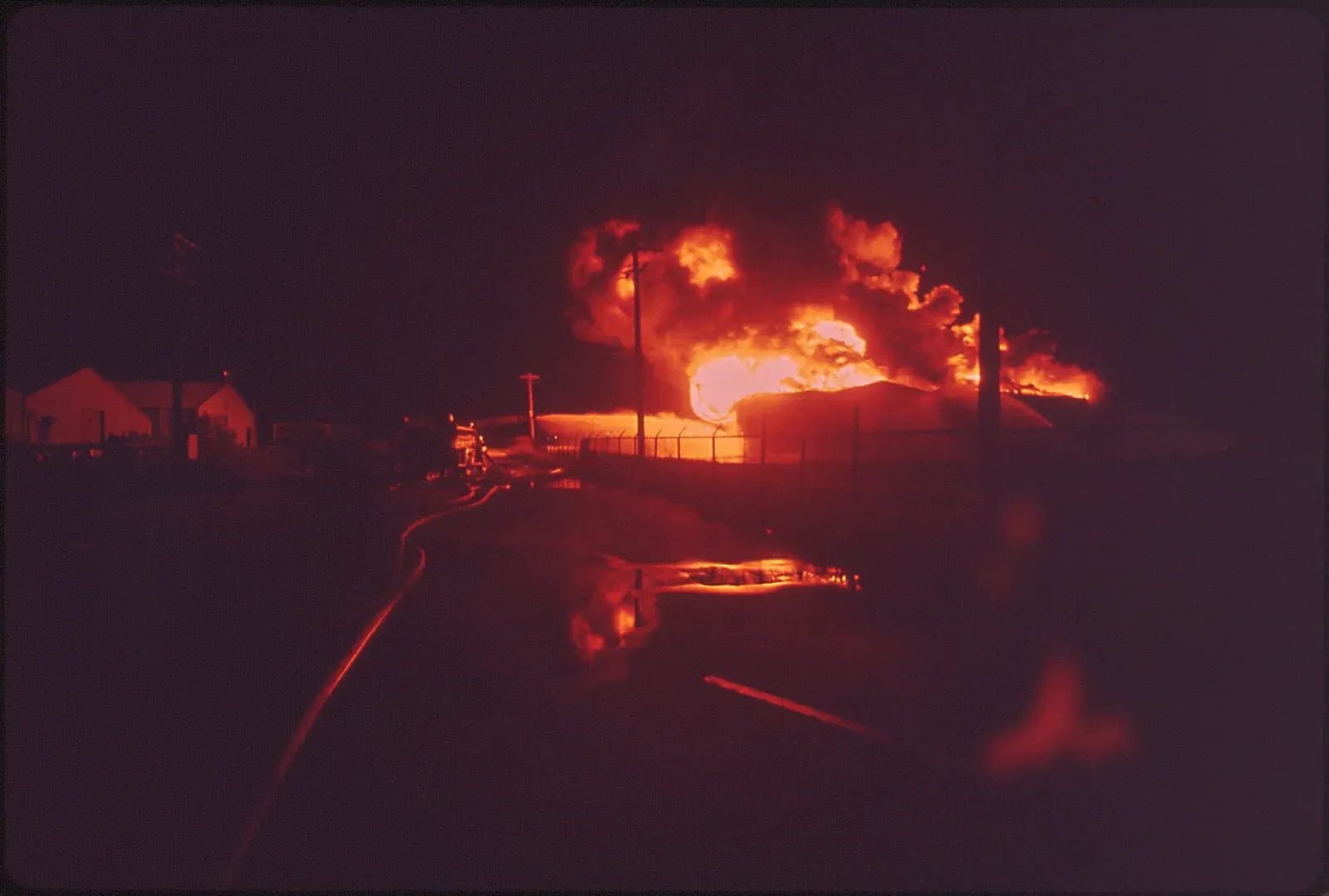
- A crude oil storage tank burning at night after a lightning strike, with a fire truck and hoses in the foreground. Photo: Jim Olive / U.S. National Archives and Records Administration (via Wikimedia Commons) (source), Public domain.