Does Lightning Come From the Ground? How a Strike Really Travels
By Site Safe Lightning Protection 7 min read
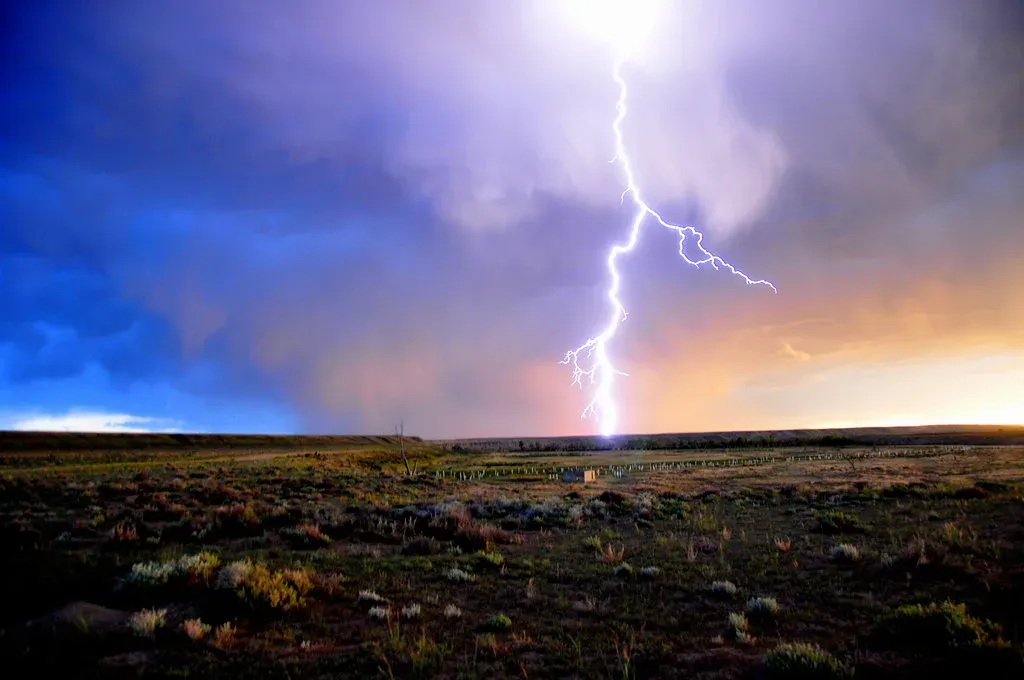
Both. A normal cloud-to-ground strike starts in the cloud and works its way down, but the bright flash you see travels from the ground back up. NOAA’s National Severe Storms Laboratory puts it plainly: cloud-to-ground lightning comes from the sky down, but the part you see comes from the ground up (NSSL). A smaller group of flashes really does start at the ground, from the tops of tall towers and buildings, and climbs into the cloud.
The upward half of every strike leaves from something on the ground, often a roof, a tree or a mast. Lightning protection systems are designed around that half.
How a cloud-to-ground strike travels, step by step
Here’s the sequence for the most common flash, a negative cloud-to-ground strike, in the order it happens.
| Step | Which way it moves | What happens | Can you see it? |
|---|---|---|---|
| 1. Stepped leader | Down | A channel of negative charge zigzags toward the ground in segments of roughly 50 yards (NSSL) | No, it’s too faint and too fast |
| 2. Upward streamers | Up | As the leader nears the ground, positive streamers reach up from taller objects such as trees, houses and poles (NSSL) | Rarely; usually only on high-speed video |
| 3. Connection | Meets in the middle | One streamer meets the leader and completes the channel (NWS) | No |
| 4. Return stroke | Up | Current surges through the channel and the bright flash travels back toward the cloud at about 60,000 miles per second (NSSL) | Yes, this is the flash |
| 5. Subsequent strokes | Down, then up again | A negative flash can have one to as many as 20 return strokes along the same path, which is why lightning flickers (NSSL) | Yes, as flicker |
The National Weather Service explains the return stroke with a drawbridge. When a closed bridge opens, the cars nearest it move first and the movement works its way back through the line of traffic. In the same way, charge near the ground drains first and the bright front climbs the channel toward the cloud (NWS).
The whole sequence takes a few thousandths of a second, so the eye can’t separate the steps (NSSL).
Why it looks like it comes from the sky
Two things fool the eye. The downward leader is invisible, and the return stroke moves so fast that the whole channel seems to light at once. The channel also branches downward, because the leader forked on its way down, and the branches point toward the ground like roots. So the picture in your head is a bolt thrown down from the cloud, even though the flash itself ran upward.
Which way is the current flowing? It depends on how you count it. In a negative flash, which is most cloud-to-ground lightning, electrons move down the channel to the ground. Engineers define conventional current the other way, so on paper it flows from the ground up to the cloud (Wikipedia).
Upward lightning: when it really does start at the ground
Some flashes have no downward leader at all. The leader starts from the top of a tall object and grows up into the cloud, branching upward as it goes. The NWS says these upward discharges are rare, almost always come from towers, tall buildings or mountaintops, and seem to need a rapid change in the charge overhead, most likely from a recent lightning flash nearby (NWS).
The NSSL calls this triggered lightning and lists very tall structures, rockets and towers as the usual starting points. It says upward lightning usually happens in response to a natural flash, but on rare occasions it starts by itself, usually in winter storms with strong winds (NSSL).
The best US data comes from Rapid City, South Dakota. Researchers filmed ten towers between 91 and 191 meters tall from 2004 to 2010 and recorded 81 upward flashes. In all but one, other lightning was visible just before the upward leader formed. A positive cloud-to-ground stroke came first in 57% of cases, and the authors concluded that most of the upward flashes were triggered by a preceding flash, usually a positive cloud-to-ground strike (Warner, Cummins and Orville, 2012).
So a tall tower can be struck twice by one storm: once by ordinary downward lightning, and again when a strike miles away sets off an upward flash from its tip. That’s part of why the Empire State Building is hit an average of 23 times a year (NWS). Our post on whether lightning strikes the same place twice has more on repeat strikes.
Downward vs upward lightning at a glance
| Downward (cloud-to-ground) | Upward (ground-to-cloud) | |
|---|---|---|
| How common | Nearly all strikes that reach the ground | Rare (NWS) |
| Where it starts | Inside the cloud | The tip of a tall tower, building or mountaintop |
| Branches point | Down, toward the ground | Up, toward the cloud |
| What sets it off | Charge building up in the storm | Usually a nearby flash, often a positive one (Warner et al.) |
| What it hits | Anything; taller objects are favored | Only tall structures |
How much lightning reaches the ground?
Only a fraction of it. The NSSL says there are roughly 5 to 10 times as many flashes that stay in the cloud as flashes that reach the ground (NSSL).
The ground still takes a lot. Over the lower 48 states, the National Lightning Detection Network has recorded an average of 20 million cloud-to-ground flashes a year since 1989. About half of those flashes hit the ground at more than one point, so at least 30 million spots are struck each year (NSSL).
Positive and negative strikes
Most cloud-to-ground flashes lower negative charge to the ground. A smaller share are positive. Wikipedia’s summary of the research puts positive flashes at under 5% of strikes (Wikipedia). The NSSL says positive flashes usually have a single return stroke and are more likely to carry a sustained current (NSSL). It also says positive lightning may be the more dangerous kind, because its peak current is often stronger and the longer current flow is thought to make fires more likely (NSSL).
Positive strikes are also the ones most likely to set off upward lightning from towers, as the Rapid City study found.
What this means for buildings and people
The upward streamer is the part of a strike that involves you. Before the flash, every tall object in the area may be sending a streamer up to meet the leader. Only one connects. The NSSL says the tallest object is the most likely to produce the upward streamer that makes the connection, which is why lightning usually, though not always, hits the tallest thing around (NSSL). We go further into height, shape and isolation in what attracts lightning.
Streamers can hurt people too. The NWS says that when the main channel discharges, the other streamers nearby discharge as well, and a person who is part of one can be killed or injured even though the strike landed somewhere else (NWS).
A lightning protection system uses this. Air terminals on the roof give the building a planned place for the upward streamer to leave from. When the strike connects there, conductors and a grounding network carry the current into the earth instead of letting it find its own way through the structure. The NWS describes it this way: a system doesn’t prevent lightning from striking, it intercepts the strike, gives it a conductive path and disperses the energy into the ground, with every part bonded to limit sparks and side flashes (NWS).
For tall structures, the upward-lightning data adds one more point. A tower, mast or tall building can be hit by flashes that begin at its own tip, sometimes after a strike some distance away. Designs for those structures use masts, catenary wires and the rolling sphere method to decide where protection goes. Our post on lightning masts covers how masts and overhead wires shield equipment and open areas.
If you manage a commercial building, an oil and gas site or a home and want to know where lightning is likely to attach and whether your structure is protected, contact Site Safe Lightning Protection. We design and install lightning protection systems for homes, commercial buildings and oil and gas facilities, and inspect existing systems. See our commercial lightning protection page or contact Site Safe Lightning Protection.
Talk to Site Safe Lightning Protection about your property.
Frequently asked questions
Does lightning come from the ground or the sky?
Both. A normal cloud-to-ground flash starts with an invisible leader moving down from the cloud. When it meets a streamer rising from the ground, the bright return stroke travels back up the channel. The flash you see moves from the ground up.
What is upward lightning?
Lightning that starts at the top of a tall tower, building or mountaintop and grows up into the cloud. The NWS says it's rare, and research on towers in Rapid City, South Dakota found most upward flashes were triggered by a nearby strike, usually a positive one.
What is ground to cloud lightning?
Another name for upward lightning: a flash that begins from a tall object on the ground and travels up into the cloud, usually branching upward as it goes.
How fast does lightning travel?
The return stroke, the bright part of the flash, travels at about 60,000 miles per second, according to NOAA's National Severe Storms Laboratory. The whole strike takes a few thousandths of a second.
Does a lightning rod make lightning come from the ground?
No. It gives the building a planned point for the upward streamer to leave from, so that when the downward leader connects, the current runs through the protection system's conductors and grounding instead of through the structure.
Sources
- NOAA National Severe Storms Laboratory: Lightning FAQ
- NOAA National Severe Storms Laboratory: Lightning Types
- National Weather Service: Understanding Lightning, Making Connection With the Ground
- National Weather Service: Understanding Lightning, Return Stroke
- National Weather Service: Understanding Lightning, Upward Leaders
- Warner, Cummins and Orville (2012): Upward lightning observations from towers in Rapid City, South Dakota, 2004-2010 (Journal of Geophysical Research 117, D19109)
- National Weather Service: Lightning Myths and Facts
- National Weather Service: How Lightning Strikes Its Victims
- National Weather Service: Lightning Rods
- Wikipedia: Lightning (current direction and positive lightning share)
Image credits
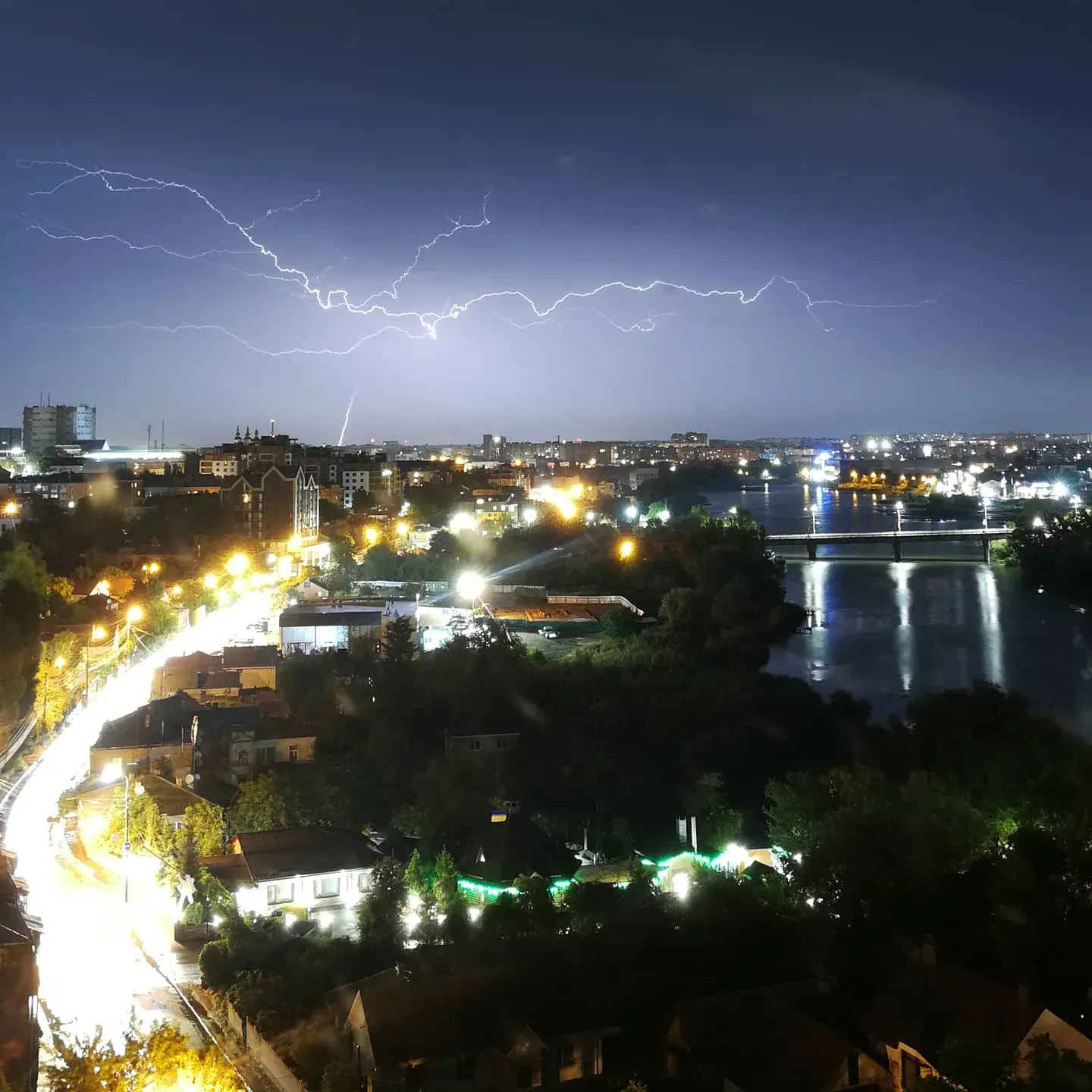
- Lightning branching across a night sky above a lit city and river, with a thin channel reaching down to the skyline. Photo: ELECTROPHORUS / Wikimedia Commons (source), CC BY-SA 4.0, resized.
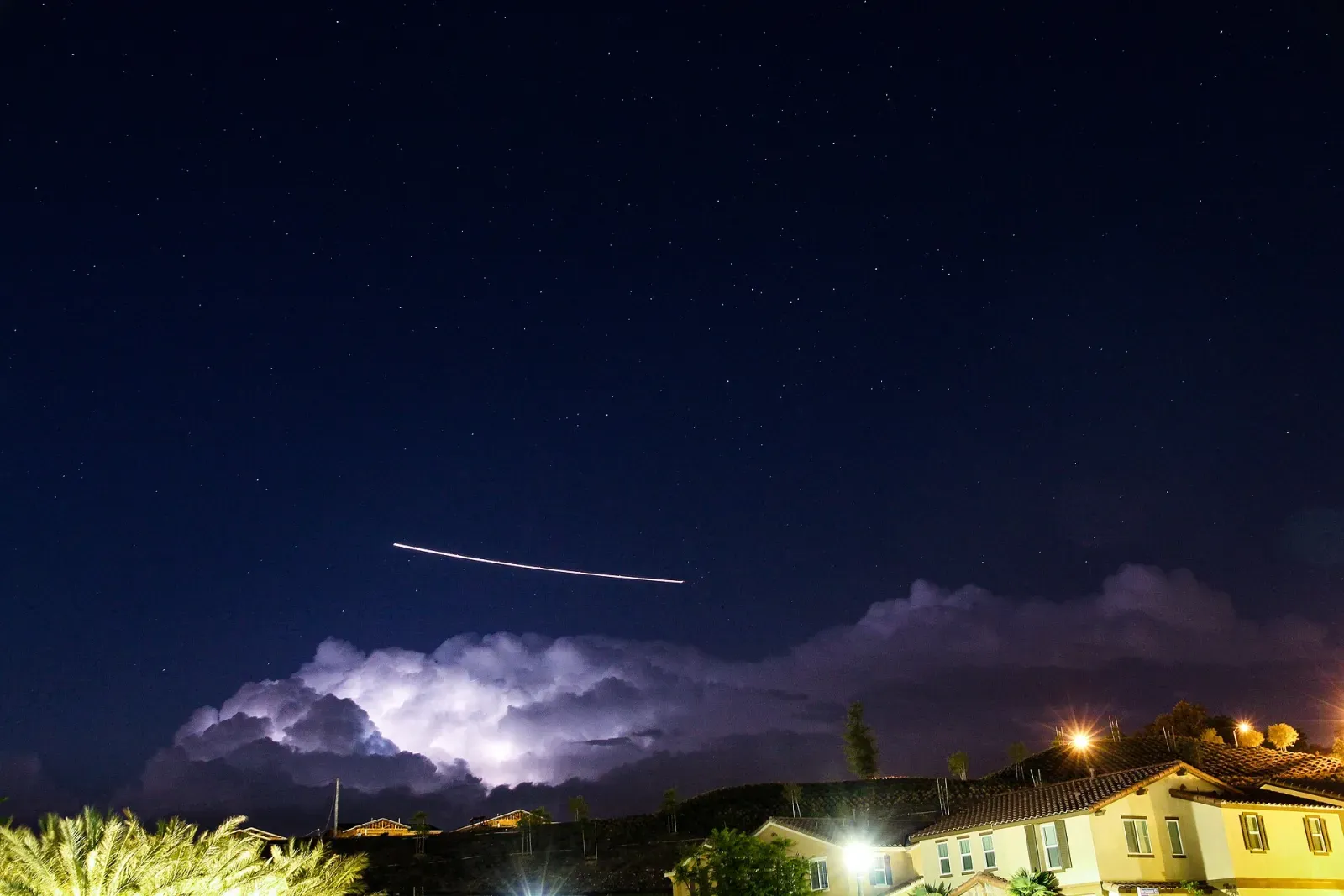
- Thunderstorm cloud lit from inside by lightning on the horizon beyond a row of houses under a starry night sky. Photo: Kevin M. Gill / Wikimedia Commons (source), CC BY 2.0, resized.