Ground Ring Electrodes for Lightning Protection: NEC vs NFPA 780
By Site Safe Lightning Protection 8 min read
A ground ring is a bare copper conductor buried in the earth in a loop around a building, with every down conductor of the lightning protection system connected to it. Two codes describe it, and they don’t match. The National Electrical Code (NFPA 70) wants at least 20 ft of bare copper no smaller than 2 AWG, buried 30 in deep. NFPA 780, the lightning protection standard, accepts 18 in but sizes the conductor by the building’s height. The Lightning Protection Institute calls a ground loop that ties all the downleads together at their base one of the strongest ways to equalize potential across a structure (LPI).
What a ground ring does
A single ground rod gives lightning current one place to leave the system. A ring gives it the whole perimeter. When a strike comes down several down conductors at once, the ring connects their bases, so all of them sit at close to the same voltage and current spreads into the soil around the whole building instead of piling up at one rod.
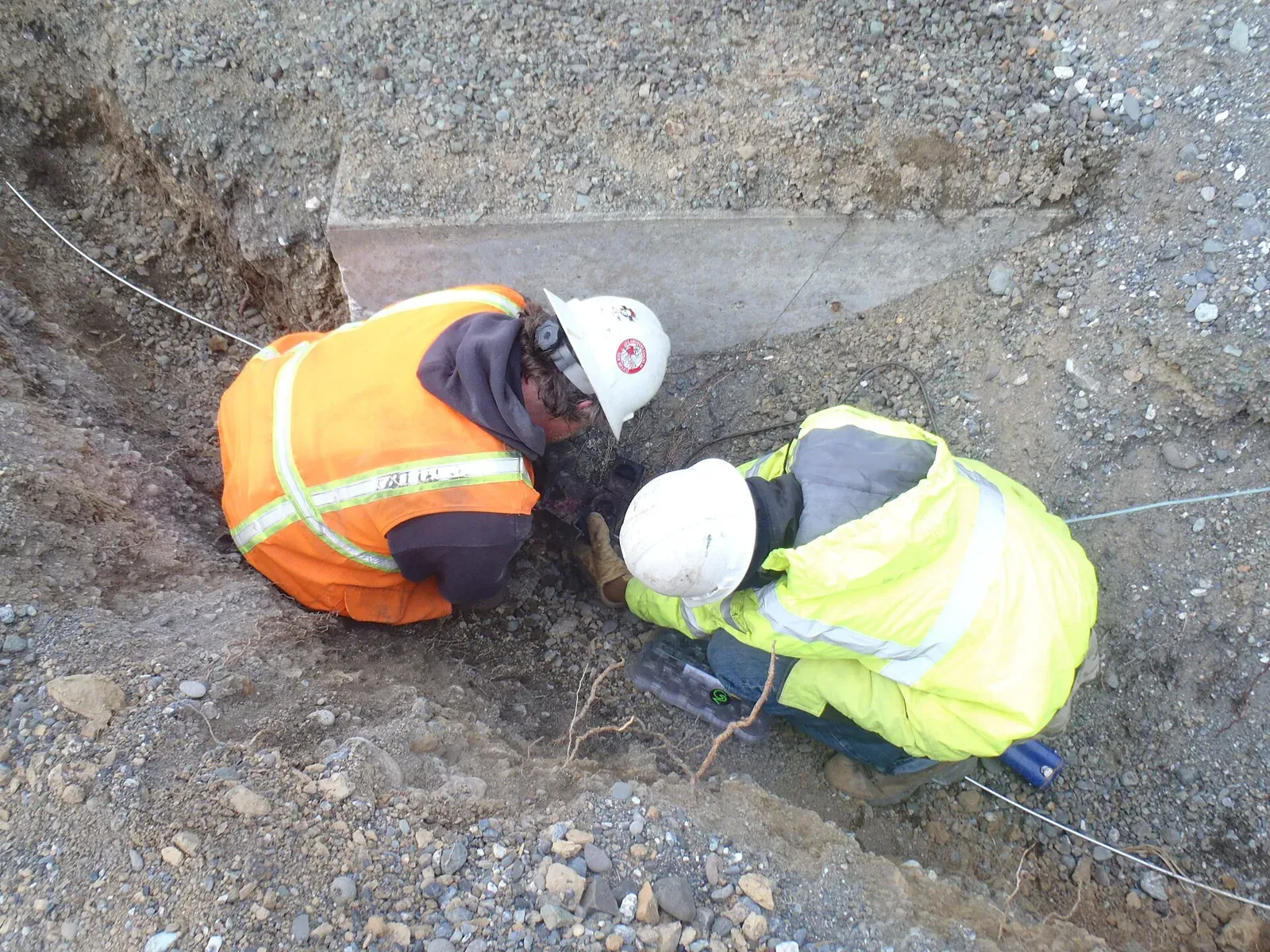
That’s why rings are standard around radio and cell towers, equipment shelters and data centers (Wikipedia: Ring ground). The photo above is from an Oregon Department of Transportation radio site, where contractors were tying new ground rings into the existing ones with exothermic welds.
The LPI’s guidance goes further for tall buildings: it says a ground loop is required for every structure over 60 ft in height (LPI).
Ground ring requirements: NEC vs NFPA 780
The two documents cover different systems. The NEC covers the electrical service’s grounding electrode system. NFPA 780 covers the lightning protection system. A building can have both, and the rules differ.
| NEC (NFPA 70) ground ring electrode | NFPA 780 ground ring (lightning protection) | |
|---|---|---|
| Where it’s defined | 250.52(A)(4) | Grounding electrode rules in Chapter 4 |
| Conductor | Bare copper, at least 2 AWG | A main-size conductor: Class I or Class II size depending on height |
| Length | At least 20 ft, encircling the building | Encircling the structure, connecting the down conductors |
| Minimum depth | 30 in (750 mm) | 18 in (457 mm) |
| Distance from foundation | Not specified in 250.52(A)(4) | None for ordinary structures; 3 ft for structures housing explosives |
The NEC conductor and length come from UpCodes, the NEC depth from Wikipedia and UFC 3-575-01, and the NFPA 780 depth and foundation distance from UFC 3-575-01 and a 2024 Los Alamos National Laboratory engineering variance. Check the edition your project is built to.
The Department of Defense criteria put the depth difference plainly. Where a power ground ring is required, UFC 3-575-01 says to install it at a minimum of 30 in, “rather than” the 18 in depth NFPA 780 requires (UFC 3-575-01, 3-3). If one ring is meant to serve both the electrical service and the lightning protection system, build it to the deeper NEC figure.
Ground ring size: when 2 AWG isn’t enough
NFPA 780 sizes conductors by class. Structures under 75 ft get Class I materials. Structures 75 ft and taller get Class II, and in the 2026 revision text a building with a taller part, such as a steeple, only needs Class II materials on the part that reaches 75 ft or more (NFPA 780 First Revision report, 4.1.1.2).
A 2 AWG solid copper conductor is 66,360 circular mils. The Class I copper main conductor minimum is 57,400 circular mils, so 2 AWG is the smallest standard AWG size that meets Class I (First Revision report, A.11.4.1.1). The standard’s own annex spells out what that means for rings: the NEC’s 2 AWG ground ring is acceptable for Class I but would not be acceptable for Class II (A.4.13.3).
So on a building under 75 ft, an NEC-sized ring can also meet the lightning protection conductor size. On a taller building, it can’t, and the lightning protection ring needs the heavier Class II conductor.
Some owners specify more than the minimum. Los Alamos National Laboratory’s engineering standard calls for at least 1/0 AWG bare copper (4/0 AWG for Class II systems), placed at least 3 ft from the foundation, at least 3 ft below grade, and at least 6 ft from any electrical or communications ground electrode (LANL VAR-10641). The lab chose the 3 ft depth to stay clear of landscaping work and frost heave, and its own guidance notes the frost line there is generally taken as 36 in. If you build in high country, ask the local building department for the frost depth and set the ring below it.
Where a ground ring is required
Lots of buildings never need a ring. Ordinary houses and small commercial buildings are usually grounded with a rod or other electrode at each down conductor, as covered in our guide to grounding a house for lightning. A ring becomes the requirement, or the better choice, in these cases:
- Structures containing flammable vapors or gases. NFPA 780’s 2026 revision text says a ground ring electrode or ground loop conductor, supplemented by grounding electrodes, shall be provided for structures containing flammable vapors, flammable gases or liquids that can give off flammable vapors. The annex excludes tanks and petroleum production, processing and storage structures, which have their own grounding rules (First Revision report, 7.3.7.1).
- Explosives facilities. UFC 3-575-01 requires a ground ring electrode of 1/0 copper on DoD explosives facilities, and NFPA 780 adds the 3 ft minimum distance from the structure (UFC 3-575-01, LANL).
- Catenary systems. Where an overhead-wire system needs its own ring, UFC 3-575-01 makes it the primary ring, places it at least 3 ft beyond the inner ring, and bonds the two rings together in at least two places.
- Tall buildings, under LPI’s 60 ft guidance above, and Class II buildings at 75 ft and up.
- Owner, insurer or federal specifications. The UFC applies to DoD facilities, and many corporate and campus standards copy it.
For oil and gas sites, check which part of the facility you’re dealing with. A compressor building or control building containing flammable gas falls under 7.3.7.1. A tank uses the separate tank grounding methods in 7.3.7.3.
Ground ring vs ground rods
| Ground rods at each down conductor | Ground ring | |
|---|---|---|
| How current leaves | At each rod | Along the whole perimeter |
| Equalizes the down conductors | Only through the roof conductors and bonds | Directly, at grade |
| Works in shallow or rocky soil | Hard if rods won’t drive | Needs a trench, not a deep hole |
| Cost to retrofit | Lower | Higher: a trench around the building, plus restoring paving and landscaping |
| Inspection | Each rod can sit in a test well | Buried and harder to see, so plan test wells at the connections |
You can use both. UFC 3-575-01 suggests a ground rod in a test well between each down conductor and the ring, so that if someone cuts the ring with a backhoe later, each down conductor is still grounded (UFC 3-575-01, 3-3).
Bonding the ring to the electrical ground
A lightning protection ground ring doesn’t replace the electrical service ground, and the electrical ground can’t stand in for it. LPI says electrical or communication system electrodes must not be used in place of lightning grounding electrodes, and that the separate grounding electrodes of different systems must be bonded together (LPI). NFPA 780’s annex adds that all electrodes at a building have to be bonded into one grounding electrode system under NEC 250.50, which coordinates with the standard’s own bonding rules (A.4.13.3).
The bond keeps the two systems at the same voltage during a strike, so current has no reason to jump from one to the other through wiring, piping or people. We cover the reasoning in grounding vs bonding.
Checking a ground ring that’s already installed
A ring is buried, so problems hide. On an inspection, look for:
- Every down conductor connected to the ring, with no conductor ending at a lone rod that was never tied in.
- Connections that are exothermically welded or made with listed clamps, and test wells where you can reach them.
- Recent trenching, paving or landscaping near the perimeter. Utility, fiber and irrigation trenching can cut a ring without anyone noticing.
- Conductor size that matches the building’s class, especially where a building was extended above 75 ft or a ring was sized only to the NEC.
- A bond between the lightning ring and the electrical grounding electrode system.
- Ground resistance readings compared with earlier ones. For explosives facilities, the 2026 revision text requires the three-point fall-of-potential method (8.9.7.6).
Requirements depend on the code edition, contract and authority having jurisdiction, so confirm them with your local building department or the facility’s engineer of record.
Planning a ground ring with Site Safe Lightning Protection
If you’re designing a new commercial building, an oil and gas facility, or a home on a tall or exposed lot, contact Site Safe Lightning Protection about the grounding for a new lightning protection system or an inspection of an existing one. Our oil and gas facility lightning protection page covers the sites we work on.
Talk to Site Safe Lightning Protection about your property.
Frequently asked questions
What is a ground ring?
A ground ring is a bare copper conductor buried in a loop around a building, connected to every down conductor of the lightning protection system and bonded to the electrical grounding system. It spreads lightning current along the whole perimeter and keeps the down conductors at close to the same voltage.
How deep does a ground ring have to be buried?
The NEC calls for at least 30 in. NFPA 780 accepts 18 in for a lightning protection ground ring. A ring meant to serve both the electrical service and the lightning protection system should be built to the deeper NEC figure, and below the local frost line where that's deeper.
What size wire is used for a ground ring?
The NEC minimum is 20 ft of bare copper no smaller than 2 AWG. For lightning protection, NFPA 780 requires a main-size conductor: 2 AWG meets Class I, but buildings 75 ft and taller need the heavier Class II conductor. Explosives facilities on DoD sites use 1/0 copper.
Is a ground ring better than ground rods?
A ring equalizes the down conductors directly at grade and spreads current around the whole building, and it works where rods won't drive. It costs more to retrofit. Many designs use both, with a rod in a test well at each down conductor so the system stays grounded if the ring is ever cut.
When is a ground ring required for lightning protection?
NFPA 780 requires a ground ring or ground loop conductor for structures containing flammable vapors or gases (tanks have their own rules), and on explosives facilities. LPI calls for a ground loop on structures over 60 ft, and owner or federal specifications such as UFC 3-575-01 often require one.
Sources
- NFPA 70 (NEC) 250.52(A)(4) Ground Ring, UpCodes
- NFPA 780 (A2025 cycle) First Revision report
- UFC 3-575-01 Lightning and Static Electricity Protection Systems, with Change 1 (2021), WBDG
- Los Alamos National Laboratory, VAR-10641 Lightning Protection Ground Ring Minimum Distance (ESM Ch. 7 D5090), 2024
- Lightning Protection Institute: Lightning Protection Overview
- Wikipedia: Ring ground