How Many Volts Is Lightning? And Why the Amps Matter More
By Site Safe Lightning Protection 6 min read
A typical lightning flash is about 300 million volts and about 30,000 amps, according to the National Weather Service. Household current is 120 volts and 15 amps (NWS). NOAA’s National Severe Storms Laboratory gives a wider range of 100 million to 1 billion volts, with billions of watts of power (NSSL).
The voltage is the number everyone quotes. For a building, the current and how long it flows matter more. Those decide how hot things get, how high the ground voltage rises and what reaches the wiring inside.
Lightning vs household power
| Measure | Typical lightning flash | Household circuit |
|---|---|---|
| Voltage | About 300 million volts; range 100 million to 1 billion | 120 volts |
| Current | About 30,000 amps | 15 amps |
| Power | Billions of watts | About 1,800 watts (120 × 15) |
| Charge moved | About 15 coulombs for an average negative flash | n/a |
| Energy | About 1 gigajoule for an average negative flash | n/a |
| Air temperature | 18,000 to 60,000°F | n/a |
| Time | The return stroke happens in a few thousandths of a second | Continuous |
Sources: voltage and current from the NWS; voltage range, power, temperature and timing from the NSSL; charge and energy from Wikipedia. The household power figure is simple multiplication.
The NWS also says lightning can heat the air to 50,000°F, about five times hotter than the surface of the sun (NWS).
Why you see so many different voltage numbers
Search for lightning voltage and you’ll find 100 million, 300 million and 1 billion volts. They’re all in the published range, and flashes vary a lot. The NWS uses 300 million as a typical figure. The NSSL gives the full spread.
Voltage is the push between the charged cloud and the ground before the flash. Once the channel connects, the charge rushes to ground, and from then on the current and its duration decide the damage. Grounding manuals and surge tables, including the NWS figures below, are written in amps and ohms.
How many amps is lightning?
A typical flash carries about 30,000 amps, or 30 kiloamps (NWS). That’s the figure for an ordinary negative flash, which is the most common kind.
Positive flashes are the strong ones. The NSSL says their peak current is often stronger and their peak charge can be much greater than a negative strike (NSSL). Wikipedia’s summary of the research puts the average positive flash at roughly double the peak current of a negative one, with peaks up to 400 kiloamps. It also notes that high-current positive flashes are often followed by long continuing currents (Wikipedia).
Why duration matters for fires
Most of a flash is over in thousandths of a second. That short burst is mostly what you see. The NWS separates it from continuing current, sometimes called hot lightning, where charge keeps flowing for longer. Return strokes alone are brief and don’t produce much heat. Continuing current produces considerably more, which makes it “much more of a fire concern” (NWS).
You can see the heat in the ground. When lightning passes through sandy soil, the sand around the channel can melt into glassy tubes called fulgurites (Wikipedia).

Inside a building, the same heat means fire. The NWS describes lightning protection systems as protection against direct strikes and especially the fires they cause, and warns that lightning entering through wires and pipes can cause surges and fires as well (NWS).
What 30,000 amps does to a building’s ground
When lightning current flows into a building’s grounding system, the ground itself rises in voltage for that instant. The amount depends on the current and on how well the grounding connects to the earth.
Here’s a rough example with simple Ohm’s-law arithmetic. It ignores the inductance of the conductors and the fast rise of the current, so treat it as an illustration, not a design figure:
| Grounding resistance to remote earth | Current | Voltage rise at the ground (amps × ohms) |
|---|---|---|
| 5 ohms | 30,000 A | 150,000 volts |
| 1 ohm | 30,000 A | 30,000 volts |
Both resistance values come from the National Weather Service. Its grounding manual calls for an earth electrode system of less than 5 ohms at its facilities. It also says a grounding system designed to minimize lightning-induced ground potential rise should be less than 1 ohm to remote earth (NWSM 30-4106).
Even at 1 ohm, the ground under the building briefly sits tens of thousands of volts above the earth farther away. The building copes with that when everything metal inside rises together. If a water pipe, a gas line or a cable shield isn’t bonded to the same ground, a large voltage can appear between it and the lightning protection conductors, and the current can jump the gap as a side flash. That’s why the same NWS manual requires metal bodies to be bonded to the lightning protection system wherever a side flash could occur (NWSM 30-4106). Our grounding vs bonding post goes further into this.
The same thing happens outdoors. The NWS says lightning that hits the ground spreads along the surface, and many lightning deaths and injuries are linked to that ground current (NWS).
What reaches the wiring
Not every strike hits the building. A nearby strike to a power line or the ground can still push a surge in through the service. The NWS manual sizes surge protection at its own facilities against a table of expected lifetime surges on the incoming power service:
| Surge current (8/20 µs, line to ground) | Expected number over the facility’s life |
|---|---|
| 10 kA | 1,500 |
| 20 kA | 700 |
| 30 kA | 375 |
| 50 kA | 8 |
| 100 kA | 2 |
| 180 to 240 kA | 1 |
Source: NWSM 30-4106, Table 2-1. The 100 kA and larger rows use a 4/10 µs waveform.
Small surges arrive often, and very large ones are rare but still expected over a building’s life. A surge device at the service entrance, and more at sensitive equipment, deals with the frequent ones. Our guide to protecting electronics from lightning covers the layers.
How many volts can a person survive?
There’s no published voltage threshold to quote here. The NWS does publish outcomes. Only about 10% of people struck by lightning are killed, and the other 90% are left with various degrees of disability (NWS). From 2009 to 2018, the US averaged 27 lightning deaths and an estimated 243 injuries a year (NWS).
What the numbers mean for a lightning protection system
Every part of a lightning protection system answers one of the numbers above.
- Air terminals and conductors give tens of thousands of amps a planned path from the roof to the ground. The NWS calls for UL-listed copper or aluminum cable for that path (NWS).
- Grounding electrodes spread the current into the earth and keep the voltage rise as low as the site allows. Test wells let an inspector check that over time. See our post on ground test wells.
- Bonding ties metal pipes, gutters, antennas and cable shields into the system so they rise together instead of arcing.
- Surge protection on power, data and communication lines handles what comes in through the wires.
If you manage a commercial building, an oil and gas site or a home in a lightning-prone area and want to know whether your system can handle a real strike, contact Site Safe Lightning Protection. We design and install lightning protection systems for homes, commercial buildings and oil and gas facilities, and inspect existing systems, including their grounding and bonding. See our commercial lightning protection page or contact Site Safe Lightning Protection.
Talk to Site Safe Lightning Protection about your property.
Frequently asked questions
How many volts is a lightning bolt?
About 300 million volts for a typical flash, according to the National Weather Service. NOAA's National Severe Storms Laboratory gives a range of 100 million to 1 billion volts.
How many amps is lightning?
A typical flash carries about 30,000 amps. Positive flashes are often stronger, and the largest peaks have been put at up to about 400,000 amps.
How hot is lightning?
Lightning heats the air around it to between 18,000 and 60,000°F, according to the NSSL. The NWS says the channel can reach 50,000°F, about five times hotter than the surface of the sun.
How powerful is lightning compared to household electricity?
A household circuit is 120 volts and 15 amps. A typical lightning flash is about 300 million volts and 30,000 amps, so roughly 2.5 million times the voltage and 2,000 times the current, but only for a fraction of a second.
Does a lightning protection system handle that much current?
It's designed to. A properly installed system gives the current a low-resistance path of listed copper or aluminum conductors into a grounding system, with bonding and surge protection so the current doesn't find its own way through the building.
Sources
- National Weather Service: How Powerful Is Lightning?
- NOAA National Severe Storms Laboratory: Lightning FAQ
- Wikipedia: Lightning (current, charge and energy figures)
- National Weather Service: Lightning Science Overview
- National Weather Service: Continuing Current / Hot Lightning
- National Weather Service: How Dangerous is Lightning?
- National Weather Service: Lightning Science, Ground Current
- National Weather Service: Lightning Rods
- National Weather Service Manual 30-4106: Lightning Protection, Grounding, Bonding, Shielding, and Surge Protection Requirements (April 25, 2017)
Image credits
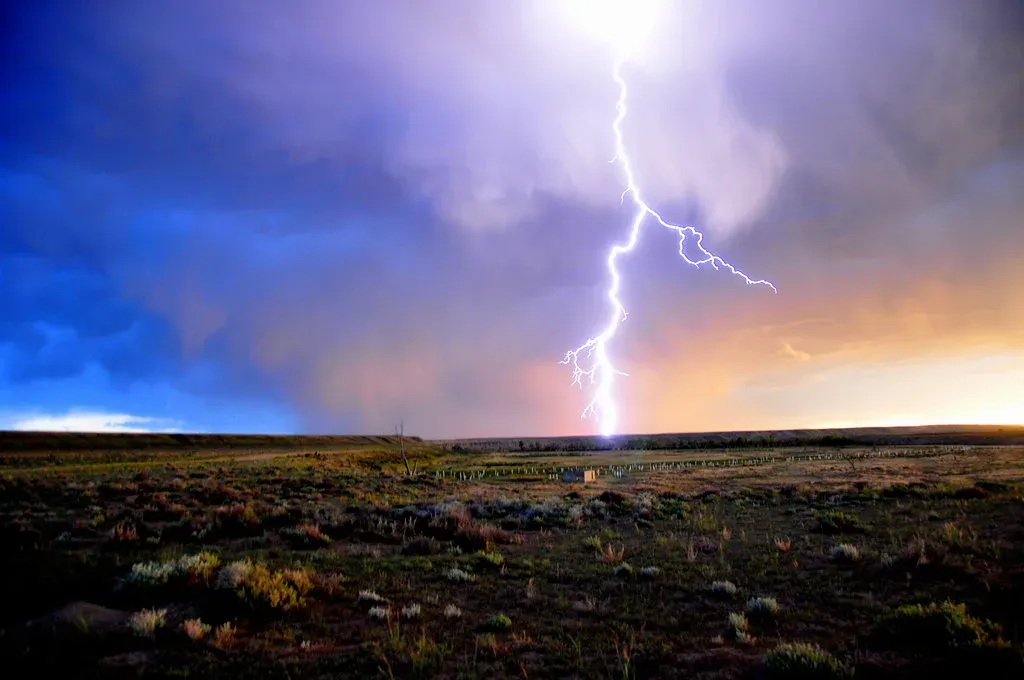
- Bright cloud-to-ground lightning bolt striking open sagebrush range under a purple storm sky at Seedskadee National Wildlife Refuge. Photo: Tom Koerner / USFWS Mountain-Prairie, Flickr (source), CC BY 2.0, resized.
- Rough tan fulgurite, a lump of sand fused into glassy rock by lightning, on a black background. Photo: Rama / Wikimedia Commons (source), CC BY-SA 2.0 FR, resized.