Grounding vs Bonding: What Each One Does in a Lightning Protection System
By Site Safe Lightning Protection 6 min read
Grounding connects a system to the earth so current has somewhere to go. Bonding connects metal objects to each other so they sit at the same voltage. In a lightning protection system you need both. Grounding gets the strike into the soil, and bonding stops it from jumping between metal parts of the building on the way down.
Most explanations of grounding vs bonding are written for electricians thinking about fault current in a panel. Lightning is a different load. A strike can exceed 300,000 amps according to UL’s lightning protection guide, so a small gap between two unbonded metal systems can turn into an arc. This article explains the difference from the lightning side.
Grounding vs bonding: the short definitions
UL’s Lightning Protection Marking and Application Guide uses these definitions:
- Grounded: “Connected to earth, or to a conductive material that is connected to earth, so that electric charges are distributed freely to the earth.”
- Bonding: “An electrical connection between an electrically conductive object and a component of a lightning protection system … that is intended to significantly reduce potential differences created by lightning currents.”
Put simply, grounding is about the connection to the dirt. Bonding is about the connections between metal things, so that none of them sits at a very different voltage from its neighbor while the strike passes.
Comparison table
| Grounding | Bonding | |
|---|---|---|
| Job | Moves lightning current into the earth | Equalizes voltage between metal systems |
| Hardware | Ground rods, ground ring, ground plates, radials, concrete-encased electrodes | Bonding conductors and listed fittings between the lightning protection system and pipes, wiring grounds, gutters, HVAC units, antennas |
| Where it happens | At and below grade | Throughout the building: roof, walls, service entrances, below grade |
| What goes wrong without it | Current has no good path out, so it looks for one through the building | Side flash: an arc between a lightning conductor and nearby metal |
| Key references | NFPA 780 and UL 96A grounding electrode requirements; NEC Article 250 for the electrical service | NFPA 780 and UL 96A bonding and common-grounding requirements; NEC Articles 250, 800 and 810 for service, communications and antenna grounds |
Why bonding matters so much in lightning protection
When lightning current runs down a conductor, the conductor’s voltage rises very high for a moment. A metal water pipe, a cable TV line or an HVAC unit a few feet away stays near ground potential if it isn’t connected to the system. That voltage difference across a short gap of air or wood is what makes a side flash.
The National Weather Service puts it plainly in its homeowner guidance: system components must be “properly connected (bonded) to minimize the chances for any sparks or side flashes.” The Lightning Protection Institute says the same thing in its overview. Bonding is what prevents sideflashing between independently grounded systems, because it creates a common ground potential throughout the structure.
A good system doesn’t try to keep lightning away from the building’s metal. It ties the building’s metal into the system so everything rises and falls together.
What gets bonded to a lightning protection system
UL’s guide lists the systems that must be bonded to the lightning protection ground using main-size conductor:
- The electrical service grounding electrode system
- The communications system ground
- Any antenna system ground
- Underground metallic piping: water service, gas piping, underground conduits, LP-gas piping
- Well casings within 25 feet of the structure
UL notes that the connection to a utility gas line has to be on the customer’s side of the meter.
On the roof and walls, the National Weather Service facility standard (NWSM 30-4106) gives a practical list of metal bodies that can take a direct strike and need to be tied in: exhaust pipes, exhaust fans, metal cooling towers, HVAC units, ladders, railings, antennas and large louvers. Gutters, downspouts, satellite dishes and solar racking come up on homes and shops for the same reason.
The LPI model specification adds one more rule. Grounded metal bodies located within the calculated bonding distance, worked out from the formulas in the standards, must be bonded with properly sized bonding conductors. That calculation is why an installer can tell you one vent stack needs a bond and another one across the roof doesn’t.
Conductor sizes for bonding
Bonding conductors aren’t ordinary house wire. UL’s guide gives these minimums for structures up to 75 feet tall (Class I):
| Conductor | Copper | Aluminum |
|---|---|---|
| Main conductor | 57,400 circular mils (187 lb per 1,000 ft) | 98,600 circular mils (95 lb per 1,000 ft) |
| Secondary or bonding conductor | 26,240 circular mils | 41,100 circular mils |
Two rules from the same guide often surprise people. The conductor that bonds the lightning protection ground to the electrical service, water and gas is sized like the main down conductor, not like a small bonding jumper. And on Class II buildings (over 75 feet), main conductors step up to 115,000 circular mils copper or 192,000 circular mils aluminum.
Grounding: getting the current into the earth
Grounding is the part people picture: rods at the corners of the building. In a lightning protection system, each down conductor ends at its own grounding electrode, and every structure has at least two down conductors (LPI specification). UL’s guide sets the minimum ground rod at ½ inch diameter and 8 feet long, extending at least 10 feet into the earth and below the frost line where possible. It allows ground rings, plates, radials and concrete-encased electrodes where the soil calls for them.
Penn State’s solar engineering course makes a point that applies to any building. A lightning protection system has its own grounding electrode system, separate from an equipment grounding conductor sized for fault current. The two are then bonded together, so the building doesn’t end up with grounds at different potentials.
Our companion article, grounding a house for lightning, covers electrode types and soil.
Common bonding mistakes to check for
Each of these is worth checking on an existing system:
- A satellite dish or antenna grounded to its own rod, never bonded back to the service or the lightning protection system.
- New solar, a new HVAC unit or a rooftop exhaust fan added years after the system went in, with no bond to the roof conductor.
- A gas line bond on the utility side of the meter.
- A bond run in light-gauge wire instead of main-size conductor.
- Copper conductor clamped directly to aluminum or galvanized metal. UL says copper components can’t be installed on aluminum or external galvanized steel surfaces. A listed bimetallic fitting is needed.
- Loose or painted-over connections. Facility standards hold bonds to very low resistance. The NWS standard calls for bonds to its earth electrode system of no more than 1 milliohm each, so a corroded clamp matters.
For oil and gas sites, where bonding also controls static and vapor ignition, see the role of grounding systems in oil and gas lightning protection.
Getting a system checked
Site Safe Lightning Protection installs and inspects lightning protection systems on homes, commercial buildings and oil and gas facilities. If you’ve added equipment to a roof, run new utilities, or aren’t sure whether your building’s grounds are bonded together, contact Site Safe Lightning Protection to arrange a look. More detail is on our residential and commercial service pages.
Talk to Site Safe Lightning Protection about your property.
Frequently asked questions
What is the difference between grounding and bonding?
Grounding connects a system to the earth so current can dissipate. Bonding connects metal objects to each other so they stay at the same voltage. In lightning protection, grounding gets the strike into the soil and bonding prevents arcing between metal systems along the way.
Can you have bonding without grounding?
Physically, yes. You can tie metal objects together without connecting them to earth. A lightning protection system needs both, because the bonded metal has to be tied to a grounding electrode system that can carry the current away.
What is equipotential bonding?
Connecting all the conductive systems in a building (the electrical ground, water and gas piping, communications grounds and structural metal) so they rise and fall in voltage together. With no large voltage difference between them, current has no reason to jump.
Does my lightning protection system need to be bonded to my electrical ground?
Yes. UL's guide requires the lightning protection grounding system to be bonded to the electrical service grounding electrode system, communications and antenna grounds, and underground metallic piping, using main-size conductor.
What is a side flash?
An arc that jumps from a conductor carrying lightning current to a nearby metal object or person that isn't bonded to it. Proper bonding is the main defense against side flash inside and around a building.
Sources
- Lightning Protection Marking and Application Guide (UL, 2016)
- Lightning Protection Systems Specification (Lightning Protection Institute)
- Lightning Protection Overview (Lightning Protection Institute)
- NWSM 30-4106 Lightning Protection, Grounding, Bonding, Shielding, and Surge Protection Requirements (National Weather Service, 2017)
- Lightning Rods and Lightning Protection Systems (National Weather Service)
- Grounding and Lightning, AE 868 (Penn State)
Image credits
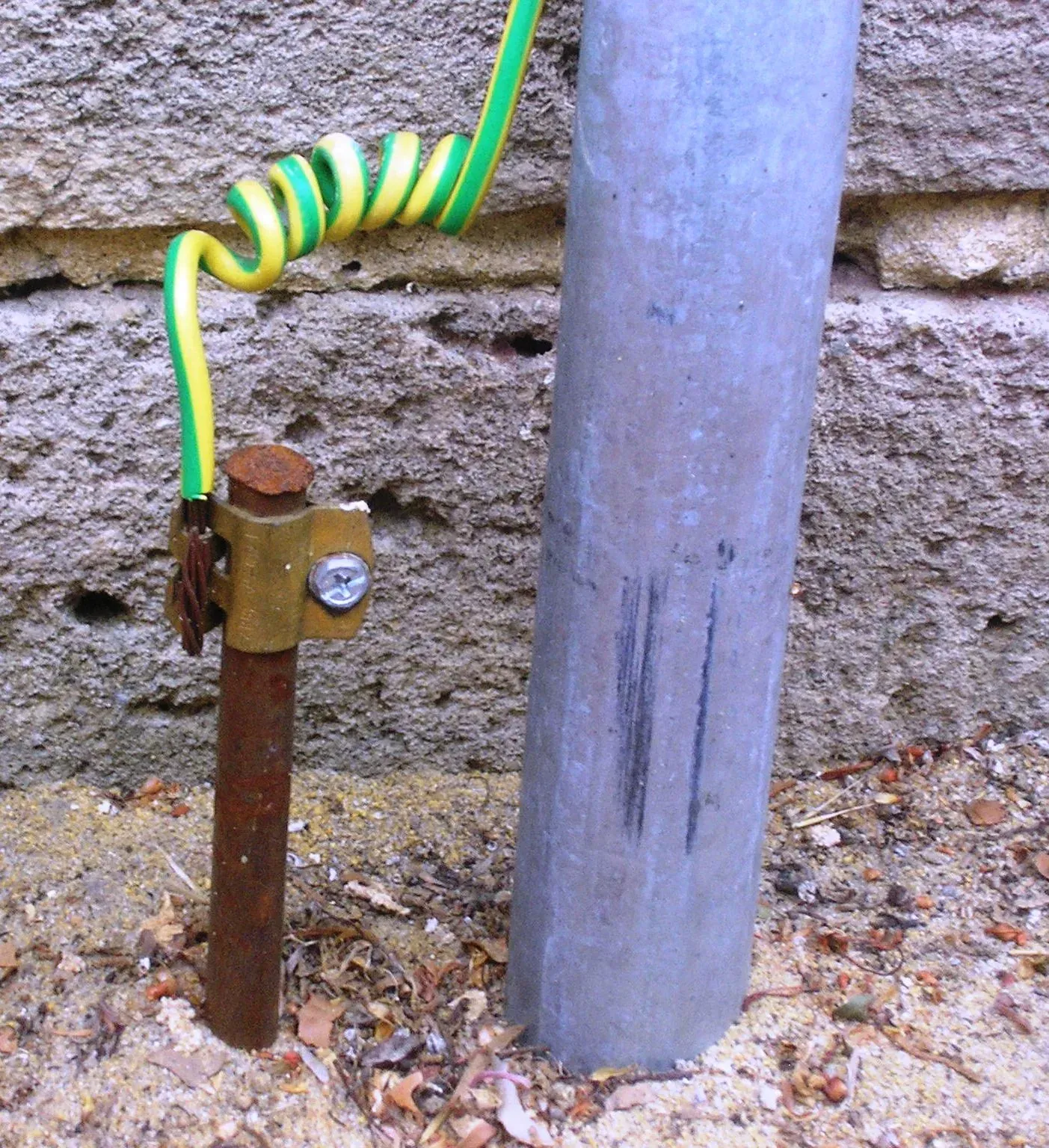
- Residential ground rod with a clamp and green-yellow grounding conductor beside a house wall. Photo: Ali K / Wikimedia Commons (source), CC BY-SA 3.0, resized.