Does Lightning Strike the Same Place Twice? What It Means for Your Building
By Site Safe Lightning Protection 6 min read
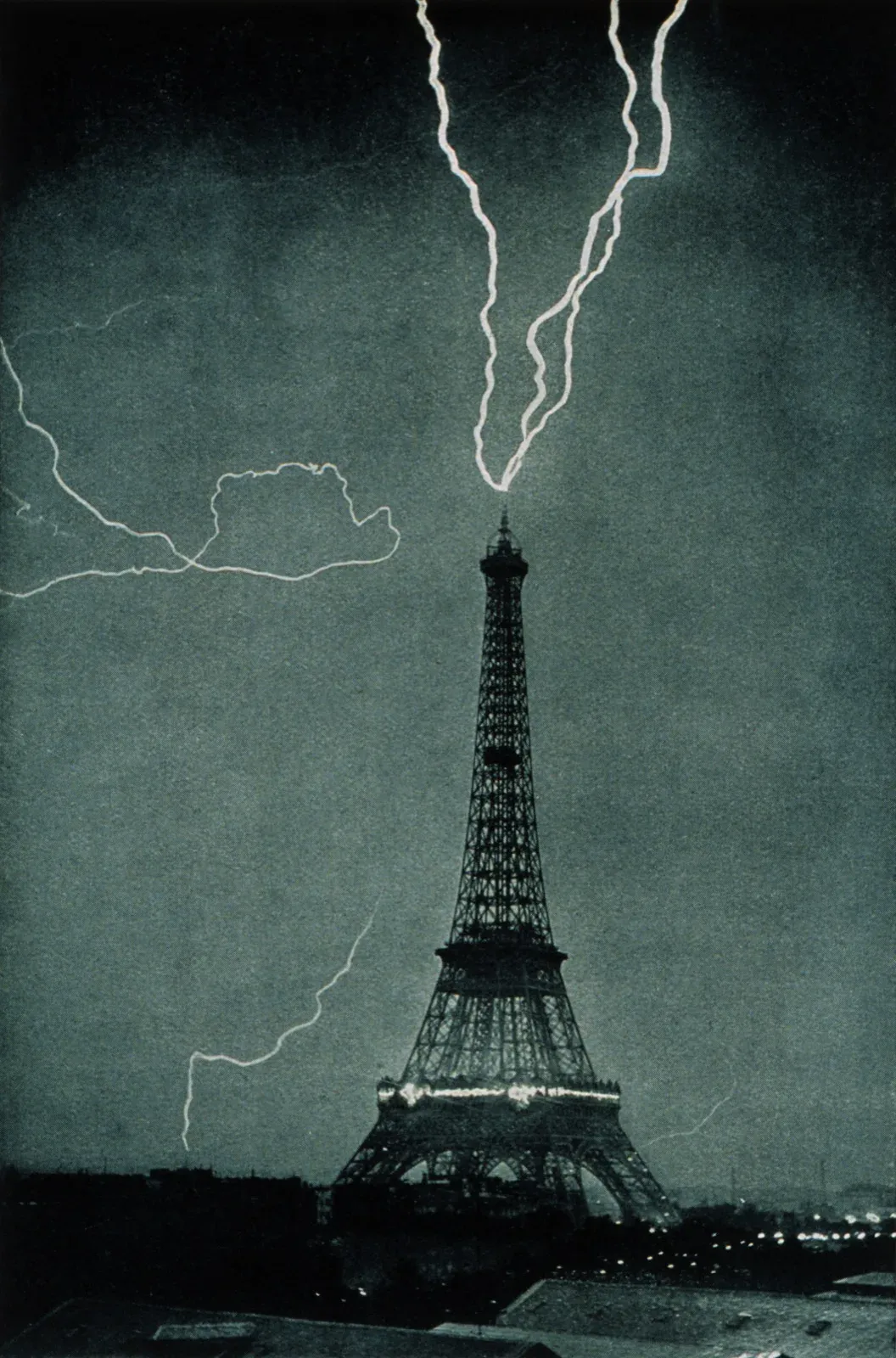
Yes. Lightning often strikes the same place more than once, and tall, pointed, isolated objects get hit over and over. The National Weather Service says the Empire State Building is hit an average of 23 times a year (NWS). The old saying is wrong for towers and steeples, and for a ranch house on an open rise too.
For a property owner, the practical point is simple. A building that has been struck has shown it’s a likely target, and the features that drew the first strike are still there.
Why lightning keeps hitting the same spots
Lightning doesn’t pick a target from the cloud. A faint channel called a leader works its way down. When it gets close, objects on the ground send up their own small channels, and the first one to connect decides where the strike lands. NOAA’s National Severe Storms Laboratory says taller objects are more likely than shorter ones to produce that upward channel, which is why lightning usually, though not always, strikes the tallest object (NSSL).
The NWS names three factors that control where a bolt strikes: height, a pointed shape and isolation. It also says the presence of metal makes no difference to where lightning strikes, though metal will conduct the current once it arrives (NWS).
None of those factors change after a strike. A lone barn in a hayfield is still the tallest thing for half a mile when the next storm comes through, so it faces the same odds it faced the first time.
NSSL adds one more mechanism that only applies to tall structures. Natural lightning can trigger upward discharges from tall towers such as broadcast antennas, so a very tall structure can set off a flash itself (NSSL).
The Empire State Building: 23 or 25 times a year?
You’ll see two numbers for the Empire State Building. The NWS lightning myths page says an average of 23 strikes a year. A NOAA story on the same myth says about 25 (NOAA). Both are federal sources, and the gap is small. Strike counts swing from year to year with the storm season, so treat either figure as an average.
What matters is the scale: a tall structure in a city with regular thunderstorms takes dozens of strikes a year, year after year.
One flash can hit several places at once
Short answers to this question usually leave out that a single lightning flash often touches the ground in more than one spot.
In 1997, University of Arizona researchers William Valine and Philip Krider filmed 386 cloud-to-ground flashes near Tucson with two video systems and went through the tapes frame by frame. They found that 136 of those flashes, about 35%, struck the ground in two or more places separated by tens of meters or more. The 386 flashes produced 558 separate strike points, an average of 1.45 per flash (University of Arizona via Newswise).
The study, published in the Journal of Geophysical Research, added a few details:
- 67% of the new strike points came from the second stroke of the flash.
- Krider said the chance of being struck is about 45% higher than flash counts alone suggest.
- The researchers suggested multiplying the national detection network’s flash counts by about 1.5 to estimate the real number of strike points.
The NWS backs this up. Its myths page says forked or multiple attachment points have been verified in at least half of negative flashes and more than 70% of positive flashes (NWS).
At building scale, “the same place” can mean two corners of one roof, or a barn and the house 100 feet away, struck by the same flash a fraction of a second apart. Covering only one high point leaves the rest of the roof exposed.
What this means for a building that’s already been struck
If your property has been hit once, the strike tells you something about the site. These features usually explain a repeat target:
| Feature | Why it matters |
|---|---|
| Height above nearby structures and trees | Taller objects are more likely to send up the connecting channel (NSSL) |
| Isolation, such as open land, a hilltop or the edge of a field | Nothing nearby competes to take the strike (NWS) |
| Pointed or tall roof features: steeples, chimneys, cupolas, masts | Shape is one of the three controlling factors (NWS) |
| Large footprint | A wider roof gives a multi-point flash more places to land |
NFPA 780’s risk method works the same way. As summarized in Consulting-Specifying Engineer, it estimates how often a structure will be struck from the local flash density, the structure’s collection area and an environmental coefficient. That coefficient runs from 0.25 to 2.0 and accounts for the building’s height and its closeness to other tall structures. The worked example in the article looks at surrounding structures within three times the building’s height (CSE). A tall, isolated building scores higher on every part of that calculation. Our article on lightning risk assessment walks through how the method decides whether a system is recommended.
Colorado, Texas and Oklahoma
The NWS office in Pueblo reports that about 500,000 lightning flashes strike the ground in Colorado in an average year, and that the state averaged 4.8 cloud-to-ground flashes per square kilometer from 2009 to 2018. Colorado ranked 3rd in the nation for lightning fatalities from 2006 through 2024, and El Paso County has the most lightning casualties in the state (NWS Pueblo).
Ranch buildings on the plains, homes on Front Range ridgelines and tank batteries in open country are tall and isolated compared with what surrounds them. Rural sites in Texas and Oklahoma stand out from their surroundings in the same way.
After a strike: what to check
If your building has been hit, run through this before the next storm season:
- Check for damage you can’t see from the yard. Attic framing, wiring and electronics are common places for hidden damage. Our guide to signs your house was struck by lightning lists what to look for room by room.
- Write down where the strike landed, if you know. Burn marks, a split shingle, a damaged chimney cap or a scorched tree all tell you which feature took it.
- Look for a second strike point. With roughly a third of flashes touching ground in more than one place, check other high points on the same building and nearby structures.
- If the building has a lightning protection system, have it inspected. A strike can loosen connections, damage conductors or crack a fitting even when the system did its job.
- If it has no system, get a risk assessment. One strike doesn’t prove a building needs protection, but it’s a strong hint about exposure.
Protection is built for repeat strikes
A lightning protection system doesn’t stop lightning from striking. It gives the strike a planned path: air terminals at the high points, conductors to carry the current and grounding to put it into the earth. Because the system covers every high point on the roof, a flash that lands in two places still lands on metal meant to take it. And it can take strike after strike, as long as it’s maintained and inspected.
Talk to Site Safe Lightning Protection
Site Safe Lightning Protection installs lightning protection systems for homes, commercial buildings and oil and gas facilities, and inspects existing systems. If your property has been struck before, or it stands taller and more alone than anything around it, contact Site Safe Lightning Protection to talk through an assessment. For larger buildings, see our commercial lightning protection services.
Talk to Site Safe Lightning Protection about your property.
Frequently asked questions
Can lightning strike the same place twice?
Yes. The National Weather Service says lightning often strikes the same place repeatedly, especially tall, pointed and isolated objects. The Empire State Building is hit an average of 23 times a year.
Why do people say lightning never strikes the same place twice?
It's a figure of speech for unlikely events, not a statement about weather. Lightning goes where height, shape and isolation favor it, and those don't change after a strike, so the same targets keep getting hit.
Can one lightning bolt strike two places at once?
Yes. A University of Arizona study of 386 flashes found that about 35% struck the ground in two or more places, with an average of 1.45 strike points per flash. The NWS says multiple attachment points occur in at least half of negative flashes.
Is a building that was struck once more likely to be struck again?
The strike doesn't change the odds by itself, but it shows that the building has the features lightning favors. Unless something taller goes up nearby, it stays a likely target.
Does a lightning rod stop lightning from striking twice?
No. A lightning protection system doesn't prevent strikes. It gives each strike a safe path to ground, and a maintained system can handle repeated strikes.
Sources
- National Weather Service: Lightning Myths
- NOAA: 5 striking facts versus myths about lightning you should know
- University of Arizona (via Newswise): Lightning really strikes more than twice in the same place (Valine and Krider, 2003)
- NOAA National Severe Storms Laboratory: Lightning FAQ
- NWS Pueblo: Colorado Lightning Ranking
- Consulting-Specifying Engineer: Lightning Protection: Optional or Recommended? (NFPA 780 risk assessment)
Image credits
- Black and white photo of a lightning bolt striking the top of the Eiffel Tower at night in 1902. Photo: Gabriel Loppé / NOAA Photo Library (Historic NWS Collection) (source), Public domain.