Benjamin Franklin's Lightning Rod: What He Built, What Failed and What Still Holds
By Site Safe Lightning Protection 8 min read
Benjamin Franklin invented the lightning rod. He proposed it in letters written between 1747 and 1750, described a do-it-yourself version in Poor Richard’s Almanack for 1753, and had rods on Philadelphia buildings by the fall of 1752 (Krider, ICHM 2004). His first design was an iron rod a few feet above the roof, a sharpened brass tip and a few staples. After real strikes damaged those early rods, he revised the design in 1762, and that later version is surprisingly close to what UL 96A and the Lightning Protection Institute require today.
When did Benjamin Franklin invent the lightning rod?
The idea came in stages. Franklin started experimenting with electricity around 1746 and reported his results in five letters to Peter Collinson in London between 1747 and 1750. Collinson published them in April 1751 as an 86-page pamphlet, Experiments and Observations on Electricity (Krider).
The fifth letter proposed fixing “upright rods of iron, made sharp as a needle” on the highest parts of houses, churches and ships, with a wire running down the outside of the building into the ground (Krider). The Franklin Institute dates the rod idea to 1750 and describes an iron rod 8 to 10 feet long, sharpened to a point (Franklin Institute).
Proof that lightning is electricity came in 1752:
- May 10, 1752: At Marly-la-Ville near Paris, a retired French dragoon working from Franklin’s instructions drew sparks from an iron rod about 13 m (40 ft) tall, insulated from the ground with wine bottles (Physics Today).
- June 1752: Franklin flew his kite in Philadelphia, after the French test but before he’d heard about it (Franklin Institute; Krider).
- Late summer or fall 1752: Protective rods went up on the spires of the Academy of Philadelphia and the Pennsylvania State House, now Independence Hall (Krider).
Those experimental rods were insulated from the ground on purpose so they could collect charge. A protective rod has to be grounded, and Krider notes that Franklin drew that distinction himself.
Did Benjamin Franklin get struck by lightning?
There’s no record that he was. The Franklin Institute notes that some people believe he wasn’t hurt because he didn’t fly the kite during the worst part of the storm, and that his 21-year-old son William was the only witness. Franklin did shock himself by accident during an earlier lab experiment and described it as a blow through his whole body (Franklin Institute).
Franklin’s first design: the 1753 almanac version
In late 1752 Franklin published “How to secure Houses, &c. from Lightning” in Poor Richard’s Almanack for 1753. His instructions:
- An iron rod long enough to sit 3 or 4 feet in moist ground and stand 6 to 8 feet above the highest part of the building.
- About a foot of brass wire, the thickness of a knitting needle, sharpened to a point and fixed to the top.
- A few small staples to hold the rod to the house.
- On a long house or barn, a rod and point at each end with a wire along the ridge between them.
(Pennsylvania Center for the Book; Krider)
Krider points out that this already has the three parts a modern system has: air terminals, conductors and a grounding system. The first down conductors were iron nail rods several feet long, hooked together like chain links. Fragments of one were found inside the tower stairwell of Independence Hall (Krider).
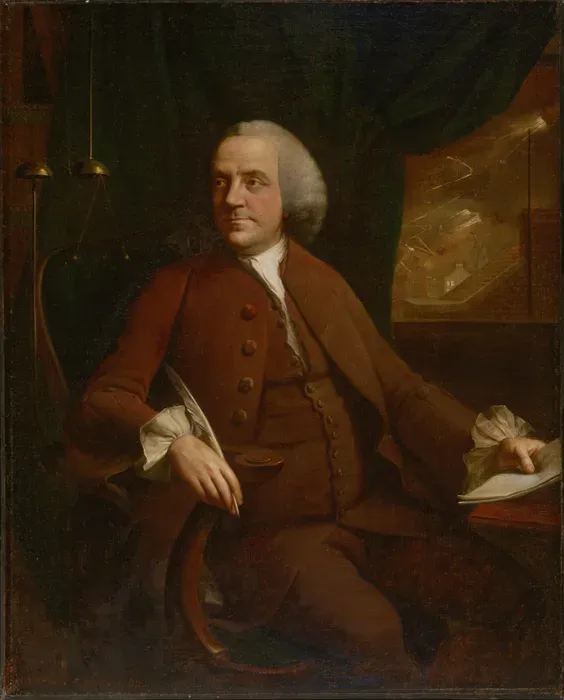
Franklin also put a rod on his own house. He split its conductor with a gap and hung a small ball between two bells, so the bells rang whenever a charged cloud passed overhead. He used that setup to measure the polarity of storm clouds (Krider). Those are the bells in the Chamberlin portrait above.
What went wrong with the early rods
Within a few years, real strikes showed where the almanac design was too light. In March 1761, Ebenezer Kinnersley wrote to Franklin about a strike on William West’s house in Philadelphia, which had a rod much like the almanac version. The strike melted the brass tip from 10 inches down to about 7.5 inches, and current spread across the wet pavement two or three yards from the foot of the conductor. Otherwise, the house was undamaged (Krider).
Two houses in South Carolina came through worse. On one, the points and part of the brass conductor vaporized. On the other, three brass points were destroyed, the hooked links of the iron down conductor came apart, nearly every staple was loosened, and the strike blew cavities in the soil around a ground rod sunk only about 3 feet (Krider). Those houses were saved, but the hardware wasn’t.
Inspectors still find the same failures on old systems: hooked or loose joints, undersized conductors, and grounds that are too shallow or too close to the foundation. Our post on common problems found during lightning protection inspections covers what turns up today.
Franklin’s 1762 rules compared with today’s
In January 1762 Franklin sent revised specifications to the philosopher David Hume. The table compares the almanac version, the 1762 revision and current US requirements.
| Element | Almanac, 1753 | Franklin to Hume, 1762 | Today (UL 96A inspection guide, LPI) |
|---|---|---|---|
| Air terminal | Iron rod 6 to 8 ft above the roof, 1 ft brass needle tip | Steel terminal 5 to 6 ft long, tapered to a sharp point | At least 10 in above the structure |
| Spacing | A point at each end of a long house | A rod at each end of any building over about 100 ft, joined by a conductor | Perimeter terminals no more than 20 ft apart (25 ft with 24 in terminals), no more than 2 ft from the roof edge |
| Conductors | Iron rod, hooked links, a few staples | At least 1/2 in diameter, continuous, joints filled with lead solder | Listed conductors, fastened no more than 3 ft apart, 8 in minimum bend radius |
| Grounding | Rod 3 to 4 ft into moist ground | 1 in iron rod driven 10 to 12 ft, ideally 10 ft from the foundation; a well is best | Ground rods at least 8 ft long and 1/2 in diameter |
| Bonding | Not addressed | Not addressed | All grounding media interconnected: electrical, phone and antenna grounds plus metal water and gas piping |
| Surges | Not addressed | Not addressed | Surge protection devices at every service entrance |
| Materials | Nailer’s rod iron, brass | Iron and steel, painted against rust | Copper or aluminum components listed to UL 96 |
Sources: Krider for 1753 and 1762; UL Marking and Application Guide and the LPI overview for today.
Franklin’s 1762 letter got the big structural ideas right: continuous conductors, heavier metal, deep grounds kept away from the foundation, and a terminal at each end of a long roof. Krider concludes that virtually every lightning protection code in the world still recommends Franklin rods for ordinary structures, with basic elements that are, in essence, his 1762 specifications (Krider).
The two big additions came later. One is bonding, which ties the lightning system to the building’s other metal so a strike can’t arc between them. The other is surge protection for the wiring and electronics that didn’t exist in 1762 (LPI; NWS).
What Franklin got wrong: pointed tips and “drawing off” the cloud
Franklin hoped sharp points would “draw the electrical fire silently out of a cloud” before it could strike (Franklin Institute). That part didn’t hold up. The NWS states plainly that lightning protection systems don’t prevent strikes. They intercept a strike and carry it safely to ground (NWS).
The shape of the tip became a political fight. Franklin favored sharp points, his English critics argued for blunt ones, and King George III had a blunt rod put on his palace (Franklin Institute). Modern field work has gone against Franklin on that too. In tests by Charles B. Moore’s group at New Mexico Tech, rounded rods were struck 13 times while the pointed rods nearby weren’t struck at all (Pennsylvania Center for the Book). Our air terminal guide explains why many new terminals have rounded tips.
Franklin never patented the lightning rod. He believed inventions like this should be shared (Pennsylvania Center for the Book).
Does an old Franklin-style rod still protect a house?
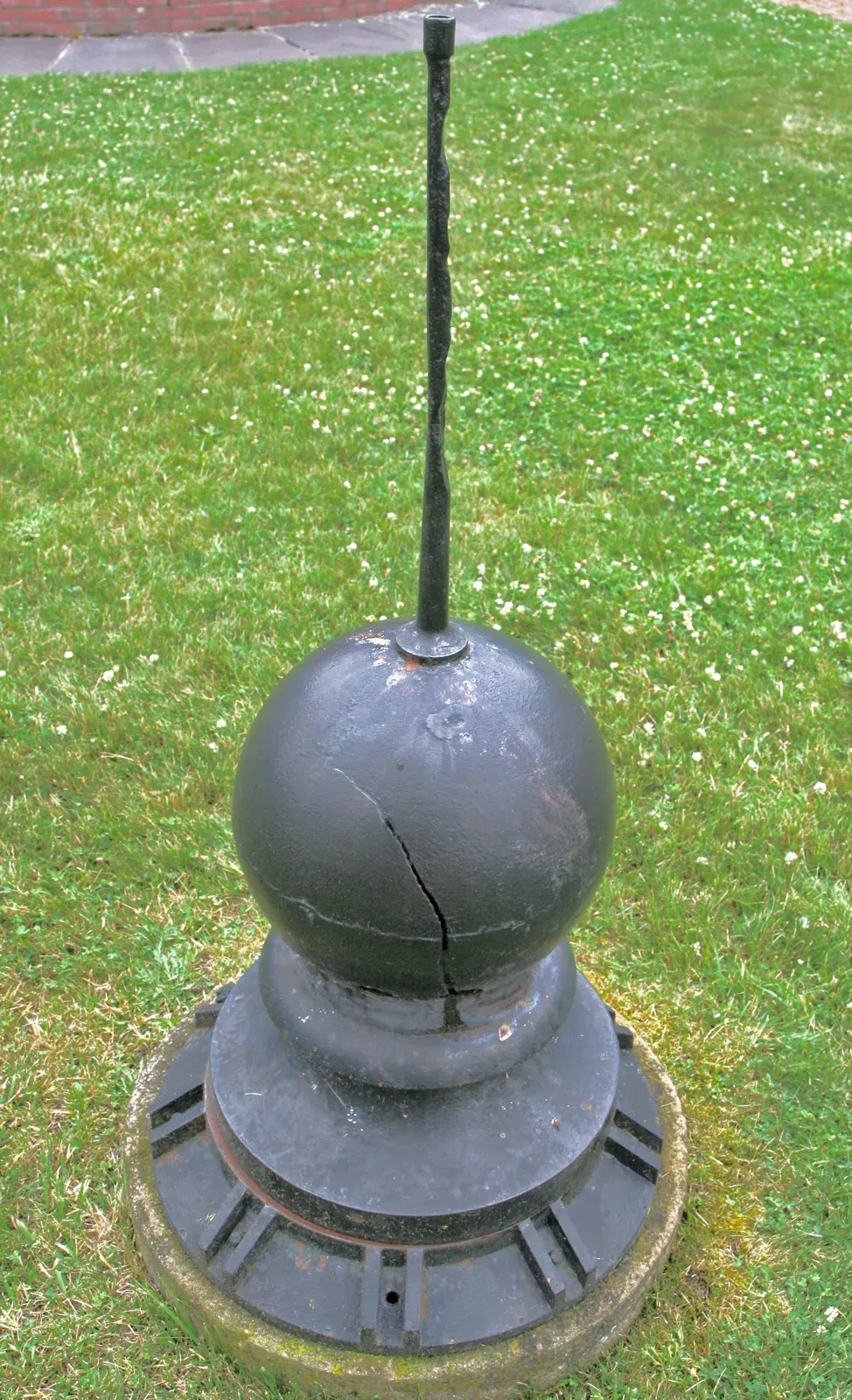
Maybe, if every part is still intact, but you can’t tell from the street. The weak points Franklin found in 1761 are the same ones that fail on century-old systems: corroded or broken conductors, loose joints, shallow or rotted grounds, and no bonding to the plumbing, gas line or electrical service that went in long after the rods did. For more on the decorative glass balls and what they mean, see our post on lightning rod balls. For how a modern system works, read how lightning rods work.
Bringing an old system up to date
Site Safe Lightning Protection installs lightning protection systems on homes, commercial and public buildings, and oil and gas facilities, and inspects and maintains existing systems. If you own an older house or building with antique rods, or you’re not sure what’s left of a system on the roof, contact Site Safe Lightning Protection for an inspection and an honest read on what can stay and what needs replacing. Our residential lightning protection page explains how a modern home system goes together.
Talk to Site Safe Lightning Protection about your property.
Frequently asked questions
Who invented the lightning rod?
Benjamin Franklin. He proposed grounded iron rods in letters written between 1747 and 1750, published in London in 1751, and had protective rods on Philadelphia buildings by the fall of 1752.
When did Benjamin Franklin invent the lightning rod?
He described the idea around 1750. After the Marly-la-Ville experiment (May 1752) and his kite experiment (June 1752), he put rods on buildings in 1752 and published how-to instructions in Poor Richard's Almanack for 1753.
What was Franklin's lightning rod made of?
The almanac version was a nailer's iron rod with about a foot of sharpened brass wire on top, held to the house with staples and driven 3 to 4 feet into moist ground. By 1762 he called for steel terminals, conductors at least 1/2 in thick and an iron ground rod 10 to 12 feet deep.
Do lightning rods still use Franklin's design?
The basic idea is the same: terminals on the high points, continuous conductors and deep grounds. Modern systems add listed copper or aluminum parts, closer terminal spacing, bonding to the building's other metal systems and surge protection, and they don't depend on sharp tips.
Did Franklin's lightning rod work?
Yes. Early reports from Philadelphia and South Carolina showed rods taking strikes that would otherwise have hit the houses. Some tips and conductors were destroyed in the process, which led Franklin to call for heavier conductors and deeper grounds in 1762.
Sources
- E. Philip Krider, Benjamin Franklin and the First Lightning Conductors, Proceedings of the International Commission on History of Meteorology 1.1 (2004)
- E. Philip Krider, Benjamin Franklin and lightning rods, Physics Today (2006)
- The Franklin Institute: Franklin's Lightning Rod (archived 2026)
- Pennsylvania Center for the Book (Penn State): The Lightning Rod, A Not-So-Shocking Invention
- UL: Lightning Protection Marking and Application Guide
- Lightning Protection Institute: Lightning Protection Overview
- National Weather Service: Lightning Rods
Image credits
- 1762 portrait of Benjamin Franklin with his lightning bells and a house rod being struck in the window behind him. Photo: Mason Chamberlin, Philadelphia Museum of Art / Wikimedia Commons (source), Public domain.
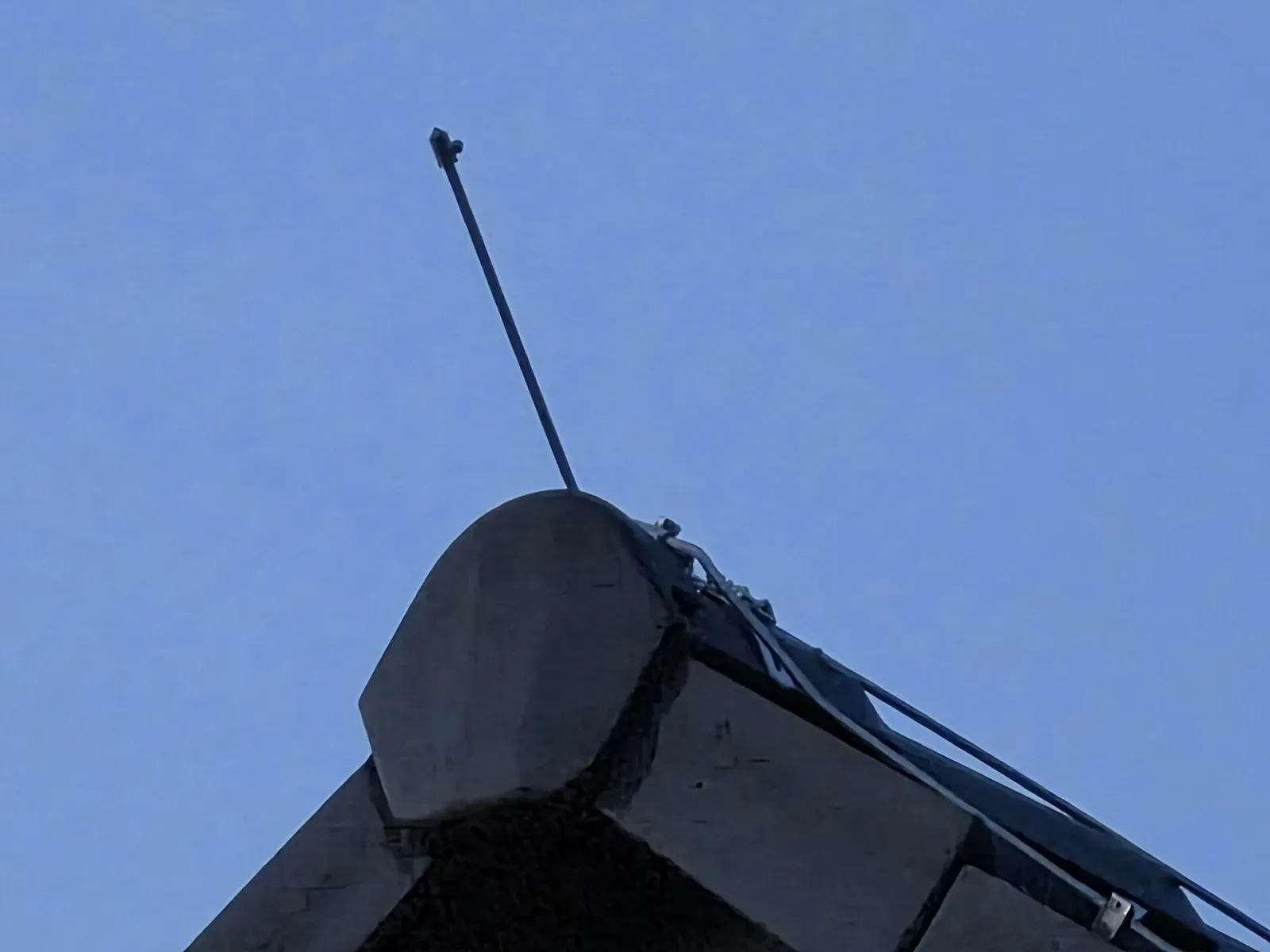
- Cast-iron lightning ball from the 1856 Gay Head Light topped with a straight Franklin-style lightning rod. Photo: William Waterway / Wikimedia Commons (source), CC BY-SA 3.0, resized.