Lightning Arrester vs Lightning Rod: What an Arrester Does and Where It Goes
By Site Safe Lightning Protection 8 min read
A lightning arrester is a device wired between a power or signal line and ground. At normal voltage it does nothing. When lightning, or a switching event on the grid, pushes a surge down the line, the arrester conducts and sends that current to earth before it reaches wiring and equipment. It protects the electrical system. It doesn’t protect the building from a direct strike; that’s the job of a lightning rod system. On the low-voltage wiring inside homes and commercial buildings, US codes and UL now call the device a surge protective device, or SPD.
A “lightning arrester for my home” usually means a listed SPD at the electrical service, protectors on the phone, cable and antenna lines, and good bonding between them.
Lightning arrester vs lightning rod
People mix them up because both deal with lightning and both end at a ground connection, but each protects something different.
| Lightning rod system | Lightning arrester (SPD) | |
|---|---|---|
| What it protects | The structure: roof, framing, masonry, people inside | Wiring and the equipment plugged into it |
| What it handles | A direct strike to the building | Surges that arrive on power, phone, cable, data or antenna lines |
| Where it sits | Air terminals on the roof, conductors, ground rods | Utility pole, meter, service panel, line entry points, outlets |
| US standards | NFPA 780, UL 96A, UL 96 for components | UL 1449 for SPDs, NEC (NFPA 70) for installation |
NIST’s homeowner guide on surges puts it plainly: lightning rods protect the structure and help prevent fires, but they don’t prevent surges in the wiring (NIST). A complete system needs both. LPI says surge protection devices have to be installed at every service entrance to stop lightning coming in on utility lines (LPI).
Surge arrester, lightning arrester, SPD: what the names mean
“Lightning arrester” is the old trade name. You’ll still see it on antenna grounding blocks and electric-fence products, and utilities call theirs “surge arresters.”
On wiring under 1,000 volts, UL stopped using the terms “TVSS” and “secondary surge arrester” in September 2009. Since then the device is an SPD, sorted into numbered Types by where it’s installed, with Types 1, 2 and 3 for complete devices (ABB SPD FAQ). The National Electrical Code follows the same split: surge arresters for systems over 1 kV in Article 280, and SPDs for 1 kV or less in Article 285. The 2020 NEC moved both into a new Article 242, “Overvoltage Protection,” with SPDs in Part II and surge arresters over 1 kV in Part III (EC&M, 2020 NEC changes). Older editions still in force in some places use 280 and 285.
NIST’s guide points out that the devices divert a surge to ground. Nothing in them stops or “arrests” it.
How a lightning arrester works
Inside, an arrester is a voltage-sensitive part that is close to an open circuit at normal voltage and close to a short circuit during a surge. Common parts are metal oxide varistors (MOVs), gas discharge tubes and spark gaps. Large utility arresters are porcelain housings filled with zinc oxide discs (Wikipedia).
An SPD is wired in parallel with the equipment it protects. Once the voltage passes its rating it starts to clamp, conducts the surge to the grounding system, then opens again when the surge is over, without tripping the breaker upstream (ABB SPD FAQ).
The ground path matters as much as the device. ABB calls lead length the most important factor in SPD installation: the shorter the wires to the SPD, the better it performs.
Where lightning arresters go
Surges come in on every conductor that runs outside. The NWS lists three ways lightning gets into a structure: a direct strike, through wires or pipes that run outside, and through the ground. Once inside it travels on electrical, phone, plumbing and radio/TV reception systems (NWS). Each of those entry points can need its own protector.
| Location | Device | Who installs it |
|---|---|---|
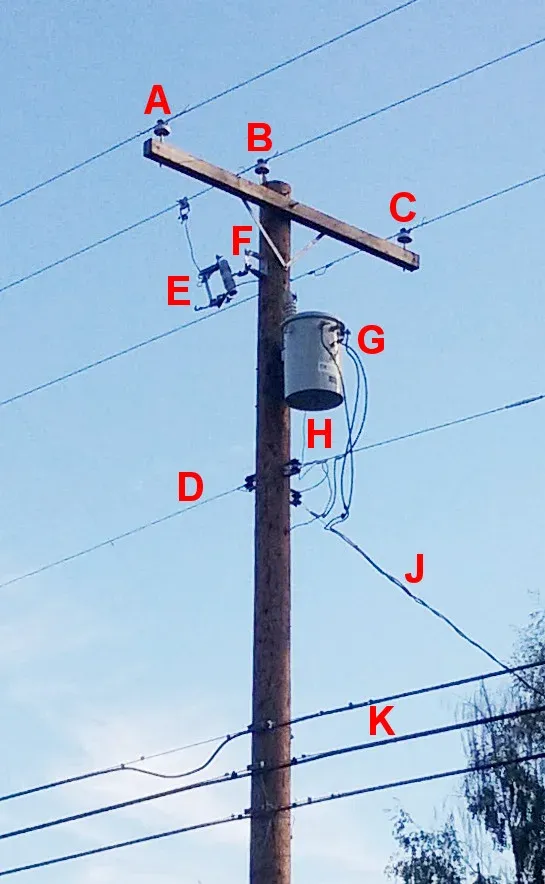
| Utility pole or pad-mount transformer | Distribution surge arrester | The utility |
| Meter base or line side of the main breaker | Type 1 SPD | Licensed electrician, sometimes the utility |
| Main panel, load side | Type 2 SPD | Licensed electrician |
| Outlet or equipment, 30 ft or more of wire from the panel | Type 3 SPD (plug-in strip or receptacle) | Owner |
| Phone line entry | Primary protector in the network interface device | Phone company |
| TV antenna, dish or cable entry | Listed antenna discharge unit or coax grounding block | Installer or electrician |
| Circuit leaving the house to a well pump or outbuilding | SPD where the line leaves the building | Licensed electrician |
SPD Types are defined in UL 1449 (UL 1449 overview, ATIS). The phone, coax and well-pump rows follow NIST’s homeowner guide, which puts an SPD where the pump circuit leaves the house so a surge picked up on that long run stays out.
Do you need a lightning arrester for your home?
For new and replaced electrical services, the code may already require one. Section 230.67 of the 2020 NEC says all services supplying dwelling units must have an SPD. It has to be part of the service equipment or right next to it, it must be Type 1 or Type 2, and the rule applies when service equipment is replaced (Leviton, NEC 230.67 text). An exception allows the SPD at each next level of distribution equipment downstream instead.
Colorado, Texas and Oklahoma adopt the NEC at the state and local level, and editions differ by jurisdiction, so check with your local building department.
A panel SPD won’t save equipment from everything. The NWS warns that typical surge protectors won’t protect equipment from a lightning strike (NWS), which is why the service-entrance device, the bonding and the lightning rod system all work together.
What changes when the building has a lightning protection system
If a building has, or will get, a lightning protection system built to NFPA 780 or UL 96A, the surge protection has to meet a higher bar. According to UL’s overview of those standards:
- SPDs at the service entrance need a nominal discharge current (In) rating of at least 20 kA (8/20 µs) per phase. A UL 1449 Type 1 or Type 2 SPD rated 20 kA meets that.
- Signal, data and communications SPDs at the entrance need a maximum discharge current (Imax) of at least 10 kA (8/20 µs).
- PV surge protectors on solar arrays need an In of 20 kA per mode and must be listed for PV and marked “DC” or “PV SPD” (NFPA 780, 12.4.2.2 and 12.4.2.3).
Those figures are from the UL 1449 overview. ABB notes that 20 kA is the highest In rating UL assigns, and states that a UL 96A system needs a UL-listed SPD with that rating at the service entrance (ABB SPD FAQ). So check the In rating on the label before an inspection; an SPD that meets the NEC may not meet an NFPA 780 design.
Reading an SPD label
Packaging leans on big numbers, and some of them mean little. These are the ratings to read, per UL’s test program (UL 1449 overview) and ABB’s FAQ (ABB SPD FAQ).
| Rating | What it means | What to look for |
|---|---|---|
| Type (1, 2 or 3) | Where it’s allowed to be installed | Type 1 or 2 at the service |
| Nominal discharge current (In) | Peak 8/20 µs current it survives 15 times and still works | 20 kA where a lightning protection system is installed |
| Voltage protection rating (VPR) | Clamping voltage measured with a 6 kV/3 kA combination wave | Lower is better |
| Short circuit current rating (SCCR) | Fault current it can safely interrupt if it fails; not a surge rating | At least the available fault current at the panel (NEC 285.6) |
| Joules | Not recognized as a performance rating by any standards body | Ignore it |
| Response time | Not supported by standards organizations as a specification | Ignore it |
Why one arrester at the panel isn’t the whole job
The damage that surprises owners usually involves equipment connected to two systems at once: a TV on power and cable, a computer on power and a network line, an alarm panel on power and phone. NIST’s guide explains that a surge on one system can raise its voltage relative to the other, and the equipment in between takes the hit even when each line has its own protector. It singles out houses where power and phone or cable enter on opposite ends as the worst arrangement, often made worse when the incoming services aren’t bonded together as the NEC requires.
The fixes are bonding and placement. Bring every service’s protector to one grounding point near where power enters, keep the bonding conductors short and straight, and use combined power-and-coax or power-and-data protectors at sensitive equipment. On a building with a lightning protection system, LPI says every grounded system, including electric, communication and antenna grounds plus metal water and gas piping, must be bonded to the lightning protection grounding system near grade (LPI). We go deeper on that in grounding vs bonding.
A short checklist
- Is there a Type 1 or Type 2 SPD at the service, and does it have a status light you can see?
- If the building has lightning protection, is the service SPD rated In 20 kA, and are the data and coax lines protected at entry?
- Do power, phone, cable and antenna lines enter near the same spot, and are their grounds bonded together?
- Are the SPD leads short, without coils or loops?
- Does a circuit leave the house for a well pump or outbuilding, and is there an SPD where it leaves?
Talk to Site Safe Lightning Protection
Surge protection works best when it’s designed with the rest of the lightning protection system. If you’re planning a system for a home, a commercial building or an oil and gas site, or you want an existing one inspected, contact Site Safe Lightning Protection. See our residential lightning protection services and the plain-English guide to how lightning rods work. Electrical work on the panel itself should be done by a licensed electrician.
Talk to Site Safe Lightning Protection about your property.
Frequently asked questions
What is the difference between a surge protector and a lightning arrester?
They do the same job at different points. "Lightning arrester" is the older name, still used for utility hardware and antenna or fence protectors. On wiring under 1,000 volts, UL now calls the device a surge protective device (SPD). A plug-in surge protector is a Type 3 SPD at the outlet; the protector at the service panel is a Type 1 or Type 2 SPD.
Where should a lightning arrester be placed?
At each point where a conductor enters the building: the electrical service, the phone line, the cable or antenna lead-in and any data line run from outside. The device needs a short, straight connection to the building's grounding system to work.
Can lightning strike a building that has an arrester?
Yes. An arrester doesn't stop or attract strikes. It only limits surges that travel in on wires. Protecting the structure from a direct strike takes a lightning protection system with air terminals, conductors and grounding.
Do I need a lightning arrester for my home?
The 2020 NEC requires a Type 1 or Type 2 SPD on services supplying dwelling units, including when service equipment is replaced. Your local building department can tell you which NEC edition applies where you live. If your home has a lightning protection system, the service SPD should be rated at least 20 kA In.
Sources
- Leviton technical note: 2020 NEC 230.67 Surge Protection (code text)
- DeGregoria (UL LLC): Overview of UL 1449 Surge Protective Devices, incl. NFPA 780/UL 96A SPD ratings (ATIS PEG, 2018)
- ABB: Surge protective devices, frequently asked questions (2019)
- NIST: Surges Happen! How to Protect the Appliances in Your Home (recommended practice guide, public domain, Wikimedia Commons copy)
- National Weather Service: Lightning Safety When Inside
- Lightning Protection Institute: Lightning Protection Overview
- Wikipedia: Lightning arrester
- EC&M: 2020 National Electrical Code Changes (new Article 242)