Lightning Rod Balls: What the Glass Globes Mean and Whether Old Rods Still Protect
By Site Safe Lightning Protection 5 min read
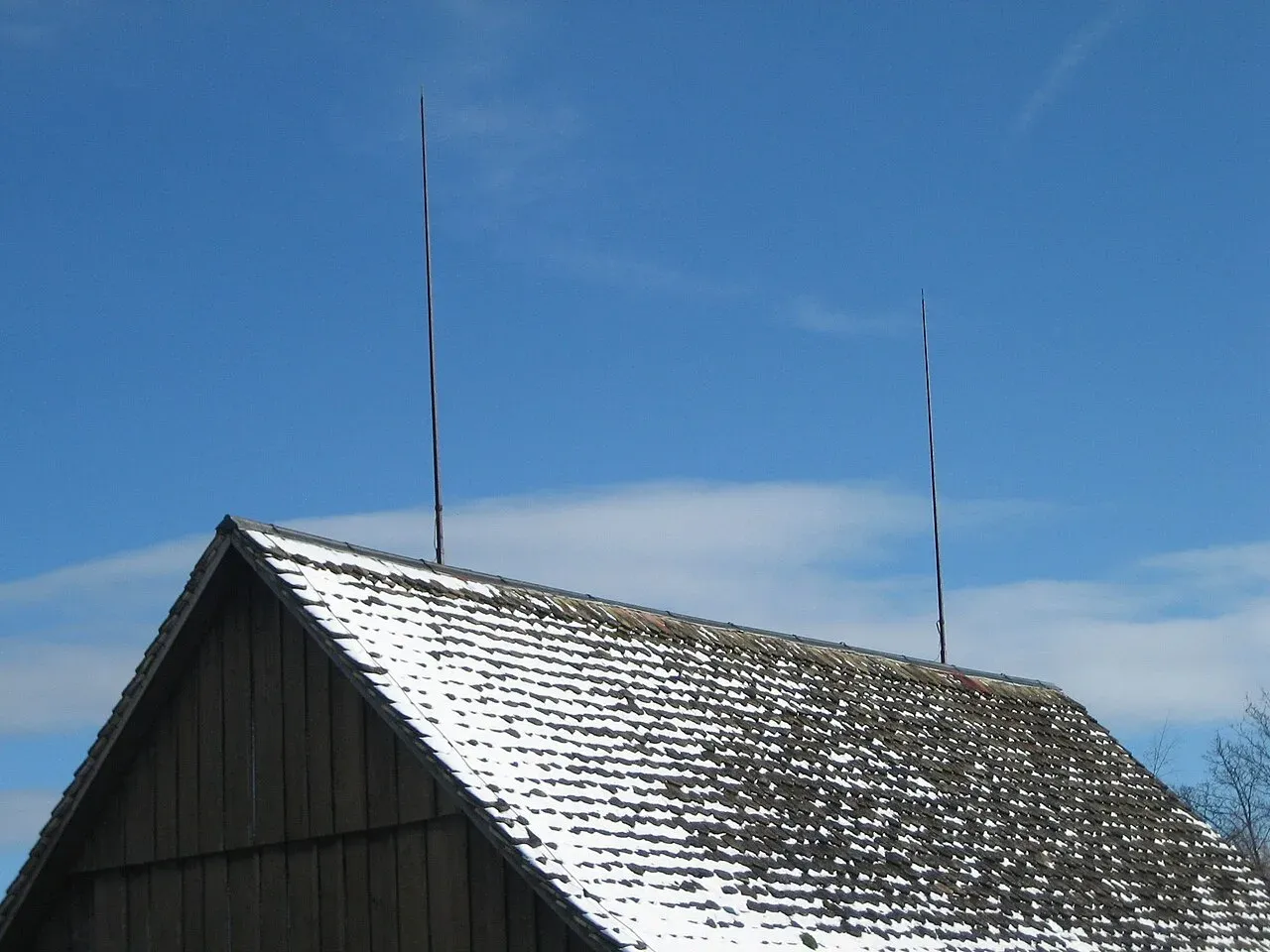
Lightning rod balls are the glass (sometimes ceramic) globes threaded onto old lightning rods on barns and farmhouses. They’re decorative. Collectors prize them, and you’ll find them in a range of shapes and colors. What they can’t tell you is whether the rod system under them still works, and on a building that’s 80 or 100 years old, it often doesn’t.
This article covers where the balls came from, the “broken ball means a strike” story, and how to decide what to keep and what to replace.
A short history
Benjamin Franklin conceived the pointed lightning rod in 1749, according to Wikipedia’s history of the device. By the 19th century, rods had become a decorative feature as well as a practical one.
The glass balls came later. A collector’s write-up at Peachridge Glass, drawing on the Iowa Barn Association and The Complete Book of Lightning Rod Balls by Rod Krupka and Mike Bruner, reports that:
- Some balls were made as early as 1840.
- Salesmen sold them farm to farm from horse-drawn wagons from about 1870 until the Great Depression shut many companies down.
- There are some 34 shapes or styles.
- Most balls were about 4½ in. in diameter.
- Glass balls were typically white or blue milk glass. Clear glass often turned amethyst from sun exposure acting on impurities in the glass.
Many patterns are tied to particular lightning rod companies of the era, which is part of their appeal to collectors.
Did a broken ball mean the barn was struck?
You’ll hear that the ball was there to shatter or fall off when lightning hit, so the farmer would know to check the barn. Wikipedia repeats this, saying their main purpose was to provide evidence of a strike.
Not every source agrees. The same Peachridge page quotes the Iowa Barn Association describing the balls as ornaments that had no practical use. Since sources disagree, treat the “strike indicator” idea as folklore rather than fact.
Either way, the practical point holds. A broken ball might mean a strike, hail, a stray rock or a hundred years of weather. An intact ball tells you nothing about whether the cable is continuous or the ground rod is still in the dirt.
What an antique system usually lacks
Old rod systems were built to their era’s practices, long before today’s NFPA 780. Common gaps:
| Problem | Why it matters |
|---|---|
| Broken or missing cable between rods | Current has no continuous path to ground |
| Cable cut or removed during re-roofing or re-siding | Same as above, often hidden behind new material |
| Corroded or missing ground connections | The strike has nowhere to go but the building |
| A single down conductor | Modern guidance calls for at least two ground connections on most buildings |
| No bonding to wiring, plumbing or metal roofing | A strike can side-flash to nearby metal and start a fire |
| No surge protection | Current enters on power lines, which old systems never addressed |
| Mixed metals with no bimetallic fittings | Corrosion at joints; NFPA 780 requires bimetallic connectors between copper and aluminum (Section 4.3.4.2) |
The National Weather Service says a complete system needs properly bonded components and surge protection on incoming power, data and communication lines. A row of antique rods with one rusted cable doesn’t meet that description.
NFPA 780 isn’t retroactive by default. The 2023 edition says its provisions don’t apply to installations that existed before the standard’s effective date unless specified. So an old system isn’t “illegal.” It just may not protect anything.
Do old lightning rods still work?
Sometimes, partly. The points on the roof are the part you can see. The weak links are usually the parts you can’t easily see: the cable, the connections and the ground. A rod that’s still standing but connected to a broken cable is a strike point with no path down, which is worse than not having it.
The only way to know is an inspection that checks:
- Continuity from every rod to ground.
- The condition of every ground connection, including whether a ground rod is still there.
- Bonding to electrical service, water piping and metal roofing.
- Damage from later roofing, siding, gutters or additions.
On barns specifically, Extension Foundation guidance calls for at least two ground connections for most buildings, using rods driven at least 8 ft into the ground. That’s a quick check against what’s there.
See common problems found during lightning protection inspections for what inspectors typically find.
Keeping the look with a modern system
You don’t have to choose between the look of an old farmhouse and real protection. Manufacturers still sell decorative glass balls and finials as add-ons for air terminals. ECLE, for example, lists glass balls among its decorative products.
NFPA 780 has one rule here. The 2023 edition says an ornament on a freestanding, unbraced air terminal can’t present more than 20 sq in. of wind-resistance area in any plane. A 4½ in. ball has a cross-section of about 15.9 sq in. (π × 2.25²), so a typical ball fits under that limit on an unbraced terminal. Larger ornaments or weathervanes need a different mounting approach.
| Keep (if sound) | Replace or add |
|---|---|
| Antique glass balls, mounted on new listed air terminals | Broken, missing or corroded cable |
| Original rod points, if the designer can integrate them | Ground connections, and add a second ground where there’s only one |
| The general rod layout along the ridge, if it fits current spacing | Bonding to the electrical service, plumbing and metal roof |
| Weathervanes, if incorporated into the system | Surge protection at the electrical service |
Store valuable balls during the work. They’re fragile, and collectors pay for intact ones.
Barns and farmhouses: why it matters
Barns are tall, isolated, full of dry hay and wood, and often far from a hydrant. NFPA’s report Lightning Fires and Lightning Strikes (2010) estimated an average of 50 lightning fires a year in grain or livestock storage buildings and 50 in agricultural properties from 2004 to 2008. A working system on the barn is about more than the antiques on top.
Get your old rods checked
If you own a farmhouse, barn or older home with an antique rod system, contact Site Safe Lightning Protection for an inspection. We’ll tell you what’s working, what isn’t, and how to keep the character of the building while making the protection real. See our residential lightning protection page, read about when to re-inspect a system, or contact us.
Talk to Site Safe Lightning Protection about your property.
Frequently asked questions
What are lightning rod balls for?
They're decorative glass or ceramic globes mounted on lightning rods, sold widely from about 1870 to the Great Depression. Some sources say they were meant to break and show a strike; others say they had no practical use.
Does a broken lightning rod ball mean lightning struck?
Not reliably. A ball can break from hail, weather or impact. Whatever broke it, have the rod system inspected, because the ball tells you nothing about the cable and ground.
Are old lightning rods still effective?
Only if the whole path from rod to ground is intact and bonded. Cables, connections and ground rods are the usual failure points on antique systems. An inspection is the only way to know.
Are lightning rod balls valuable?
Collectors buy and sell them, and value depends on pattern, color and condition. There are some 34 recognized shapes or styles.
Can I put glass balls on a new lightning protection system?
Yes, in most cases. NFPA 780 limits an ornament on a freestanding, unbraced air terminal to 20 sq in. of wind-resistance area in any plane, which a typical 4½ in. ball fits within.
Sources
- Wikipedia: Lightning rod
- Peachridge Glass: Lightning Rod Balls (citing the Iowa Barn Association and The Complete Book of Lightning Rod Balls)
- NFPA 780, Standard for the Installation of Lightning Protection Systems, 2023 edition (NFPA document page, free read-only access)
- National Weather Service: Lightning Rods and Lightning Protection Systems
- Lightning Protection Institute: Lightning Protection Overview
- East Coast Lightning Equipment website (product menu lists glass balls under decorative items)
- Safety, Health and Wellness in Agriculture (Extension Foundation): Lightning Protection Systems
- NFPA: Lightning Fires and Lightning Strikes (Ben Evarts, December 2010)
Image credits
- Two tall lightning rods on the ridge of an old barn roof. Photo: Adrian Michael / Wikimedia Commons (source), CC BY-SA 3.0, resized.