Antenna Lightning Protection: How to Ground a TV Antenna, Dish or Starlink Mast
By Site Safe Lightning Protection 8 min read
Antenna lightning protection comes down to three things. Bond the mast to the building’s grounding electrode system with a conductor of at least 10 AWG copper. Put a listed antenna discharge unit (a grounding block) on every lead-in cable where it enters the house. And tie those grounds to the same point as the electrical service, and to the lightning protection system if the building has one. That’s what Article 810 of the National Electrical Code requires for TV antennas, satellite dishes and amateur radio antennas. It won’t make an antenna survive a direct hit, but it keeps static and nearby-strike surges off the coax and out of the living room.
Can lightning strike a TV antenna?
Yes. An outdoor antenna is often the highest piece of metal on the house, and it has a cable that runs straight to the equipment inside. The NWS lists three ways lightning gets into a home: a direct strike, through wires or pipes that extend outside, and through the ground. Once inside, it travels on the electrical, phone, plumbing and radio/TV reception systems (NWS).
A direct strike to the antenna is the rare case. The common one is a nearby strike that induces a surge on the mast and coax. Wind also builds a static charge on an outdoor antenna and its cable, and that charge can jump across a gap, often through the electronics in a dish’s LNB or the receiver. Grounding drains that charge off (EC&M, Mike Holt). A rooftop antenna in Colorado, Texas or Oklahoma gets plenty of both during storm season; see our notes on the Colorado monsoon season.
What the NEC requires for antenna grounding
Article 810 covers receiving antennas (VHF/UHF TV, AM/FM radio, satellite dishes) and amateur radio stations. Coax beyond the point where it enters the building falls under Article 820 (EC&M, Mike Holt). The rules that matter on a house:
| Item | Requirement | NEC section |
|---|---|---|
| Mast and metal supports | Bonded or grounded per 810.21 | 810.15 |
| Lead-in cable | A listed antenna discharge unit on each lead-in, as close to the entry as practicable, away from combustible material | 810.20 |
| Conductor material | Copper or other corrosion-resistant conductor; insulated or bare; stranded or solid | 810.21(A), (B) |
| Conductor size | Not smaller than 10 AWG copper or 17 AWG copper-clad steel or bronze | 810.21(H) |
| Routing | Securely fastened, protected where it could be damaged, run in as straight a line as practicable | 810.21(C), (D), (E) |
| Where it terminates | The intersystem bonding termination; in older buildings, the nearest accessible grounding electrode system, metal water pipe within 5 ft of entry, service raceway or enclosure, or grounding electrode conductor | 810.21(F) |
| Separate ground rod | Allowed, but it must be bonded to the power grounding electrode system with at least 6 AWG copper | 810.21(J) |
| Connections | Exothermic weld, listed lug, listed pressure connector or listed clamp; buried fittings listed for direct burial | 810.21(K) |
| Service mast | Don’t attach antennas or lead-ins to the electric service mast | 810.12 |
| Clearances | Antennas and lead-ins at least 2 ft from exposed power conductors; lead-ins at least 6 ft from lightning protection system conductors | 810.13, 810.18 |
Sources: the 2020 NEC bonding and grounding text for 810.21 (Mike Holt Enterprises) and the 2017 NEC illustrated text for 810.12 to 810.18 (Mike Holt Enterprises). Section numbers shift between editions, and Colorado, Texas and Oklahoma jurisdictions adopt different editions, so check with your local building department.
Two more rules catch people out. An antenna mast within 5 ft of a swimming pool has to be bonded to the pool’s equipotential bonding grid (680.26(B)(5)) (EC&M, Mike Holt). And the 2017 NEC added an exception: a mast doesn’t need its own grounding under 810.15 if the antenna and mast sit inside a zone of protection defined by a 150 ft radius rolling sphere, the method from NFPA 780 (Mike Holt Enterprises). In practice that means the house already has a lightning protection system that covers the antenna. Our guide to the rolling sphere method shows how that zone is drawn.
How to ground an antenna on a house
On a typical install the work looks like this:
- Bring the coax into the house close to the electrical service, so the grounding run stays short.
- Mount a listed grounding block (antenna discharge unit) at the entry point, outside or just inside.
- Run a 10 AWG copper conductor from the mast clamp, and a jumper from the grounding block, to the intersystem bonding termination at the service. Keep it straight. Mike Holt’s note on 810.21(E) explains why: lightning tends to jump across corners and loops instead of following them.
- Don’t coil extra wire and don’t route the conductor around the gutter and back. Cut it to length.
- Don’t drive an isolated ground rod at the base of the mast and stop there. If you add a rod, bond it to the house electrode system with 6 AWG copper (810.21(J)).
- Use listed clamps and lugs, and direct-burial-rated fittings on anything in the soil.
Satellite dishes often use coax with a 17 AWG copper-clad steel wire molded into the jacket, which the code accepts as the grounding conductor for the dish (EC&M, Mike Holt).
Wiring that touches the electrical service should be done by a licensed electrician where your jurisdiction requires it.
Starlink and other internet dishes
Newer internet dishes don’t always use standard coax, so a regular coax grounding block may not fit the cable. Starlink’s own mounting guide says that in lightning-prone areas an external lightning protection system (lightning rod, ground rod, surge protector) may reduce the product’s susceptibility to lightning, and it recommends unplugging the power supply and disconnecting the antenna cable during storms or when the system sits unused (Starlink pole mount guide).
The mount itself is still a metal antenna support, so bond the pole or mast the same way as any other (810.15). For the cable, ask the dish maker which listed protector it approves for its connector, and fit it where the cable enters the building.
Ham radio towers
Amateur stations carry more exposure: taller masts, more lead-ins, and transmitting equipment. Article 810 Part III adds rules for them. Each lead-in needs a listed discharge unit or another means to drain static unless it’s protected by a grounded continuous metallic shield or the antenna itself is grounded, and the operating grounding conductor can’t be smaller than 14 AWG copper (810.57, 810.58(C)) (EC&M, Mike Holt). The ARRL publishes a three-part series on station lightning protection that goes well past code minimums (ARRL).
When the house also has a lightning protection system
Antenna grounding and lightning protection have to be tied together. LPI’s design overview says all grounding media in or on a structure must be interconnected, including the lightning protection grounding electrodes, the electric, communication and antenna system grounds, and metal water and gas piping. It also says electrical or communication electrodes can’t be used in place of the lightning protection ground electrodes (LPI). One shared, bonded ground means a surge has no reason to arc from the antenna system to the power system inside the walls.
For the equipment end, NFPA 780 asks for signal, data and communications surge protectors at the building entrance with a maximum discharge current of at least 10 kA (8/20 µs), and UL lists protectors for antenna lead-ins under Subject 497E (UL 1449 overview, ATIS).
On the roof, the designer either keeps the antenna inside the system’s zone of protection or brings it into the system. The NEC also keeps antenna lead-ins at least 6 ft from lightning protection conductors (810.18), so the coax and the down conductors shouldn’t share a run down the wall. If you’re adding an antenna or dish to a house that already has lightning rods, tell the installer before the mast goes up. For how the grounds tie together, see grounding vs bonding.
Problems that show up on older antenna installs
- Antenna or lead-in clamped to the electric service mast.
- No grounding block, or one that isn’t connected to anything.
- Ground wire coiled at the bottom, looped around trim, or broken where it was stapled.
- A separate ground rod at the mast that was never bonded to the house electrode.
- Coax entering on the opposite side of the house from the power service, with its ground run to whatever pipe was nearby.
- An abandoned antenna still on the roof with its cable still connected inside.
NIST’s homeowner surge guide flags that last layout, with power and cable or phone entering at opposite ends, as the worst arrangement for equipment damage, often made worse when the services aren’t bonded together as the NEC requires (NIST).
Ask about antennas when you plan lightning protection
An antenna, dish or tower is one of the details a good lightning protection design accounts for on the roof and at the ground. If you’re planning a system for your home or want an existing one inspected, contact Site Safe Lightning Protection and mention any antennas, dishes or towers on the property. Our residential lightning protection services page explains what a home system includes.
Talk to Site Safe Lightning Protection about your property.
Frequently asked questions
Do I need to ground my TV antenna?
Yes, for an outdoor antenna. NEC 810.15 requires the mast and metal supports to be bonded or grounded, and 810.20 requires a listed antenna discharge unit on each lead-in. Indoor antennas aren't covered by those outdoor rules.
What size wire do you use to ground an antenna?
At least 10 AWG copper or 17 AWG copper-clad steel or bronze (NEC 810.21(H)). If you add a separate ground rod, it must be bonded to the house electrode system with at least 6 AWG copper.
Does Starlink need to be grounded?
Starlink's mounting guide recommends external lightning protection in lightning-prone areas and suggests disconnecting the cable during storms. The metal mount is an antenna support, so bond it the same way you'd bond a TV antenna mast, and check with the maker about a listed protector for the cable.
How do I protect my TV from lightning?
Ground the antenna or dish and its coax at the entry point, bond that ground to the electrical service, and use a service-entrance surge protector plus a plug-in protector that covers both power and coax at the TV. None of that protects against a direct strike to the house; that takes a lightning protection system.
Sources
- EC&M (Mike Holt): Article 810, Radio and Television Equipment
- Mike Holt Enterprises: Understanding 2020 NEC Requirements for Bonding and Grounding, 810.21
- Mike Holt Enterprises: 2017 NEC illustrated sample, Article 810 (810.12-810.21, 150 ft rolling sphere exception)
- Starlink: Ground Pole Mount guide (lightning protection notice)
- ARRL: Lightning Protection
- Lightning Protection Institute: Lightning Protection Overview
- DeGregoria (UL LLC): Overview of UL 1449 Surge Protective Devices, incl. NFPA 780/UL 96A SPD ratings (ATIS PEG, 2018)
- National Weather Service: Lightning Safety When Inside
- NIST: Surges Happen! How to Protect the Appliances in Your Home (recommended practice guide, public domain, Wikimedia Commons copy)
Image credits
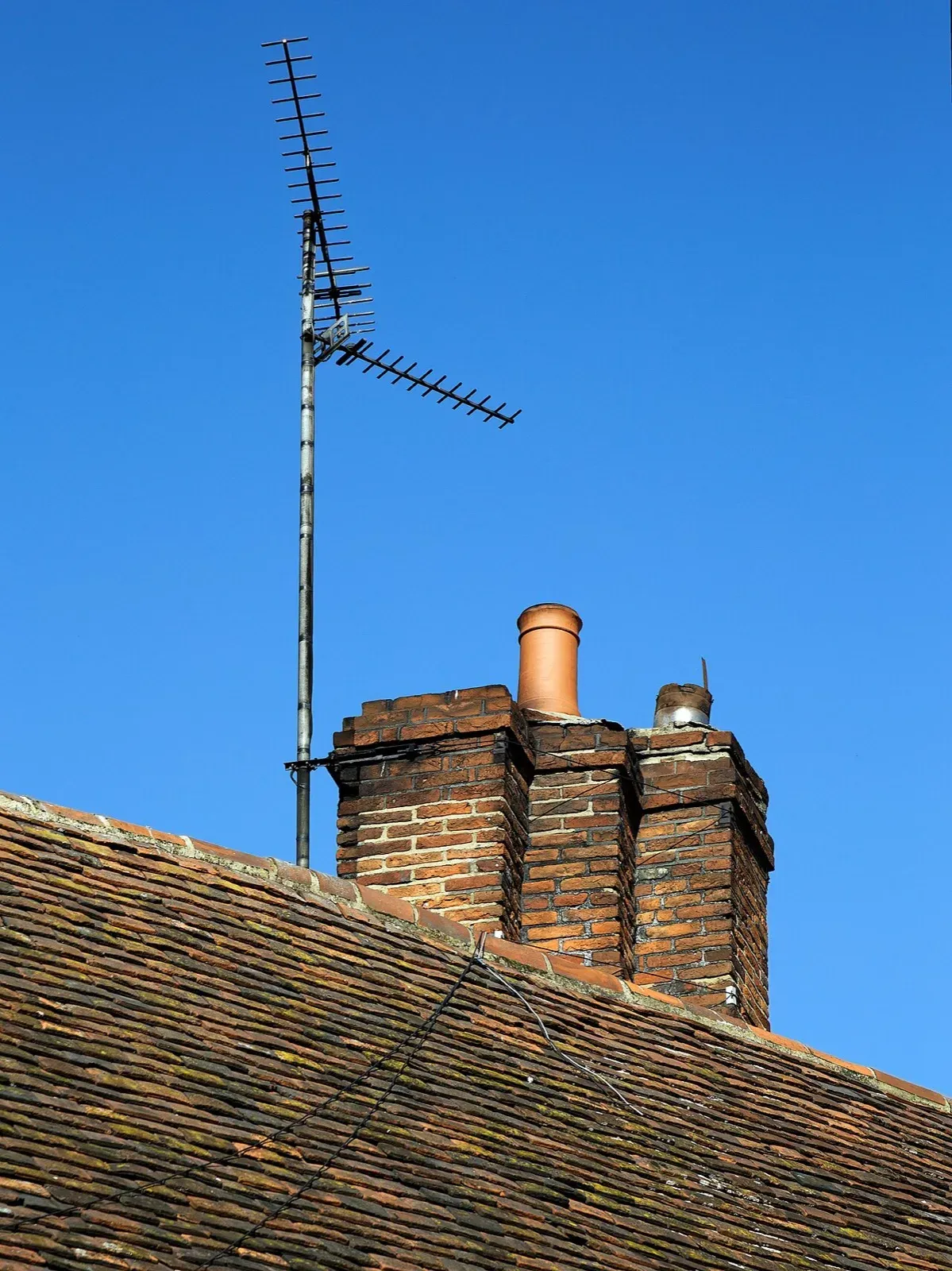
- Rooftop TV antenna on a tall metal mast beside a brick chimney on a tile roof. Photo: Acabashi / Wikimedia Commons (source), CC BY-SA 4.0, resized.