Static Grounding for Tank Trucks, Tanks and Drums: What the Rules Require
By Site Safe Lightning Protection 9 min read
Static grounding is the wire, clamp and earth connection that drains static charge off a tank truck, tank, drum or pipe before the charge can jump as a spark. Liquid picks up charge as it moves through pipes, valves and filters. If the metal it’s flowing into is isolated, that charge has nowhere to go and the voltage climbs until it finds a gap. In a vapor space full of gasoline, solvent or condensate, that gap is where fires start.
For flammable liquids, static grounding is a legal requirement as well as good practice. OSHA’s flammable liquids standard, 29 CFR 1910.106, lists static sparks next to lightning as an ignition source and spells out when trucks, racks and containers must be bonded (29 CFR 1910.106).
How static builds up during a transfer
The Chemical Safety Board (CSB) explains it plainly: static is generated as liquid flows through pipes, valves and filters, and also by entrained water or air, splashing, agitation and sediment stirred up off the tank bottom (CSB Barton case study). Two numbers from the same report matter in the field:
- The rate of charge generation in a pipe rises roughly with the square of the flow velocity. Double the pumping speed and the charging rate goes up about four times.
- A liquid with conductivity below 100 picosiemens per meter (pS/m) is generally treated as nonconductive. Nonconductive liquids hold their charge longer because they “relax” it slowly.
The CSB’s list of common static accumulators that can also form ignitable vapor inside tanks includes VM&P naphtha, cyclohexane, heptane, benzene, toluene, hexane, xylene, ethyl benzene and styrene.
Bonding vs grounding for static
The two words get used as one, but they do different jobs. The CSB defines bonding as electrically connecting conductive objects, such as a tank trailer and the tank it’s filling, so they sit at the same voltage. Grounding connects a conductive object to the earth so static, lightning current and equipment faults go into the ground, away from people and ignitable mixtures (CSB).
On a truck transfer you usually need both. The bond ties truck, hose, pump and tank together so no spark can jump between them. The ground drains the whole connected set to earth. Our post on grounding vs bonding in lightning protection covers the same pair of ideas from the lightning side.
What OSHA 1910.106 requires
OSHA’s rules are scattered through the standard. These are the parts that cover static (29 CFR 1910.106):
| Where | Paragraph | What it says |
|---|---|---|
| Industrial plants | 1910.106(e)(6)(ii) | Category 1 or 2 flammable liquids, or Category 3 with a flashpoint below 100 °F, shall not be dispensed into containers unless nozzle and container are electrically interconnected. A grounded metal floorplate tied to the fill stem, or a bond wire from fill stem to container, satisfies it. |
| Bulk plant loading racks | 1910.106(f)(3)(iv) | Bonding facilities are required where tank vehicles are loaded through open domes with those liquids. |
| Bulk plant container filling | 1910.106(f)(3)(vi) | Same nozzle-to-container interconnection rule as industrial plants. |
| Tank car racks | 1910.106(f)(3)(v) | Protect against stray currents by bonding the pipe to at least one rail and to a metal rack, and bond multiple lines entering the rack together. |
| Processing plants | 1910.106(h)(7)(i)(b) | Same container interconnection rule. |
The loading rack paragraph is the most detailed. The bond is a metallic wire permanently connected to the fill stem or to rack structure in contact with it, with a clamp on the free end that attaches to metal in contact with the cargo tank. The clamp has to go on before dome covers are raised and stay on until filling is done and every dome is closed and secured.
OSHA does not require that rack bond in three cases:
- Vehicles loaded only with products that don’t tend to accumulate static. The rule’s examples are asphalt, most crude oils, residual oils and water-soluble liquids.
- Facilities that handle no Category 1 or 2 liquids and no Category 3 below 100 °F, where the trucks also haul only higher-flashpoint products.
- Loading or unloading through closed top or bottom connections.
The standard also says open-dome filling of a tank that holds, or can form, a flammable vapor-air mixture must use a downspout that reaches near the bottom of the tank, unless the liquid is a nonaccumulator.
The crude oil exemption deserves a careful read on a lease. It covers rack bonding for products that don’t accumulate static, and the rule says “most” crude oils, not all. The CSB’s advice for any flammable liquid is to ask the manufacturer whether it accumulates static and whether it forms explosive vapor inside tanks, and to get conductivity data where you can (CSB).
What resistance should a static ground have?
The standards quoted on Newson Gale’s industry guidance page give two different figures, and they answer two different questions (Newson Gale standards page):
| Figure | Source as quoted | What it means |
|---|---|---|
| 10 ohms or less (copper wire), 25 ohms or less (stainless steel or other metals) | NFPA 77, Annex A.3.3.2 | A bonding path through metal in good condition should read this low |
| Under 10 ohms | IEC TS 60079-32-1, 13.4.1 | Typical resistance of a continuous earth path |
| Up to 1 megohm | IEC TS 60079-32-1, 13.2.2 | Enough to drain static charge, because charging currents are tiny |
Both can be right at once. A megohm will bleed off static, but a metal-to-metal path should never read anywhere near that. Newson Gale quotes NFPA 77 as saying higher resistance in a continuous ground path usually means loose connections or corrosion (Newson Gale FAQ). So crews treat 10 ohms as the pass mark for metal clamps, cables and lugs, and anything higher as a connection to fix.
Some racks use ground verification units that check the connection to the truck before pumping is allowed. Those are products sold by equipment makers, and the standards above give the numbers they check against.
When bonding and grounding weren’t enough: Barton Solvents, 2007
On July 17, 2007, a storage tank exploded at the Barton Solvents facility in Valley Center, Kansas, while it was being filled with VM&P naphtha from a tank trailer. Eleven residents and one firefighter were treated, about 6,000 residents of Valley Center were evacuated, and the tank farm was destroyed (CSB).
According to witnesses, the trailer, pump, piping and tank were all bonded and grounded at the time. The CSB found several things that combined anyway:
- The naphtha measured 3 pS/m, well into nonconductive territory.
- The crew pumped from three trailer compartments with stops between them, which pushed air pockets into the line. Sediment and water were likely in the tank bottom. Both sped up charge buildup.
- The transfer line ran about 215 feet of 2.5-inch pipe at roughly 15 feet per second.
- The tank’s level gauge float had a loose linkage that could separate slightly, interrupting its ground. The CSB concluded it most likely sparked. Testing an exemplar float showed a loose linkage could make a spark strong enough to ignite the vapor.
The CSB’s headline was “Normal Bonding and Grounding May Not Be Enough.” For nonconductive flammable liquids it listed extra precautions: add inert gas to the tank head space, modify or replace loose-linkage level floats, add an anti-static agent, and reduce pumping velocity (CSB investigation page).
A clamp on the truck covers the path from truck to tank. It does nothing for metal inside the tank that has lost its own ground, like the Barton float. The CSB says bubbling from the stop-start pumping likely put slack in the gauge tape, letting the float linkage separate.
Static grounding and lightning protection on the same site
Static and lightning show up together in OSHA’s list of ignition sources, and they share the same earth, but the hardware is sized for very different jobs. A static path only has to drain the tiny charging currents that build up during a transfer (Newson Gale FAQ). A lightning down conductor has to carry a strike that the National Weather Service puts at about 30,000 amps for a typical flash (NWS).
NFPA 77, as quoted by Newson Gale, says a fixed grounding system that is acceptable for power circuits or lightning protection is more than adequate for static grounding. The same quoted passage then says grounding to power grounds or lightning protection systems is not recommended (Newson Gale standards page). In practice, that means a site’s grounding electrode system can serve both. Where the static clamp actually lands is a design decision to check against the current edition with your engineer, and the safer habit is clamping to the equipment, not to a lightning down conductor.
Where the two systems really meet is bonding. The tanks, piping and racks that need static bonds for loading are the same metal bodies a lightning protection design has to bond so a strike doesn’t arc between them. Our guides to tank battery lightning protection and fuel tank lightning protection cover the lightning half of that work.
Static grounding checklist for a loading point
- Clamp on before any hatch opens or any product moves. Clamp off only after the last dome is closed.
- Clamp to bare metal in contact with the cargo tank, as the OSHA rack rule describes.
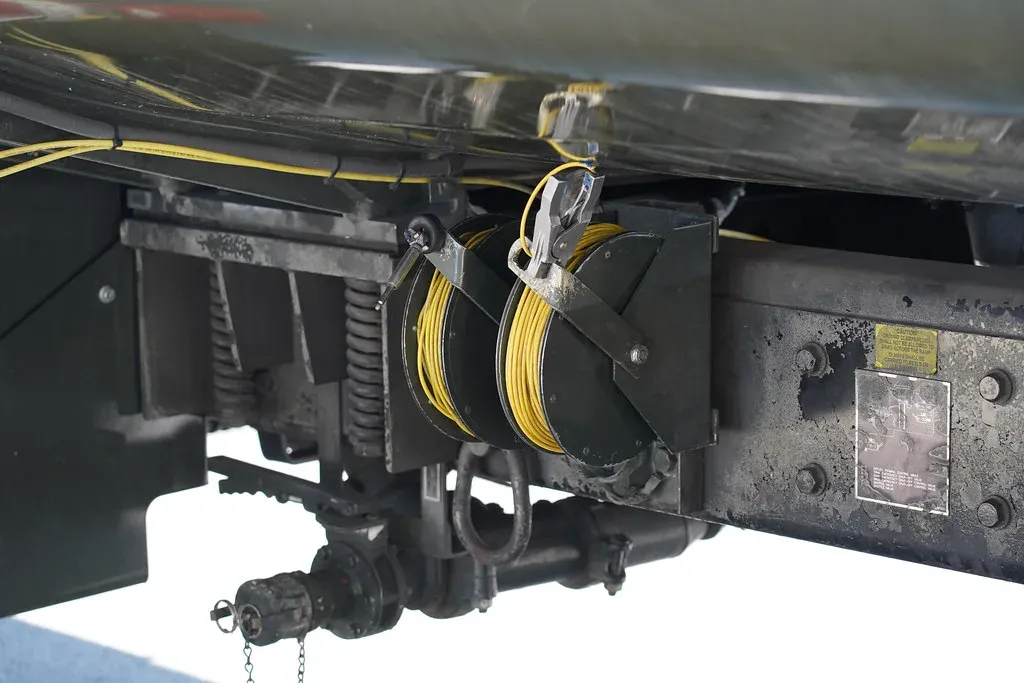
- Check bond cables and reels for broken strands, cracked jackets and worn clamp teeth. Test the path; anything above 10 ohms on metal is a connection to fix.
- Bond truck, hose, pump and tank together, then ground the set.
- Start pumping slowly and avoid stop-start transfers that put air in the line.
- Look inside tanks for loose floats, gauge tapes and anything else that could sit isolated in the vapor space.
- Get conductivity and static-accumulator information from the product supplier, as the CSB recommends.
- Don’t assume the crude oil exemption covers every liquid on site.
Getting the grounding looked at
Static grounding at the loading point is the operator’s daily job. The grounding and bonding underneath it, and the lightning protection over the tanks, are where Site Safe Lightning Protection works: we design, install and inspect lightning protection and grounding for oil and gas facilities, including the bonding of tanks, piping and equipment. If you want a site’s grounding and bonding checked alongside its lightning protection, contact Site Safe Lightning Protection.
Talk to Site Safe Lightning Protection about your property.
Frequently asked questions
What is static grounding?
Connecting a conductive object, such as a tank truck, tank, drum or pipe, to earth so the static charge that builds while liquid flows drains away instead of jumping as a spark. Bonding is the companion step: tying two objects together so there is no voltage difference between them.
What is the difference between bonding and grounding for static?
Bonding connects conductive objects to each other, for example a tank trailer to the tank it is filling. Grounding connects them to the earth. The CSB describes grounding as a way to send accumulated static, lightning and equipment faults into the ground, away from people and ignitable vapor.
What resistance should a static ground have?
NFPA 77, as quoted by Newson Gale, gives a resistance not exceeding 10 ohms for copper wire or 25 ohms for stainless steel or other metals in a bonding path. IEC TS 60079-32-1 says up to 1 megohm is acceptable for static dissipation, but a reading above 10 ohms on an all-metal path should be investigated because it usually means a loose or corroded connection.
Can a static ground use the lightning protection ground?
The earth itself is shared. NFPA 77, as quoted by Newson Gale, says a fixed grounding system acceptable for power or lightning protection is more than adequate for static, and in the same passage says grounding to power grounds or lightning protection systems is not recommended. Read the current edition with your engineer before tying static grounds into a down conductor.
Does OSHA require static grounding?
Yes, for flammable liquids. 29 CFR 1910.106 says Category 1 and 2 flammable liquids, and Category 3 with a flashpoint below 100 °F, may not be dispensed into containers unless nozzle and container are electrically interconnected, and requires bonding facilities at racks where tank vehicles are loaded through open domes.
Sources
- 29 CFR 1910.106, Flammable liquids (OSHA), via Cornell Legal Information Institute
- U.S. Chemical Safety Board: Static Spark Ignites Explosion Inside Flammable Liquid Storage Tank, Barton Solvents case study (2008)
- U.S. Chemical Safety Board: Barton Solvents Explosions and Fire (investigation page)
- Newson Gale: Industry standards and guidelines on static grounding (quotes NFPA 77 and IEC TS 60079-32-1)
- Newson Gale: Static Grounding FAQ
- National Weather Service: Lightning Power
Image credits
- Two yellow static grounding cable reels with clamps mounted under the tank of a fuel truck, next to its outlet valve. Photo: U.S. Air Force photo / Justin Connaher, Joint Base Elmendorf-Richardson (source), Public domain (US gov).