Lightning Protection for Fuel Tanks: Aboveground and Fixed-Roof Storage
By Site Safe Lightning Protection 9 min read
A steel aboveground fuel tank that is welded tight, sealed against vapor and properly grounded can usually take a direct lightning strike without a full system of air terminals. NFPA 780 says steel shells 3/16 in (4.8 mm) thick or more that are electrically continuous might not need air terminals and down conductors (NFPA 780 First Revision report, B.2.3). The fires start somewhere else: at vents and hatches where vapor escapes, and where current jumps between metal parts that aren’t bonded together. Lightning protection for fuel tanks comes down to grounding the tank, bonding everything attached to it, keeping vapor in, and giving extra protection to anything that can’t protect itself, such as thin roofs, fiberglass tanks and electronics.
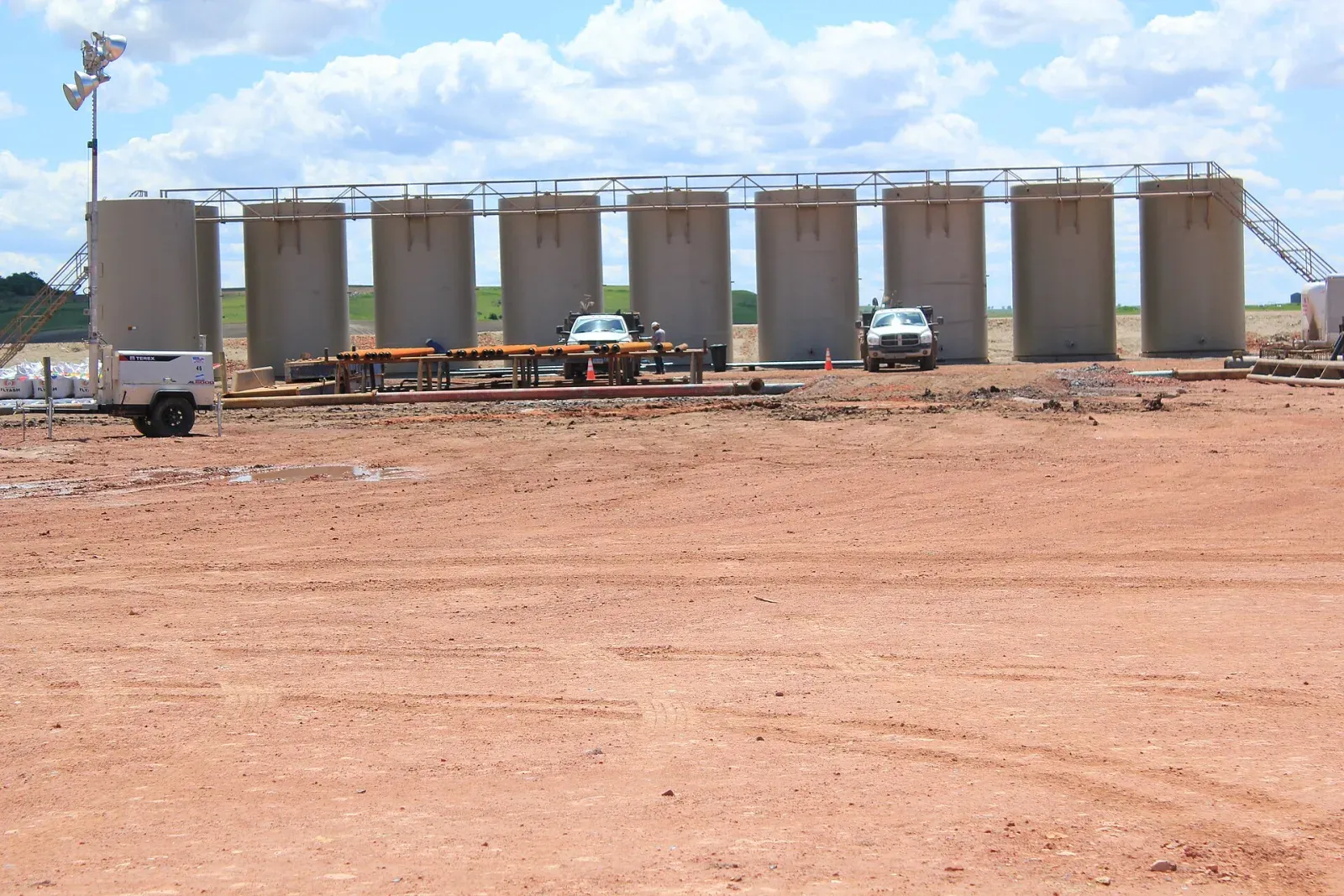
This guide covers fleet fuel, farm and ranch fuel, bulk plants and fixed-roof storage tanks. Floating roof tanks have their own problems with seals and shunts, covered in our floating roof tank guide. Production tank batteries are covered in our tank battery guide.
Why lightning starts tank fires
Lightning is one of the leading causes of storage tank accidents. A 2006 review of tank accidents by Chang and Lin found that 33% of modern hydrocarbon tank accidents were due to lightning, as cited in a University of Maryland dissertation on storage risk at frac sites (Rooke, UMD).
What’s in the tank changes the risk:
| Fuel | Flash point | What it means at the tank |
|---|---|---|
| Gasoline | -45°F (NIOSH) | Gives off flammable vapor at ordinary outdoor temperatures. Its flammable range is 1.4% to 7.6% vapor in air. |
| Diesel | 125°F (NOAA CAMEO) | Classed as combustible. It has to be heated before it gives off enough vapor to ignite, so the ignition risk is lower. |
A diesel tank still needs grounding and bonding, because a strike can damage the tank, its piping and its controls even when nothing ignites. A gasoline tank also needs every vapor path kept closed.
What NFPA 780 says about fuel tanks
Chapter 7 of NFPA 780 covers structures that contain flammable vapors, flammable gases, or liquids that can give off flammable vapors (NFPA 780). The current edition is 2026 (LPI). The section numbers below follow the 2026 revision text in NFPA’s First Revision report. Check them against the edition your company or the operator specifies.
The parts that matter most for fuel storage:
- Conductors, strike termination devices, surge protection and grounding connections are chosen and installed under the general Chapter 4 rules, except where Chapter 7 changes them (7.3.1).
- Surge protective devices are installed outside hazardous (classified) locations where practicable (7.3.6.2).
- Metal tanks are grounded by one of four methods (7.3.7.3), covered in the next section.
- The committee added a section saying the grounding this standard requires applies only to lightning protection systems. It doesn’t stand in for grounding required for other purposes.
The First Revision report also notes that the general ground ring requirement in 7.3.7.1 doesn’t apply to tanks and petroleum production, processing and storage structures (First Revision report). Tanks get their own grounding rules.
How to ground a fuel tank: the four NFPA 780 methods
The 2026 revision text gives four ways to ground a metal tank (First Revision report, 7.3.7.3):
- Connect the tank, without insulated joints, to a grounded metallic piping system at two or more points.
- For a vertical, cylindrical, flat-bottom tank, rest it on the earth, bitumen or concrete.
- Ground it through at least two grounding electrodes, spaced as far apart as practicable and no more than 100 ft (30 m) apart along the tank perimeter.
- Ground it to a site grounding system at a minimum of two locations as far apart as practicable along the perimeter.
Method 1 has an annex note worth reading before you count on buried pipe. A pipe only works as a grounding electrode if it’s electrically continuous and buried in direct contact with earth for at least 10 ft (3 m). The shorter the run from the tank to where the pipe enters the earth, the better it works, and more buried pipe is better than less (A.7.3.7.3(1)).
Method 2 changed. Earlier text added a size limit: at least 20 ft (6 m) in diameter on earth or concrete, or 50 ft (15 m) on bituminous pavement. The committee removed it, saying there was no known technical justification for the minimum diameter, and added method 4 as an alternative (First Revision report). If an older drawing or company standard grounds a small tank only because it “sits on concrete,” check it against the edition your project uses.
Tanks inside a containment liner
Some fuel tanks sit over an insulating membrane for spill containment. The 2026 revision says a tank on an insulating membrane must be grounded by method 1 (piping) or method 3 (grounding electrodes). The annex adds that the membrane doesn’t change where lightning attaches, but it can pose a threat to personnel safety, and without supplemental grounding a strike to the tank could damage the membrane itself (7.3.7.4 and A.7.3.7.3).
Fixed-roof, horizontal and floating-roof tanks compared
| Tank type | Where it’s common | Main lightning concern | What to look at |
|---|---|---|---|
| Vertical fixed-roof steel | Bulk plants, terminals, larger fleet depots | Vapor at vents and hatches; roof plate thickness | Roof and shell thickness against 3/16 in; vents and hatches closed and in good repair; two or more ground connections |
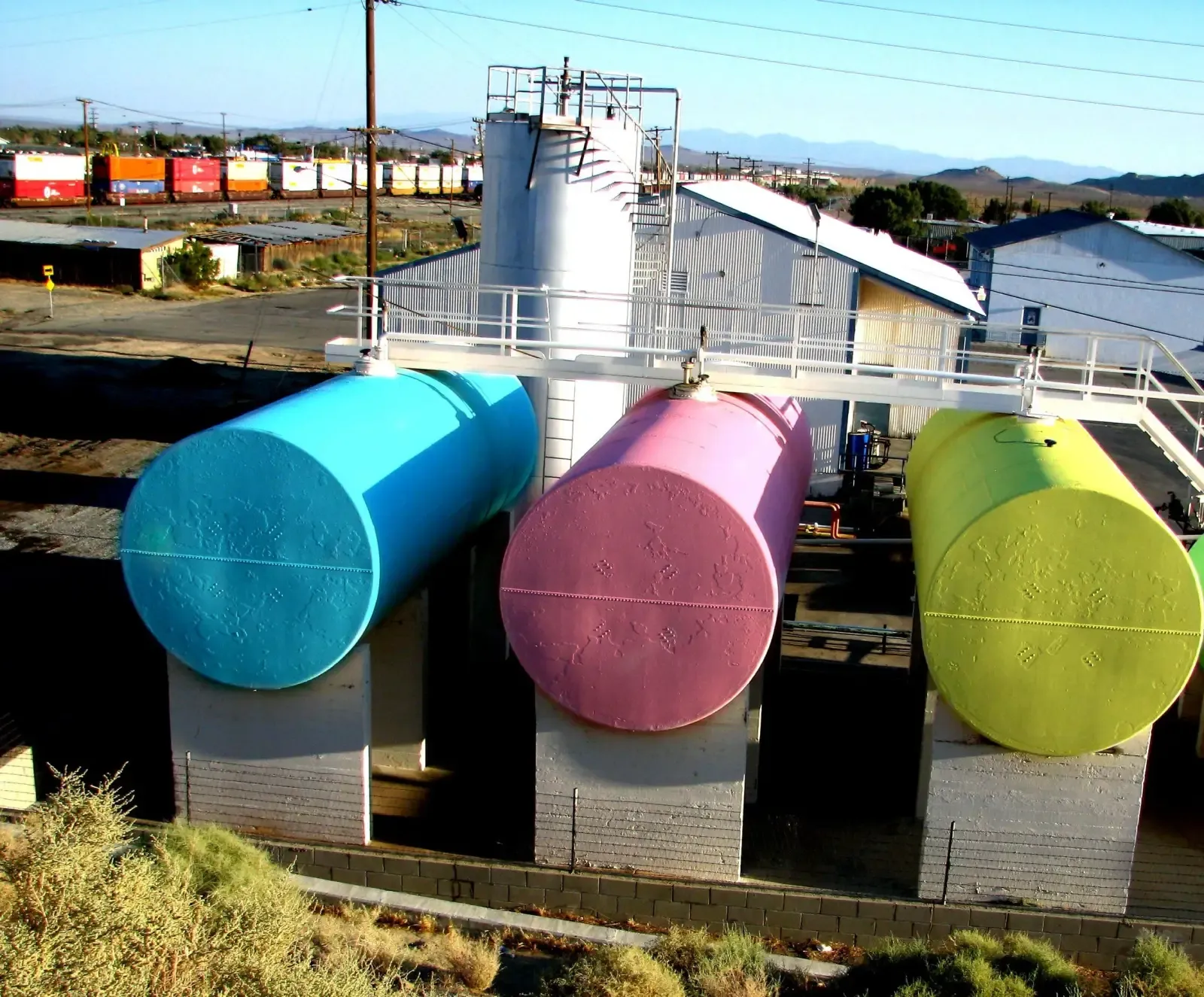
| Horizontal steel (shop-built) | Fleet fuel, farm and ranch, generator day tanks | Method 2 (resting on earth or concrete) covers only vertical flat-bottom tanks, so it doesn’t apply | Ground connections or bonding to grounded piping; fill and vent fittings; bonding of the dispenser and piping |
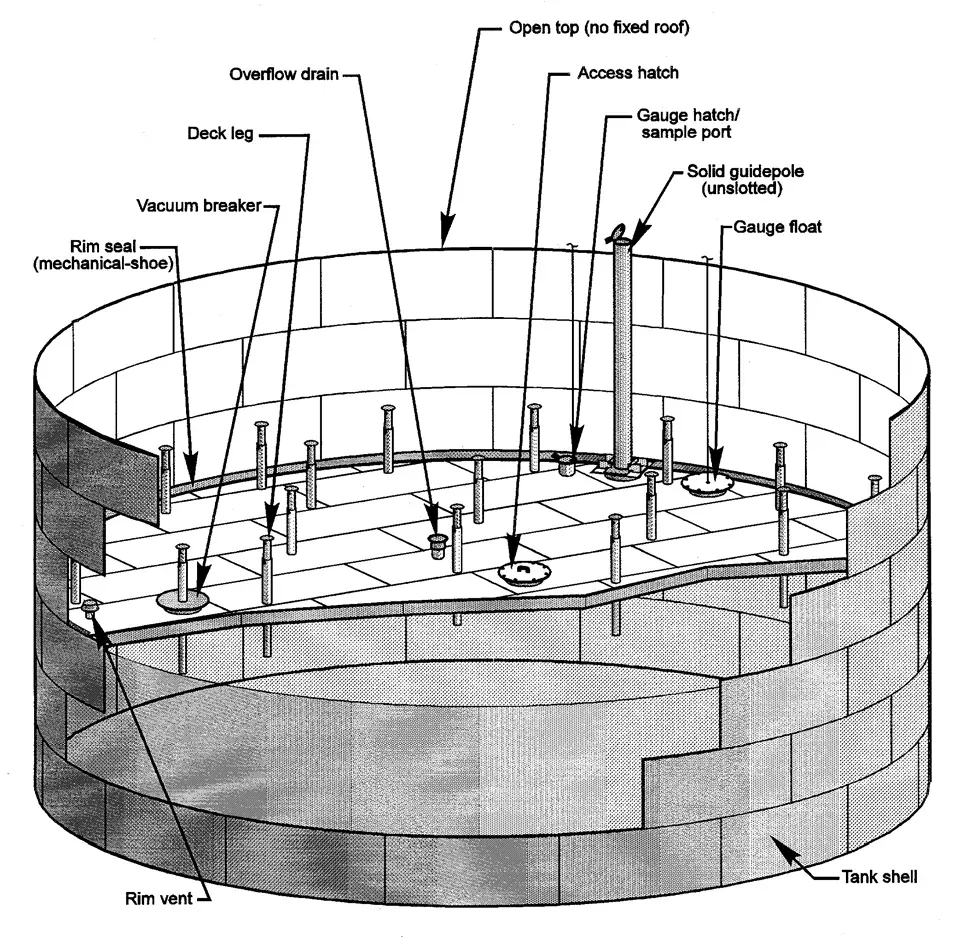
| Floating roof | Terminals and refineries | Rim seal fires from arcing between the roof and shell | See our floating roof tank guide |
| Fiberglass or plastic | Some farm and produced-water service | No conductive shell to carry the current | NFPA 780 Annex N, below |
The 3/16 in figure is the line to remember for steel tanks. Anything thinner, such as a light-gauge roof or a thin access cover, isn’t covered by the B.2.3 statement. Check the tank’s nameplate or drawings before you assume it protects itself.
Fiberglass and plastic fuel tanks
Nonmetallic tanks are a different problem. Annex N of NFPA 780 recommends that nonmetallic tanks not be used where flammable vapors might be present. Its listed problems include electrical insulation, static charge that builds up and stays, heat from the strike, and induced voltages passing straight through the tank wall. It says its methods can mitigate lightning damage but not eliminate it (First Revision report, N.1).
If a nonmetallic tank is used anyway, Annex N calls for an in-depth study of every ignition source the lightning protection could introduce. Metal parts on the tank need bonding to the lightning protection system, because the annex warns of potentials of hundreds of kV on them during a strike. Where the rolling sphere method is used for these tanks, the radius should be 100 ft (30 m) or less, not the 150 ft used for ordinary structures (N.2). Annex N is guidance unless a code, contract or authority having jurisdiction adopts it.
Electronics at fuel sites
Tank gauges, pump controls, card readers and leak monitors can be damaged by a nearby strike even when the tank itself comes through fine. Two points from Chapter 7 apply: surge protection should sit outside the classified area where practicable (7.3.6.2), and lightning grounding doesn’t replace the electrical system’s own grounding. The two still have to be tied together. LPI says electrical and communication electrodes can’t be used in place of lightning grounding electrodes, and that the separate grounding electrodes of different systems must be bonded together (LPI). That keeps them at the same potential during a strike, so current has no reason to arc between them.
Site checklist for a fuel tank
Walk the site with this list after installation, after any tank or piping work, and on the inspection schedule your insurer or company sets:
- Each steel tank has at least two ground connections on opposite sides of the perimeter, or is bonded to grounded piping at two or more points.
- No insulated flange or joint sits between the tank and the piping you’re counting on as its ground.
- Ground conductors aren’t cut, painted over, buried under gravel or corroded through at the clamp.
- Hatches, gauge ports and fill caps close and seal. Vents are in good repair.
- Thin roofs, covers and attached metal under 3/16 in are inside a zone of protection or have their own air terminals.
- Tanks over a containment liner are grounded by piping or by grounding electrodes, not by the base alone.
- Surge protectors on gauges and pump controls are in place and outside the classified area where practicable.
- Any nonmetallic tank storing fuel has a documented study and bonded metal fittings.
Our lightning protection inspection page explains how a full inspection goes.
Talk to Site Safe Lightning Protection
If you run fuel storage at an oil and gas facility, a fleet yard or a farm, contact Site Safe Lightning Protection about a new system or an inspection of what’s already there. Our oil and gas facility lightning protection page covers the facilities we work on.
FAQ
Do fuel tanks need lightning protection?
A welded steel tank 3/16 in thick or more that is sealed and grounded may not need air terminals, but it still needs grounding, bonding of its piping and fittings, and closed vapor openings. Thinner tanks, nonmetallic tanks and attached electronics need more. Requirements depend on the code, contract or authority having jurisdiction.
Can lightning ignite diesel fuel?
It’s much less likely than with gasoline. Diesel’s flash point is about 125°F, so it has to be heated before it gives off enough vapor to ignite. Gasoline’s flash point is -45°F. A strike can still damage a diesel tank, its piping and its controls.
How many grounds does a fuel tank need?
Under the NFPA 780 2026 revision text, a tank grounded through electrodes needs at least two, spaced as far apart as practicable and no more than 100 ft apart along the perimeter. Other permitted methods also use at least two points: two or more connections to grounded piping, or two connections to a site grounding system.
Do fiberglass fuel tanks need lightning protection?
Yes, and they’re harder to protect. NFPA 780 Annex N recommends against nonmetallic tanks where flammable vapors might be present, and calls for an in-depth study if one is used, with all metal fittings bonded and a rolling sphere radius of 100 ft or less.
Does a containment liner affect tank grounding?
The liner doesn’t change where lightning strikes, but it can insulate the tank from the earth. NFPA 780’s 2026 revision text requires a tank on an insulating membrane to be grounded through grounded piping or grounding electrodes.
Talk to Site Safe Lightning Protection about your property.
Frequently asked questions
Do fuel tanks need lightning protection?
A welded steel tank 3/16 in thick or more that is sealed and grounded may not need air terminals, but it still needs grounding, bonding of its piping and fittings, and closed vapor openings. Thinner tanks, nonmetallic tanks and attached electronics need more. Requirements depend on the code, contract or authority having jurisdiction.
Can lightning ignite diesel fuel?
It's much less likely than with gasoline. Diesel's flash point is about 125°F, so it has to be heated before it gives off enough vapor to ignite. Gasoline's flash point is -45°F. A strike can still damage a diesel tank, its piping and its controls.
How many grounds does a fuel tank need?
Under the NFPA 780 2026 revision text, a tank grounded through electrodes needs at least two, spaced as far apart as practicable and no more than 100 ft apart along the perimeter. Other permitted methods also use at least two points: two or more connections to grounded piping, or two connections to a site grounding system.
Do fiberglass fuel tanks need lightning protection?
Yes, and they're harder to protect. NFPA 780 Annex N recommends against nonmetallic tanks where flammable vapors might be present, and calls for an in-depth study if one is used, with all metal fittings bonded and a rolling sphere radius of 100 ft or less.
Does a containment liner affect tank grounding?
The liner doesn't change where lightning strikes, but it can insulate the tank from the earth. NFPA 780's 2026 revision text requires a tank on an insulating membrane to be grounded through grounded piping or grounding electrodes.
Sources
- NFPA 780, Standard for the Installation of Lightning Protection Systems (NFPA document page)
- NFPA 780 (A2025 cycle) First Revision report
- Lightning Protection Institute: NFPA-780 Standard (2026 Edition)
- NIOSH Pocket Guide to Chemical Hazards: Gasoline
- NOAA CAMEO Chemicals: Fuel Oil, [Diesel]
- Lightning Protection Institute: Lightning Protection Overview
- Rooke, Sensor-Augmented Lightning Mitigation; Implications for Risk at Hydraulic Fracturing Storage Facilities (University of Maryland dissertation, 2015), citing Chang and Lin (2006)