Tank Battery Lightning Protection: What Production Sites Need
By Site Safe Lightning Protection 7 min read
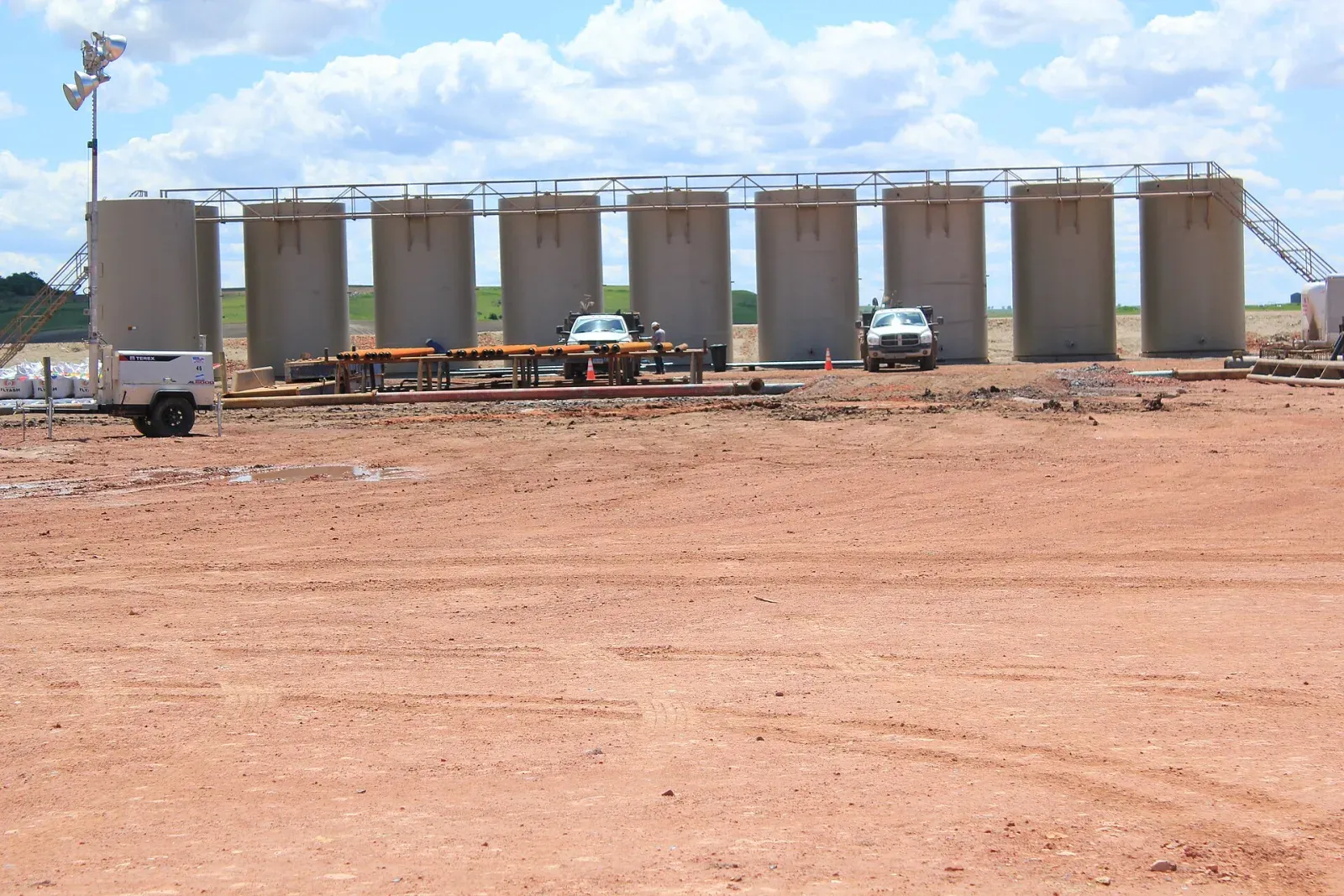
Tank battery lightning protection has its own section in the US standard now. The 2023 edition of NFPA 780 added requirements for tank batteries, which it defines as “a group of tanks and the associated process equipment for crude oil production or saltwater disposal” (NFPA 780, 2023, 7.8). In practice, protecting a battery means three things: keeping flammable vapor away from where a strike or spark can reach it, bonding every piece of metal on the pad to one ground system, and giving the tanks and vessels a low-resistance path to earth.
This article is for company men, production foremen and HSE managers who want to know what a proper job looks like and what to check on a site walk. For a broader look at oilfield risk, see our post on how lightning protection prevents explosions in oilfields.
What lightning does at a tank battery
The best public field data comes from North Dakota. The University of North Dakota’s Energy & Environmental Research Center (EERC) reviewed state spill reports for the North Dakota Industrial Commission and found 55 spills between 2014 and 2019 that listed lightning as the root cause: 28 at oil production facilities, 23 at saltwater disposal (SWD) facilities and 4 at central tank batteries (EERC). Those are only the strikes that caused a reported spill. Strikes that did no visible damage never show up in the data.
The same report cites a study of 242 tank accidents over 40 years in which lightning was the most frequent cause, at 33%, ahead of maintenance (13%) and operational error (12%).
North Dakota isn’t Oklahoma or the Permian, and the risk here is higher. AEM’s 2025 report named Oklahoma the most lightning-dense state, and Texas recorded more lightning flashes than any other state (AEM). Out on a flat lease, the tanks, separators and heater-treaters are usually the tallest things for a long way.
What NFPA 780 says about tank batteries
Chapter 7 of NFPA 780 covers structures containing flammable vapors, flammable gases, or liquids that can give off flammable vapors. Section 7.8, Tank Batteries, was added in the 2023 edition (NFPA 780). The revision work for the 2026 edition shows two of its core requirements (NFPA First Revision report):
- Ground-level potential equalization (7.8.4). The 2023 text requires interconnecting metallic components, underground piping and grounding systems within the battery. The 2026 revision extends this to aboveground piping too, because the committee said metallic piping needs bonding whether it’s above or below ground.
- Vapor control (7.8.5). Where direct strikes or arcing are likely, engineering methods (and in the 2026 revision, maintenance and operating methods as well) must minimize flammable vapor where an ignition source is likely.
The broader Chapter 7 philosophy, as quoted by EERC from the 2017 edition, is that the primary way to reduce ignition is to minimize flammable vapors in places exposed to a direct strike, lightning electromagnetic pulse, or secondary arcing (EERC).
Chapter 7 also covers grounding of metal tanks. The 2026 revision text calls for a tank to be grounded through at least two grounding electrodes, as widely separated as practicable and no more than 100 feet apart along the tank perimeter (First Revision report). Check the edition your company or the operator specifies before you design to it.
API RP 545 and RP 2003
The American Petroleum Institute has two documents that come up:
- API RP 545, Recommended Practice for Lightning Protection of Aboveground Storage Tanks for Flammable or Combustible Liquids, first published in October 2009. It replaced RP 2003’s lightning provisions for tank fires, applies to new tanks and can be applied to existing ones, and addresses fixed-roof metallic tanks and internal and external floating-roof tanks (EERC summary).
- API RP 2003, on ignitions from static, lightning and stray currents. It states that it is not recommended to store flammable liquids in nonconductive (plastic or fiberglass) aboveground tanks.
RP 545 is aimed at welded steel tanks. Most tank batteries in Colorado, Texas and Oklahoma mix steel oil tanks with fiberglass water tanks, and that’s where the real questions start.
Steel vs fiberglass tanks
EERC found that oil is typically stored in steel tanks on site, while produced water usually goes into fiberglass tanks, which operators prefer because fiberglass resists corrosive produced water (EERC).
| Steel tanks | Fiberglass (FRP) tanks | |
|---|---|---|
| Typical use on a battery | Crude oil, condensate | Produced water, SWD |
| Conductive shell | Yes; can carry current to ground when properly grounded and bonded | No; current can’t spread across the shell |
| Standard coverage | NFPA 780 Chapter 7; API RP 545 | NFPA 780 Annex N (guidance only); RP 2003 advises against flammables in nonconductive tanks |
| Main concerns | Grounding, bonding of piping and appurtenances, sparking at hatches and seals | Ignition of vapors inside; static buildup; internal metal parts arcing |
| Typical measures | Two or more ground connections, bonding to site ground, vapor control | Air terminals or masts to keep the strike off the tank, bonding of all internal and external metal, possible shielding |
NFPA 780’s Annex N, quoted by EERC, says protecting nonmetallic tanks that might contain flammable vapors requires measures “above and beyond” other structures, recommends that nonmetallic tanks not be used where flammable vapors might be present, and says its methods can mitigate but not eliminate lightning damage (EERC). Produced water often carries some oil, so “water tank” doesn’t always mean “no vapor.”
EERC is also careful on one point we hear in the field. Some operators believe fiberglass tanks get struck more often. EERC found that tank material is only one of many possible factors, along with fluid properties, missing protection, poor installation and poorly maintained grounding and bonding.
Don’t forget static
Both steel and fiberglass tanks can build up static charge during normal operations, and EERC says static can’t be overlooked as a contributor to fires and spills. NFPA 77 notes that liquid flowing into a tank can carry a charge that accumulates there (EERC). A good tank battery design handles static and lightning together: truck grounding at the load-out, bonded piping, and a single site ground. Our post on grounding systems in oil and gas lightning protection covers the ground side in more depth.
Is tank battery lightning protection required?
Mostly it’s a company decision. EERC’s 2019 regulatory review found that most oil and gas states don’t require lightning protection at production sites. Colorado and Ohio required operators to address lightning hazards, but only for facilities in urban areas, and EERC found no sign that insurers were requiring it, partly because many operators self-insure first-party property losses at these sites (EERC). Its conclusion: whether to install protection, and to which standard, is set by corporate policy, and NFPA 780 is the most appropriate standard to follow.
Rules change, so check current state rules (in Colorado, the Energy and Carbon Management Commission) and your own company’s standards. EERC also notes that only traditional lightning protection systems are recognized by NFPA, and none can claim to be 100% effective.
Site-walk checklist for company men and HSE
Use this on your next visit. It isn’t a design review, but it catches the problems we see most often.
- Ground connections. Each steel tank has at least two ground connections on opposite sides, and none are cut, buried in caliche or painted over.
- Bonding jumpers. Flexible jumpers across flanges, hatches and swing joints are present and tight. Check after any valve or line change.
- Piping. Aboveground and buried metallic lines between tanks, separators, heater-treaters and the LACT are bonded into the same ground system.
- Thief hatches and vents. Hatches seal properly and vents are where the design put them. Vapor at the top of a tank is the fuel for a lightning fire.
- Fiberglass tanks. Metal fittings, ladders, gauge boards and internal parts are bonded. Any air terminals or masts protecting them are intact and connected.
- Truck load-out. The truck grounding point or clamp works and is used every time.
- Electrical and automation. Surge protection is in place on power, RTU, radio and SCADA lines into the battery.
- Containment. Containment around the battery is intact, because a lightning-caused spill still has to stay on the pad.
- After a storm. Look for burn marks, melted jumpers, failed electronics or a tripped flare. Have the system inspected after any known strike.
- Records. The last inspection date and test results are on file.
Talk to Site Safe Lightning Protection
Site Safe Lightning Protection designs, installs and inspects lightning protection for oil and gas facilities, including tank batteries. Contact Site Safe Lightning Protection to set up a site walk or ask about your area. See our oil and gas facility lightning protection page for more.
Talk to Site Safe Lightning Protection about your property.
Frequently asked questions
What is a tank battery in NFPA 780?
NFPA 780 (2023) defines a tank battery as a group of tanks and the associated process equipment for crude oil production or saltwater disposal. Section 7.8 sets lightning protection requirements for them.
Do steel oil tanks need lightning protection?
Properly grounded and bonded steel tanks can carry lightning current to earth, but the risk is ignition of vapor at hatches, vents and seals. NFPA 780 Chapter 7 and API RP 545 cover grounding, bonding and vapor control for metal tanks.
Are fiberglass tanks more likely to catch fire from lightning?
Fiberglass can't conduct lightning current across its shell, and NFPA 780 Annex N recommends against nonmetallic tanks where flammable vapors might be present. A North Dakota study found tank material is only one of several factors, along with fluid properties, missing protection and poor grounding and bonding.
Is lightning protection required at oil and gas production sites?
Usually not by state rule. A 2019 review found that only Colorado and Ohio required operators to address lightning hazards, and only in urban areas. Most operators decide by company policy, and NFPA 780 is the recognized standard.
What does API RP 545 cover?
API RP 545 is the recommended practice for lightning protection of aboveground storage tanks for flammable or combustible liquids. It covers fixed-roof metallic tanks and floating-roof tanks and can be applied to new and existing tanks.
Sources
- NFPA 780, Standard for the Installation of Lightning Protection Systems, 2023 edition (NFPA document page, free read-only access)
- NFPA 780 (A2025 cycle) First Revision report
- UND Energy & Environmental Research Center: Lightning Protection Scoping Study, final report (revised May 2020), for the North Dakota Industrial Commission
- API: Standards (RP 545, RP 2003)
- Lightning Protection Institute: Lightning Protection Overview
- AEM: 2025 United States Lightning Report