Lightning Prevention Systems: What Dissipation Arrays Claim and What the Evidence Shows
By Site Safe Lightning Protection 7 min read
A lightning prevention system is a device, usually a dissipation array or “charge transfer system,” that its sellers say will stop lightning from striking the site it protects. Independent reviews going back to the 1970s have found no evidence that any device can do that. The US Defense Department prohibits these systems on its facilities, and the national lightning standard, NFPA 780, is written around the conventional rod-and-conductor system. A conventional system doesn’t prevent strikes either. It gives the strike a safe path to ground, and that’s the only approach the US standards recognize.
This guide is for facility managers, tower and tank-site owners, and specifiers who have been handed a quote for a prevention system and want to know what they’d be buying.
What a lightning prevention system claims to do
Dissipation arrays look like large wire brushes or umbrella frames covered in hundreds of sharp points, mounted at the top of a tower, mast or tank and wired to ground. Under a thundercloud, the sellers say, the points give off a steady stream of charge. That charge either drains the cloud above the site or builds a space-charge layer that neutralizes the downward leader before it can connect. Either way, the vendor says, lightning goes somewhere else.
Commercial charge transfer systems have been sold since the early 1970s (Mousa, 2004). Some engineers back them. In a 2001 paper in IEEE Transactions on Industry Applications, Donald Zipse called the charge transfer system “a valid concept” and predicted it would replace the Franklin rod in many applications (Zipse, 2001). US standards and federal criteria still don’t recognize it, as the sections below show.
What independent reviews found
The case against prevention devices starts with the US government. Soon after charge transfer systems came on the market, several US government departments paid for studies of whether they worked. The results were collected in Review of Lightning Protection Technology for Tall Structures, edited by J. Hughes for the Office of Naval Research (report AD-A075 449). Its conclusion was that lightning can’t be eliminated and that the devices didn’t work (Mousa, 2004).
In 2002, M. A. Uman and V. A. Rakov reviewed the literature on both “lightning elimination” and early streamer emission in the Bulletin of the American Meteorological Society. They concluded that the suggested superiority of the nonconventional techniques “is not supported by the available experimental data or by theory” (Uman and Rakov, 2002). Mousa reports that the review was endorsed by the International Conference on Lightning Protection, the American Geophysical Union and the American Meteorological Society (Mousa, 2004).
Even the industry’s own consultants didn’t back the main claim. Russian scientists hired by the charge transfer industry measured the charge the arrays actually give off. They found it wasn’t much larger than what a single electrode produces, and that it couldn’t discharge the cloud or neutralize the downward leader. They also agreed that strikes would keep landing on the array or on the structure it was supposed to protect, especially the larger strikes (Mousa, 2004).
That last finding matters for the budget. If some strikes still land, the site still needs air terminals, down conductors, bonding and grounding sized to carry them. Those same parts handle every other strike too. Mousa’s conclusion was that there’s no justification for paying the extra cost of the array on top of them (Mousa, 2004).
Lightning protection vs lightning suppression
Vendors often call their product “lightning suppression” or “prevention” to set it apart from “protection.” Here are the three kinds of system an owner is likely to be quoted.
| Conventional system | Dissipation array / charge transfer system | Early streamer emission (ESE) | |
|---|---|---|---|
| What it claims | Intercepts strikes and carries the current to ground | Stops strikes from forming over the site | One terminal protects a much larger radius than a plain rod |
| US installation standard | NFPA 780; UL 96A; LPI-175 | None | None |
| Defense Department criteria (UFC 3-575-01) | Required basis of design | Prohibited | Prohibited |
| Independent review | Basis confirmed by the Federal Interagency Lightning Protection User Group (2001) | Claims unsupported (ONR 1977; Uman and Rakov 2002) | Claims unsupported (Uman and Rakov 2002) |
Sources: LPI, UFC 3-575-01, Mousa, 2004, Uman and Rakov, 2002.
The National Weather Service is blunt about what the conventional system does and doesn’t do. Lightning protection systems “do not prevent lightning from striking the structure.” They intercept the strike, give the current a conductive path and disperse it into the ground, with surge protection on incoming power and data lines to finish the job (NWS).
We cover ESE terminals in more depth in our article on ESE lightning protection.

Where the US rules land
On Defense Department facilities the answer is simple. UFC 3-575-01 sets lightning protection criteria for Army, Navy and Air Force facilities and uses NFPA 780 as its base. Section 3-2 says nonconventional systems, “such as dissipation arrays and those using early streamer emission-type air terminals,” are prohibited (UFC 3-575-01).
Elsewhere, NFPA 780 is the national design guide for lightning protection systems in the US. UL 96 covers the air terminals, conductors and fittings, and UL inspects finished installations to UL 96A for its Master Label (LPI). All three describe the conventional system. None of them gives design or installation rules for a dissipation array, so a dissipation array can’t be inspected or certified against them. If your insurer, a spec or a corporate standard calls for an NFPA 780 or UL Master Label system, an array on its own won’t meet that requirement. Ask your authority having jurisdiction and your insurer before you sign anything. Our guide to NFPA 780 explains what the standard does cover.
The NFPA has turned down nonconventional devices before. In 1995 its Standards Council declined to issue a standard for ESE terminals after a third-party NIST review. A golf course trade newsletter at the time noted that some clubs had put special devices on clubhouses, trees and flag poles, and advised members to investigate before spending as much as $30,000 on such an installation (Harger, 1995).
The cost argument
Prevention hardware can cost far more per mounting point than a conventional air terminal. Mousa gave a 2004 example: one charge transfer device, sold as a one-to-one replacement for a Franklin rod, was priced at $105 against $6 to $10 for the rod it replaced. In effect the buyer paid more than ten times as much for protection that was, at best, about the same (Mousa, 2004). Those are 2004 prices.
The bigger cost shows up after the sale. Strikes still land, so the site still needs a grounded path that can carry them. If the array was sold as the whole answer, that path may be undersized or missing, and the owner finds out after the first strike to the tank, the tower or the control building.
Questions to ask a vendor selling lightning prevention
- Which published standard is the design built to, and can a third party inspect it against that standard?
- Are the components listed to UL 96?
- What independent field data, not company case studies, shows the site takes fewer strikes than it would without the device?
- When a strike does hit the array, where does the current go? What size are the down conductors, and how are they bonded and grounded?
- What does the warranty pay for if the site is struck? Read the exclusions.
- Will your insurer, your corporate engineering standard and, on federal work, UFC 3-575-01 accept it?
Company case studies and testimonials aren’t independent data.
What if your site already has a dissipation array?
Have it checked before you decide anything. Some installations pair an array with conventional down conductors and grounding, and some don’t. An inspection against NFPA 780 will show what’s there: whether air terminals cover the structure, whether there are enough down conductors, whether metal bodies are bonded, and whether the grounding is in decent shape. From there you can decide what to add or replace. If you run towers, tanks or other oil and gas equipment, our oil and gas lightning protection page covers how those sites are usually protected.
Get a straight assessment
Site Safe Lightning Protection installs conventional lightning protection systems on commercial buildings, homes and oil and gas facilities, and inspects and maintains existing systems. If you’ve been quoted a prevention system or you’re not sure what’s on your tower or tank site, contact Site Safe Lightning Protection for an inspection and a plain comparison of your options.
Talk to Site Safe Lightning Protection about your property.
Frequently asked questions
Can lightning be prevented from striking a building?
No device has been shown to do that. Independent reviews from 1977 and 2002 found that lightning can't be eliminated, and the National Weather Service says lightning protection systems don't prevent strikes. They give the strike a safe path to ground.
What is a dissipation array system?
A dissipation array is a cluster of many sharp metal points on a tower or mast, connected to ground. Its sellers say the points release enough charge to drain the cloud or block the downward leader. Research summarized by Uman and Rakov and by Mousa found the charge released is far too small to do either.
Is a lightning suppression system the same as a lightning protection system?
No. "Suppression" or "prevention" usually means a charge transfer device that claims to stop strikes. A lightning protection system built to NFPA 780 or UL 96A intercepts strikes and conducts them to ground. Only the second has a US installation standard.
Are dissipation arrays allowed under NFPA 780?
NFPA 780 describes the conventional system and gives no rules for dissipation arrays, so an array can't be certified to it. On Defense Department facilities, UFC 3-575-01 section 3-2 prohibits dissipation arrays and early streamer emission terminals outright.
Sources
- National Weather Service: Lightning Rods and Lightning Protection Systems
- M. A. Uman and V. A. Rakov, A Critical Review of Nonconventional Approaches to Lightning Protection, Bulletin of the American Meteorological Society 83(12), 1809-1820 (2002)
- Abdul M. Mousa, War of the Lightning Rods, Electricity Today, Issue 2 (2004)
- UFC 3-575-01 Lightning and Static Electricity Protection Systems (2012, Change 1 2021), section 3-2, WBDG
- Donald W. Zipse, Lightning protection methods: an update and a discredited system vindicated, IEEE Transactions on Industry Applications 37(2) (2001)
- Lightning Protection Institute: Lightning Protection Overview
- Jeffrey A. Harger, Exotic Lightning Protection / Prevention Devices (November 1995), MSU Turfgrass Information Center archive
Image credits
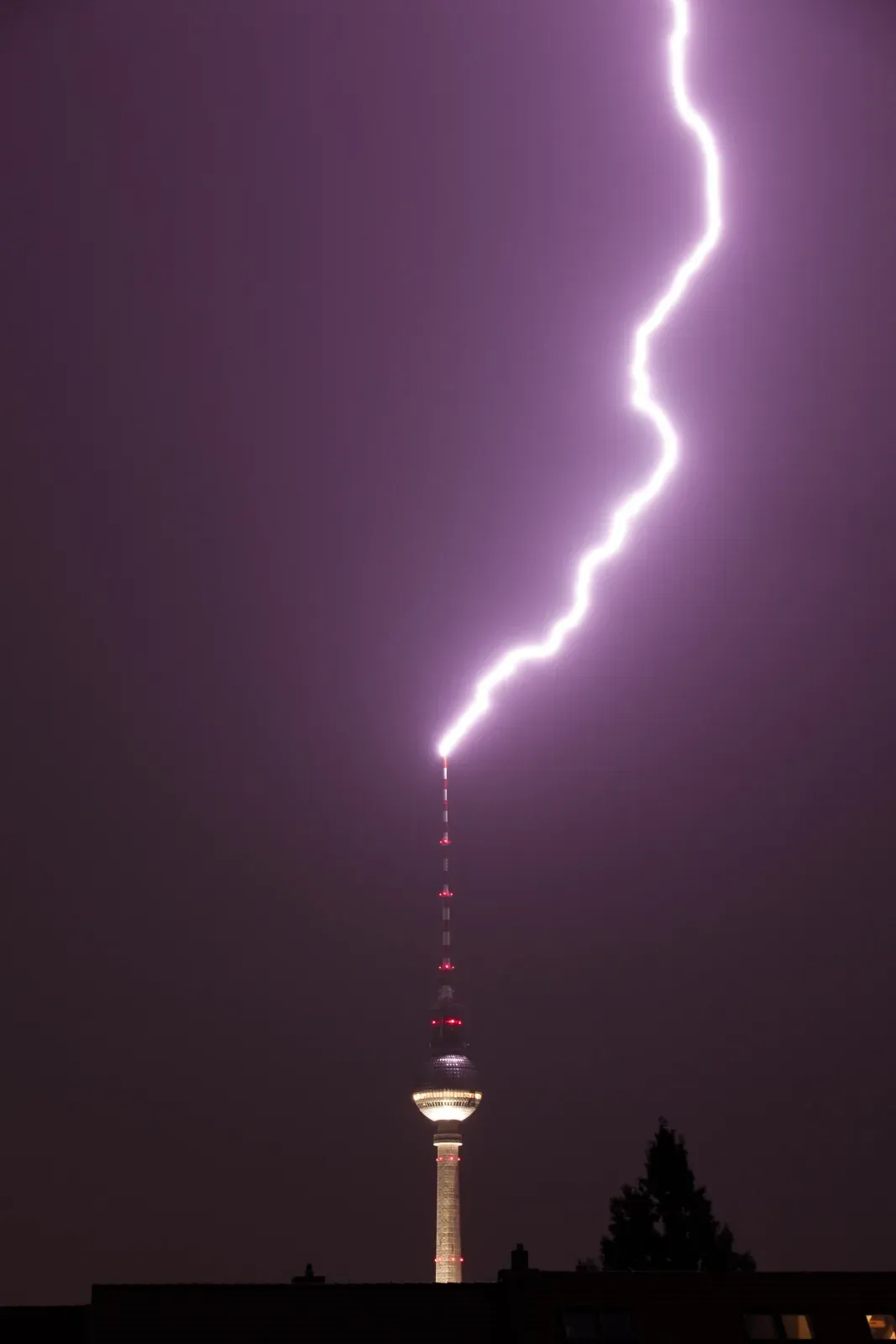
- Lightning bolt striking the antenna mast on top of the Berlin TV Tower at night. Photo: Matt Biddulph / Wikimedia Commons (source), CC BY-SA 2.0, resized.
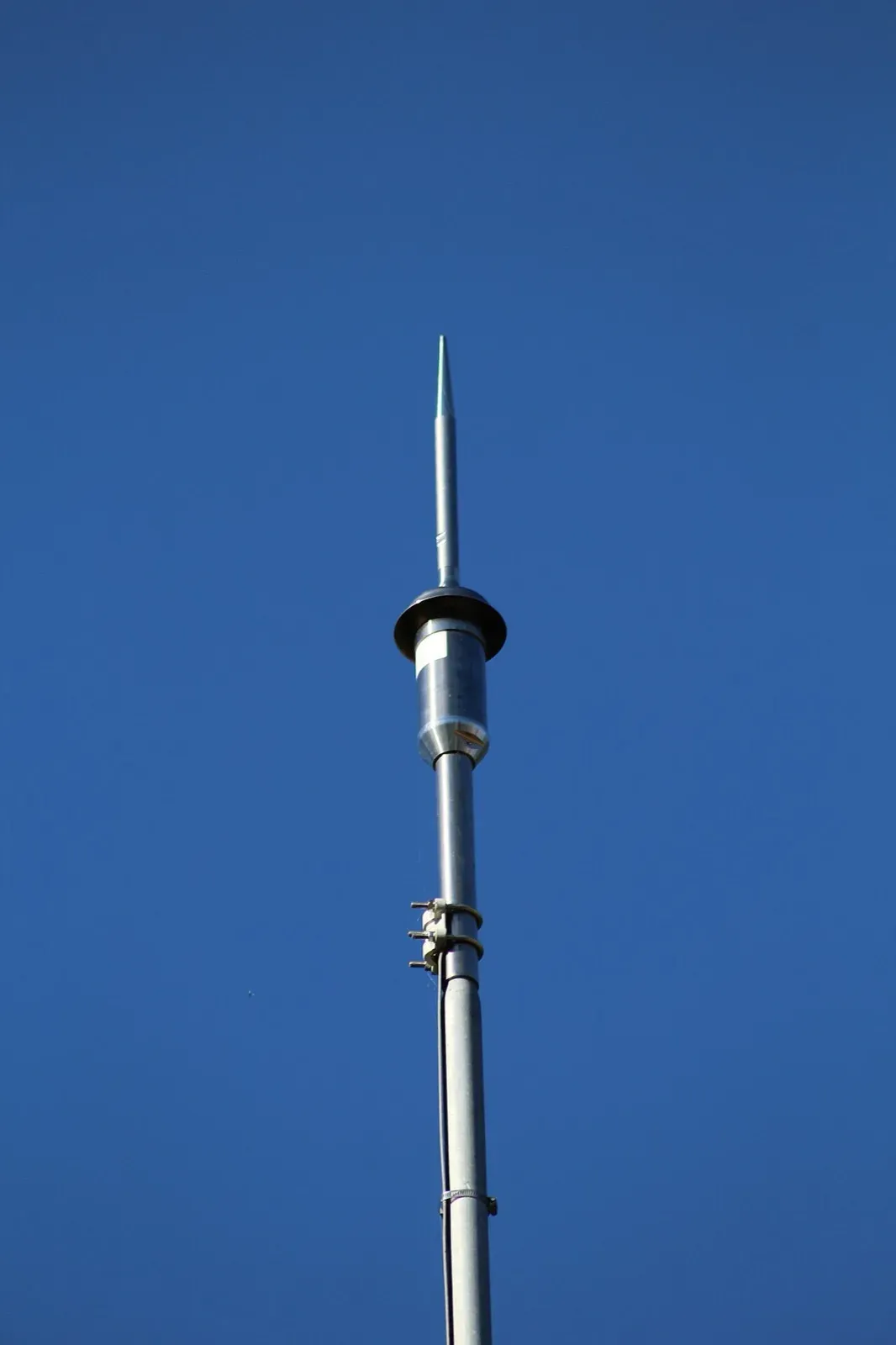
- Nonconventional early streamer emission lightning terminal on a white mast beside a stone monastery wall in Greece. Photo: Etan Tal / Wikimedia Commons (source), CC BY 3.0, resized.