Can Lightning Strike a House? Three Ways It Gets In and Does Damage
By Site Safe Lightning Protection 6 min read
Yes, lightning can strike a house, and every year it does. In 2025, US homeowners filed 61,986 lightning-caused insurance claims worth $1.65 billion, an average of $26,616 per claim (Insurance Information Institute). Most of those claims are not a bolt through the roof. The National Weather Service says lightning gets into structures three ways: a direct strike, through wires or pipes that extend outside, and through the ground.
That list explains why a house that was never hit directly can still lose a TV and a router in the same storm. It also shows which parts of a house a lightning protection system covers and which parts need other measures.
What makes a house more likely to be hit
Height, pointed shape and isolation control where a bolt lands. The NWS puts it that way, and adds that the presence of metal makes no difference to where lightning strikes (NWS Lightning Myths). A house on an open hilltop or at the edge of a tree line is more exposed than one in the middle of a block of similar roofs.
The same page also sets aside the idea that lightning never strikes twice. It often hits the same place repeatedly, especially a tall, pointed, isolated object. A house that has been struck once has not used up its share.
Three ways lightning gets into a house
The NWS Lightning Indoors page names the paths. Here they are with what each one usually does:
| Path | What happens | Typical damage |
|---|---|---|
| Direct strike | Lightning hits the roof, chimney or an antenna and travels down through the structure | Structural damage and fire |
| Wires and pipes | Current rides in on power, phone, cable, antenna or water lines | Surge damage to electronics, shock to anyone touching a corded phone, faucet or appliance |
| Ground | A strike to a tree, pole or the ground nearby sends current along the ground surface | Shock risk, including in garage floors with conductive material |
Once inside, NWS says lightning can travel through the electrical, phone, plumbing and TV or radio reception systems, and through any metal wires or bars in concrete walls or floors (NWS Lightning Indoors). Its separate page on how lightning strikes people says conduction causes most indoor lightning casualties, and that ground current is behind the most deaths and injuries overall (NWS Five Ways Lightning Strikes People).
So the answer to “can lightning strike you in your house” is yes, but not as a bolt through the ceiling. It reaches a person by conduction, through whatever the person is touching that connects to the outside.
What happens when a direct strike hits
Fire is the main concern. NWS cites NFPA figures of about 24,600 fires a year caused by lightning, with about 4,400 of them house fires costing roughly $283 million. About 16 fire deaths a year are attributed to lightning-caused fires, most of them occupants of houses (NWS Lightning and Fires).
The NWS also explains why some strikes ignite things and others don’t. Most flashes are quick return strokes. Some carry continuing current, a longer flow of charge that heats whatever it is flowing through. The NWS calls these hot lightning. The longer flow heats the object it strikes, and that heat can ignite it.
One of the photos here shows the underside of a roof deck at McConnell Air Force Base after a fire attributed to a suspected lightning strike. It is a military building, not a house, but it shows what burned decking and insulation look like from below.
Our guide to the signs your house was struck by lightning covers what to check afterward, and what happens when lightning strikes a house without protection walks through the damage in more detail.
Where the claims come from
The Insurance Information Institute lists the ten states with the most lightning claims in 2025. Florida led with 5,167 claims. California followed with 4,211 and Texas with 4,188. Texas stands out for cost: the average claim there was $60,382, more than double the national average (Triple-I). If you own a home in Texas, that figure is the one to remember when you weigh the cost of protection against a claim.
Does lightning protection stop a house being struck?
No. A lightning protection system does not prevent a strike. UL’s application guide describes the job as catching a strike at some point on the structure and conducting it to an electrode buried in the earth, where it can dissipate (UL guide). The goal is to give the current an intended path so it does not choose your framing, wiring or plumbing.
A system covers the direct-strike path. It does not by itself cover the wire and pipe path. NWS notes that lightning creates electrical surges that can damage electronics some distance from the strike, and that typical surge protectors will not protect equipment from a lightning strike (NWS Lightning Indoors). The LPI model specification calls for surge suppression at every system entrance to the structure (LPI specification). A full approach combines terminals and conductors for the roof path, grounding and bonding to tie the metal systems together, and surge protection at the service entrance.
What to do during a storm
These are the NWS indoor rules:
- Stay off corded phones. Cell and cordless phones are fine.
- Don’t touch electrical equipment, computers, TVs or their cords. Remote controls are fine.
- Avoid plumbing. Don’t shower, wash hands or wash dishes.
- Stay away from exterior windows and doors that have metal parts reaching outside.
- Stay off porches and balconies and out of open garages.
- Don’t lie on concrete floors or lean on concrete walls.
NWS also says not to unplug equipment during the storm, because the person doing it could be struck.
Is your house a candidate for a system?
The right questions are about exposure and consequence. Is the house tall, isolated or on a ridge? Is there something in it that cannot be replaced? Is there a well, a barn or an outbuilding on the same property? A lightning risk assessment answers them with a method instead of a guess.
Talk to us about your house
If you have been through a strike, or you are planning a new home, an addition or a farm or ranch property, contact Site Safe Lightning Protection and ask about an assessment. You can read more about home systems on our residential lightning protection page.
Talk to Site Safe Lightning Protection about your property.
Frequently asked questions
Can lightning strike a house?
Yes. Lightning gets into a house by a direct strike, through wires or pipes that extend outside, or through the ground, according to the National Weather Service. US insurers paid 61,986 lightning claims in 2025.
Can lightning strike you inside your house?
Not as a bolt through the roof, but you can be hurt by conduction. NWS says most indoor lightning casualties come from current traveling through wires, plumbing and metal surfaces. Stay off corded phones, avoid plumbing and don't touch electronics or their cords.
Does a lightning rod stop lightning from hitting a house?
No. A system gives a strike a path to ground so the current avoids your framing, wiring and plumbing. UL's guide describes the job as catching a strike and conducting it to a buried electrode.
Does a metal roof attract lightning?
No. NWS says height, pointed shape and isolation control where lightning strikes, and that metal makes no difference to where it lands.
Will a surge protector protect against a lightning strike?
Typical surge protectors will not protect equipment from a direct lightning strike, according to NWS. The LPI model specification calls for surge suppression at every system entrance as part of a full system.
Sources
- Insurance Information Institute: Facts + Statistics: Lightning (2025 data)
- National Weather Service: Lightning Indoors
- National Weather Service: Five Ways Lightning Strikes People
- National Weather Service: Lightning Myths
- National Weather Service: Lightning and Fires
- Lightning Protection Marking and Application Guide (UL, 2016)
- Lightning Protection Systems Specification (Lightning Protection Institute)
Image credits
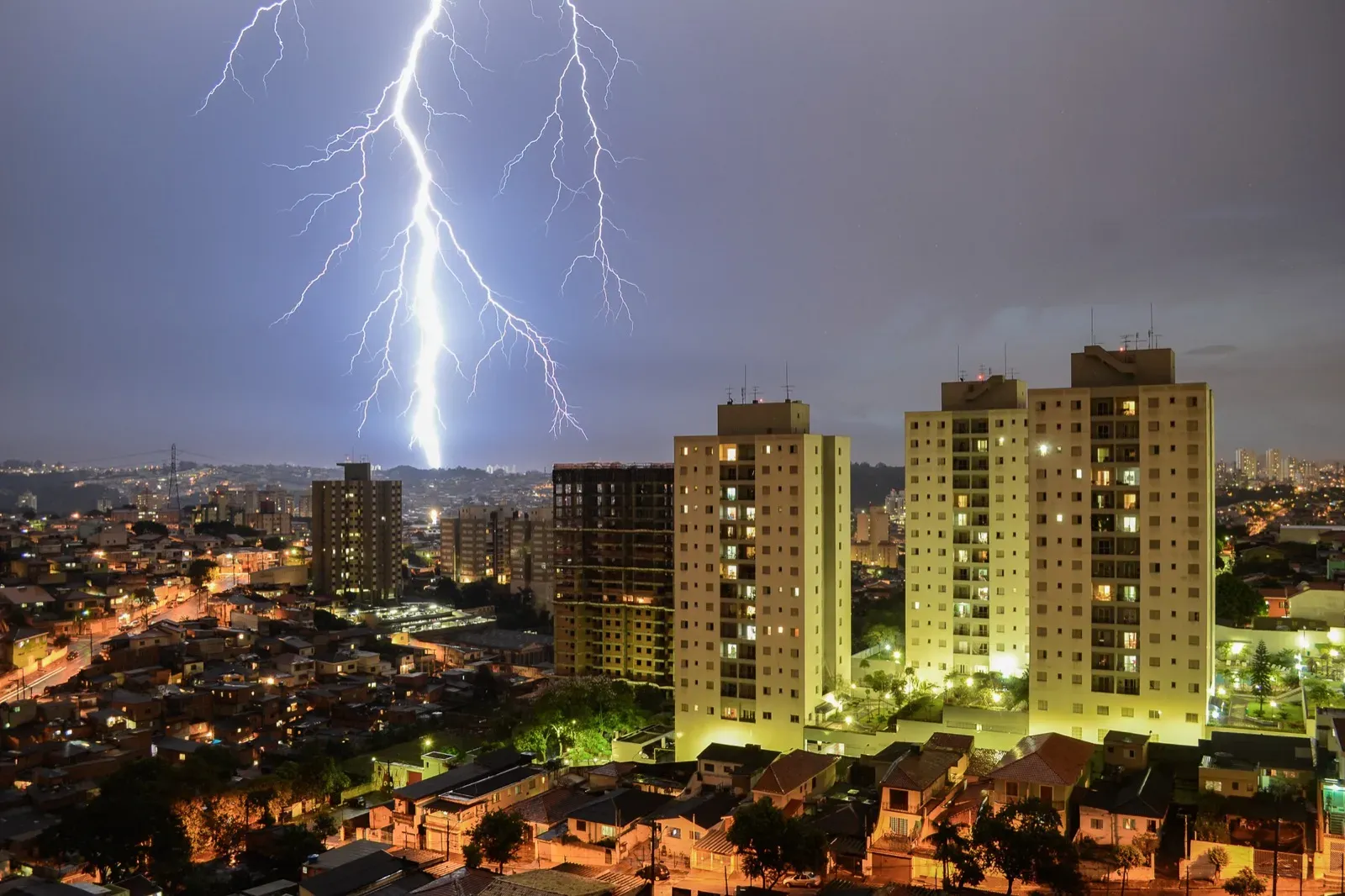
- A large lightning bolt over a night skyline of houses and three apartment towers. Photo: Guilerms / Wikimedia Commons (source), CC BY-SA 4.0, resized.
- Burned roof decking and sagging insulation seen from below after a fire. Photo: U.S. Air Force photo by Senior Airman Paige Weldon (source), Public domain (US government work).