Do Metal Roofs Attract Lightning? What Really Happens in a Strike
By Site Safe Lightning Protection 6 min read
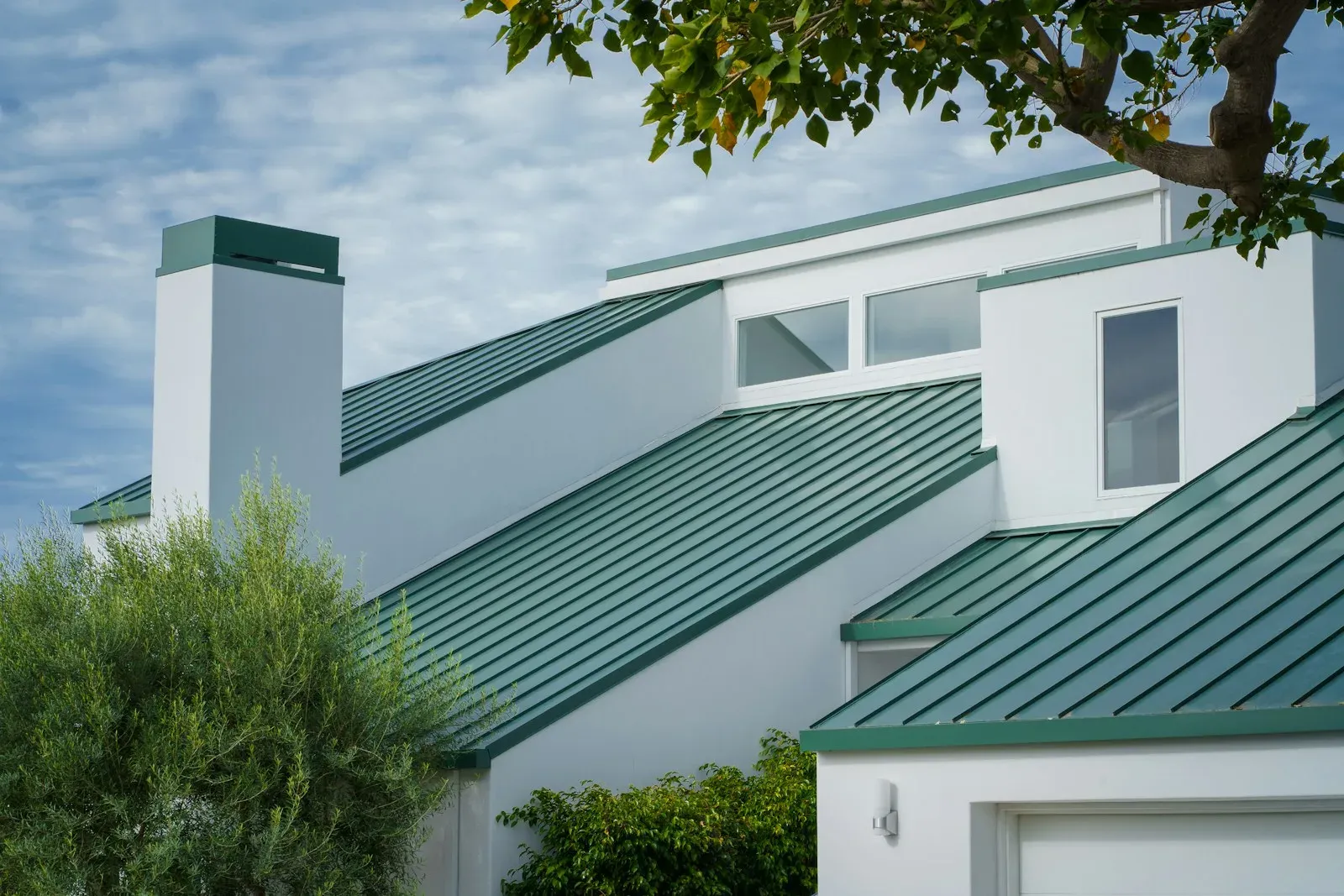
No. A metal roof doesn’t make your house or barn any more likely to be struck. The National Weather Service says height, pointed shape and isolation are what control where lightning strikes, and that “the presence of metal makes absolutely no difference” (NWS). The Metal Construction Association reaches the same conclusion: on any given building, a metal roof is no more or less likely to be struck than any other roofing material (MCA).
The flip side gets less attention. A metal roof doesn’t protect a building from lightning either. If a tall, exposed building needed protection with shingles on it, it still needs protection with steel on it.
Why metal doesn’t change the odds
Lightning doesn’t aim from miles away. NOAA’s National Severe Storms Laboratory explains that a downward channel only “chooses” its target in the last stretch: when it gets within roughly a hundred yards of the ground, objects below start sending up sparks, and whichever one connects takes the strike. Tall objects such as trees and buildings are more likely to send up that connecting spark (NSSL).
At that scale, what matters is how far a building pokes up above everything around it. A two-story house on a bare ridge is a likelier target than a one-story house under tall cottonwoods, regardless of what the roof is made of.
What happens when lightning strikes a metal roof
When a strike does hit, metal has a real advantage. The MCA explains that a metal roof properly grounded according to NFPA 780 will spread the energy of a strike over a broader area of the roof. That reduces the heat transferred into the building and reduces the chance of fire. It also points out that metal is noncombustible (MCA).
Two phrases in that explanation do a lot of work: “properly grounded” and “in accordance with NFPA 780.” A metal roof sitting on wood purlins, with nothing connecting it to the earth, gives the strike nowhere good to go. The current will look for a way down through whatever is available: fasteners, framing, wiring, a water line, a metal post. That’s where the damage happens. The MCA itself says that to minimize the risk of damage, it may be prudent in some cases to consider additional lightning protection.
Is a metal roof a lightning protection system?
Usually not on its own. NFPA 780 sets a clear test for metal on a roof. In the 2023 edition:
- Metal parts of a structure exposed to direct strikes that are 3/16 inch (4.8 mm) thick or more only need to be connected to the lightning protection system. They can act as their own strike termination (NFPA 780, 2023).
- Objects outside a zone of protection that are thinner than 3/16 inch, including thin metal objects, need strike termination devices installed on them (NFPA 780, 2023).
(NFPA 780)
UL’s application guide states the same rule: any object above the normal roof height with a surface thinner than 3/16 inch must be protected (UL guide). Roofing panels are sheet metal, far thinner than 3/16 inch, so a typical metal roof doesn’t qualify as its own strike termination. It still gets air terminals along the ridge and at the ends, just like a shingle roof.
What a metal roof can do is make the job simpler. The roof panels can be bonded into the system, which helps prevent side flash between the roof and the lightning conductors.
Copper vs aluminum on a metal roof
This is where metal roofs really change the design. NFPA 780 has strict rules about mixing metals, because two dissimilar metals in contact will corrode:
- Copper lightning protection materials can’t be installed on or in contact with aluminum roofing, aluminum siding or other aluminum surfaces (2023, 4.2.3).
- Aluminum materials can’t be installed on or in contact with copper roofing, or where they’re exposed to runoff from copper surfaces (4.2.4).
UL’s guide adds that copper components can’t be mounted on galvanized steel surfaces (UL guide). So if your steel roofing is galvanized, the installer will usually choose aluminum components for the roof and use listed bimetallic fittings where the system changes to copper. Ask your roofer what coating your panels have. LPI notes that bimetallic fittings handle aluminum-to-copper transitions (LPI). If a contractor proposes bare copper clamped straight onto a steel roof, ask why.
Do you need a lightning rod with a metal roof?
Treat it like any other roof and look at exposure and consequences:
| Situation | Typical answer |
|---|---|
| Metal-roofed house in a neighborhood of similar homes and trees | Same decision as a shingle roof; based on your risk and what’s at stake |
| Two-story home on a ridge, bluff or open acreage | Strong candidate for a full system |
| Steel pole barn or shop that’s the tallest building on the place | Strong candidate, especially with livestock, hay, equipment or fuel inside |
| Metal building with a fuel tank, propane or a shop with flammables | Protection plus careful bonding of tanks and piping |
| Metal roof with rooftop solar | Needs a design that covers the array; NFPA 780 has a solar chapter (Chapter 12 in 2023) |
Across Colorado, Texas and Oklahoma, the metal building out in an open pasture is the classic case. It’s tall, isolated and often full of things that burn. The roof being steel doesn’t change that.
What a system on a metal-roofed building looks like
The parts are the same as on any building: air terminals along the ridge and on rooftop equipment, main conductors, at least two down conductors, grounding electrodes and bonding (LPI). The differences are in the details:
- Terminals and conductors are fastened with clamps and adhesive bases suited to standing seam or corrugated panels, which limits roof penetrations.
- Materials are matched to the roof metal, as above.
- The roof panels, metal trim and gutters are bonded into the system.
- Metal rooftop units such as HVAC housings get terminals mounted directly on them, under NFPA 780 (2023), which has a section on metal rooftop units.
- Down conductors are bonded to the building’s electrical ground, and to the water and gas piping, to keep everything at the same potential. The NWS stresses bonding to minimize sparks and side flashes (NWS).
For the full component walk-through on a house, see lightning rods on a house: what a real system looks like.
Re-roofing with metal over an existing system
If your house already has lightning protection and you’re switching to a metal roof, plan for it before the tear-off:
- Have the lightning protection contractor document the existing layout first.
- Decide who removes and reinstalls the terminals and cable. Roofers often don’t put them back to standard.
- Check material compatibility. Copper parts that sat fine on asphalt shingles can’t go back on an aluminum roof.
- Bond the new metal roof into the system.
- Get the system re-inspected after the roof is done. Our post on when to re-inspect a lightning protection system covers this and other triggers.
Get a straight answer for your building
If you have a metal-roofed home, shop or barn and want to know whether it needs protection, or how to protect it without damaging the roof, contact Site Safe Lightning Protection. Learn more about our residential lightning protection services, and see our myths article for other common misconceptions.
Talk to Site Safe Lightning Protection about your property.
Frequently asked questions
Is a house with a metal roof more likely to be struck by lightning?
No. The NWS says the presence of metal makes no difference to where lightning strikes. Height, pointed shape and isolation are what matter.
What happens if lightning hits a metal roof?
If the roof is properly grounded to NFPA 780, the Metal Construction Association says it spreads the energy over a wider area, reducing heat transfer and fire risk. If it isn't grounded, the current will find its own path down through framing, wiring or piping.
Does a metal roof need to be grounded for lightning?
A metal roof should be bonded into a lightning protection system if the building has one. Typical roofing panels are thinner than NFPA 780's 3/16-inch threshold, so the roof still needs air terminals and a full system to count as protected.
Are you safe inside a building with a metal roof during a storm?
The NWS considers a house a safe place in a thunderstorm as long as you avoid anything that conducts electricity, such as corded phones, plumbing and wired electronics. Roof material doesn't change that advice.
Can you put lightning rods on a metal roof?
Yes. Installers use clamps and bases made for standing seam and corrugated panels, choose materials compatible with the roof metal, and bond the roof into the system.
Sources
- National Weather Service: Lightning Myths
- Metal Construction Association: Lightning Strikes and Metal Roofing
- NFPA 780, Standard for the Installation of Lightning Protection Systems, 2023 edition (NFPA document page, free read-only access)
- UL: Lightning Protection Marking and Application Guide
- Lightning Protection Institute: Lightning Protection Overview
- NOAA NSSL: Severe Weather 101, Lightning Basics
- National Weather Service: Lightning Rods
Image credits
- White house with a green standing-seam metal roof. Photo: Earl Wilcox / Unsplash (source), Unsplash License.