Tree Lightning Protection: How It Works and When It's Worth It
By Site Safe Lightning Protection 8 min read
Tree lightning protection is a copper conductor fastened from the top of the crown down the trunk to a ground rod set well away from the roots. It gives a strike a lower-resistance path to earth than the wet wood under the bark. It won’t stop lightning from hitting the tree. It makes it far less likely that the strike blows the trunk apart or kills the tree.
Most trees don’t need one. A short list of trees do: big, old, valuable trees, and tall trees standing close enough to a house that a strike on the tree becomes a strike on the house. That second group is where the money question usually is, so most of this article is about it.
What happens when lightning hits a tree
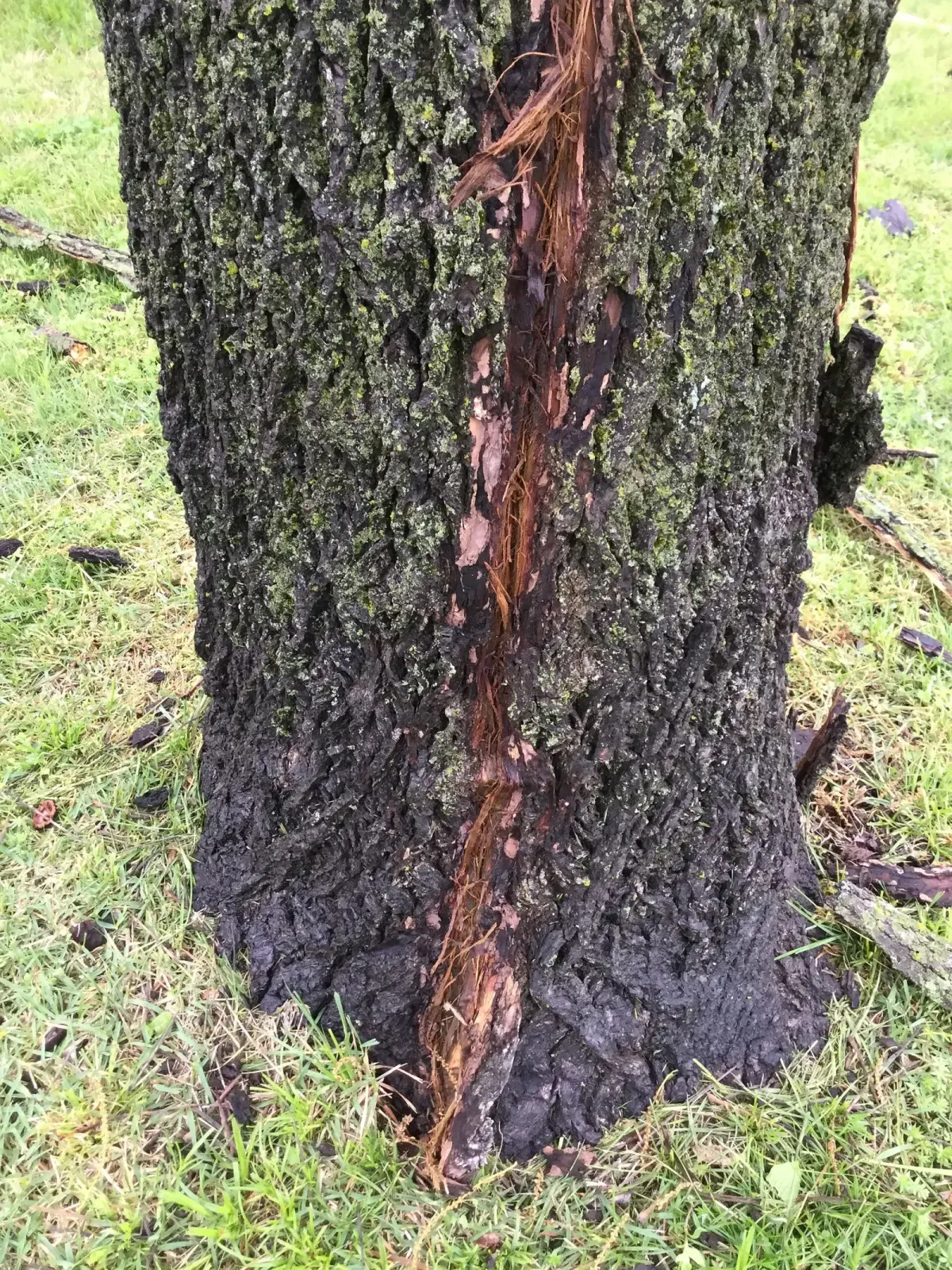
The damage comes from heat and steam. The Arbor Day Foundation describes it this way: sap boils, steam builds up, and the wood cells burst, which is why you see bark blown off in long strips. A tree hit on one side often survives. A tree with the current running through the trunk and bark split all the way down usually doesn’t. A tree that lives through the strike can still decline later, because the wound lets insects and disease in.
Bartlett Tree Experts, quoted by the Arbor Day Foundation, puts the number of trees struck in a year at more than one million. Trees on hills, in open pasture and near water get hit more. Tulip tree, oak, pine and maple are the species most often named as vulnerable.
Why a tall tree next to your house is a problem for the house
People worry about the tree. The bigger risk is often what the tree does to the building beside it.
The National Weather Service explains side flash for people: lightning hits a taller object, and part of the current jumps from that object to something nearby. The same physics applies to a house. The Lightning Protection Institute’s FAQ says it plainly: lightning can side-flash from a tree and hit a nearby structure. The Arbor Day Foundation gives “within 10 feet of a structure” as a reason to put a tree on the protection list, and names metal downspouts as a typical landing spot for the jump.
Two more paths matter around a house:
- Ground current. NWS notes that much of a strike’s energy spreads outward through and along the ground. Roots that run under a slab, a buried water line or an irrigation system can carry that current toward the house.
- Metal on or near the tree. Swing chains, a cable running to a treehouse, lights strung through the canopy, or a satellite dish bolted to a limb can all bring current toward the building.
If you already have a lightning protection system on the house, a big tree a few feet from the eaves is something your installer should look at. If you don’t, the tree is one of the questions that should go into deciding whether you need one.
What a tree lightning protection system is made of
The industry standard for tree systems is ANSI A300 Part 4, published through the Tree Care Industry Association. It covers tools, materials, conductors, connectors and fasteners, ground terminals and installation practice. It allows materials made of or clad with electrical-grade copper, copper alloys such as brass or bronze, or stainless steel. It also says the work should be done by an arborist or a certified lightning protection installer who knows tree systems. The National Park Service follows the 2008 edition of A300 Part 4 for trees in national cemeteries. Its write-up is the clearest public description of a real installation:
| Part | What it is (NPS example) | Its job |
|---|---|---|
| Air terminal | A blunt copper terminal at the top of the main leader | Takes the strike at the highest point |
| Main conductor | 14- or 32-strand, 17-gauge copper cable | Carries the current down the trunk |
| Branch conductors | Smaller runs out to major limbs | Protects big secondary leaders |
| Fasteners and copper nails | Hold the cable to the bark at intervals | Let the tree grow without girdling the cable |
| Branch connectors | Join branch runs to the main conductor | Keep one continuous path |
| Trench run | Cable buried in a shallow trench at least 10 ft from the trunk | Moves the current away from the root flare |
| Ground rod or plate | Rod driven about 8 ft (adjusted for shallow soil) | Puts the current into the earth |
At Andersonville National Cemetery, NPS crews ran the trench 35 feet out from the trunk of a roughly 100-foot oak. The trench distance is a site call. It depends on the root zone, the soil and what else is buried nearby.
Which trees are worth protecting
| Situation | Worth protecting? | Why |
|---|---|---|
| Tall tree within about 10 ft of the house | Usually yes | Side flash and root-zone current toward the structure |
| Heritage or specimen tree (old oak, historic planting) | Often yes | It can’t be replaced, so the system costs less than losing it |
| Lone tree in an open pasture or on a ridge | Often yes | Exposure makes strikes more likely, and livestock shelter under it |
| Tree that shades a patio, pool or play area | Consider it | People gather under it in summer storms |
| Young tree, or a tree in a stand of similar height | Usually not | Lower exposure, and it’s easier to replace |
| Tree already declining or hazardous | No | Have an arborist assess removal instead |
A protected tree is not a lightning shelter. NWS warns that people standing near a tree are the classic side-flash victims, and that warning still applies when a cable runs down the trunk.
How the tree system and the house system relate
This is the part arborist pages tend to skip. A tree system and a building system are two separate installations, usually done by two different trades. They still share the same ground.
Things to sort out before anything is installed:
- Where the tree’s ground rod goes. Its trench should run away from the house, not toward the foundation, the electrical service or a buried gas line.
- Whether the two grounding systems should be tied together. On a building, the lightning protection system works by keeping everything at the same potential. NWS stresses that system components must be bonded “to minimize the chances for any sparks or side flashes.” Whether a nearby tree system ties into the building’s ground is a design decision for whoever is responsible for the building system. Don’t leave it to chance.
- Whether the house is covered at all. A cable down the oak does nothing for the roof. If the tree was tall enough to worry you, the house under it probably deserves its own assessment.
We cover the bonding question in more detail in grounding vs bonding in lightning protection.
Can a tree survive a lightning strike?
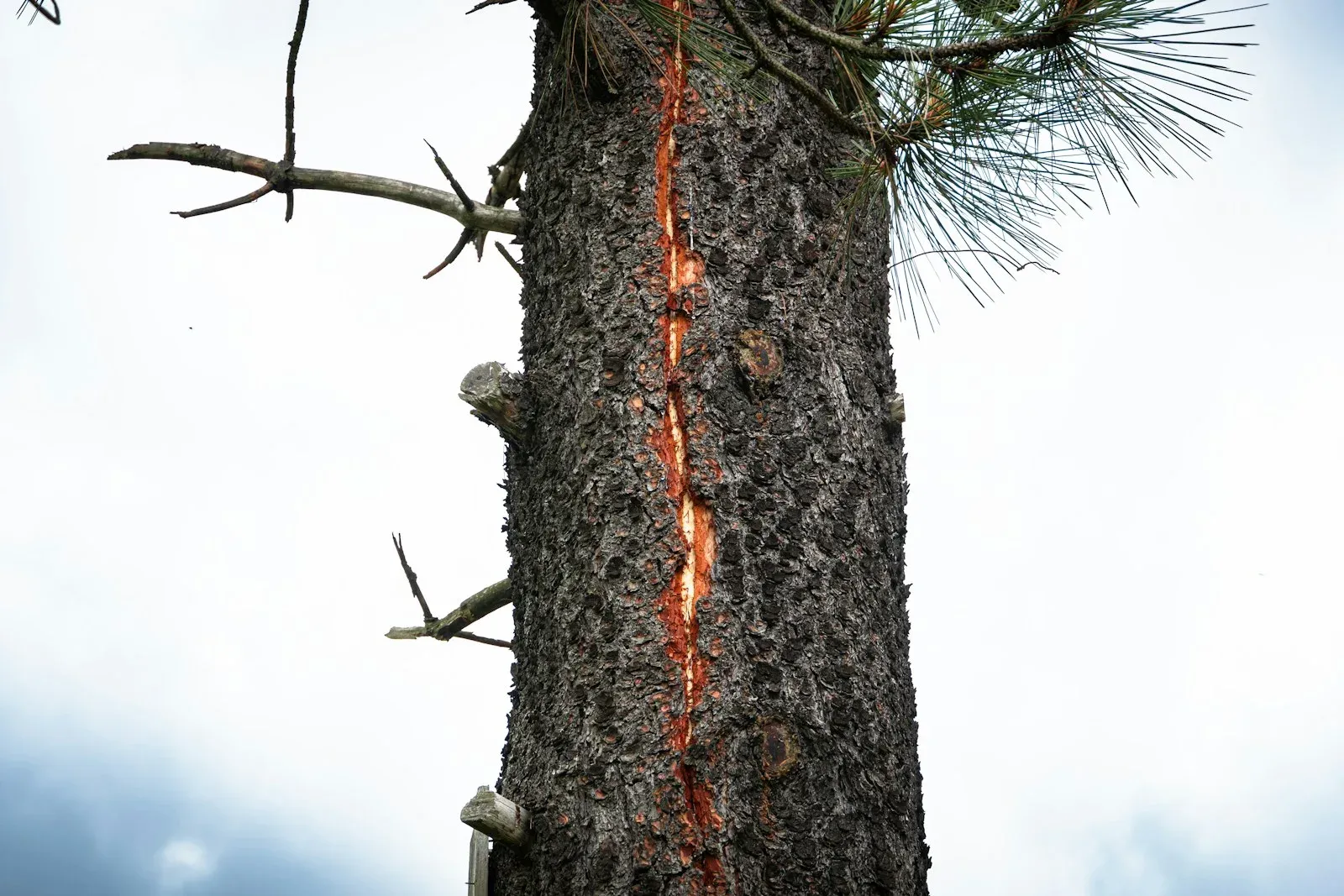 A fresh lightning scar on a pine trunk. Photo: Antonio Vivace / Unsplash, Unsplash License.
Often, yes. It depends on where the current went. Signs that point toward survival:
- Bark stripped in one narrow vertical band, with the rest of the trunk intact
- Green canopy and normal leaf-out the following season
- No deep split through the trunk
Signs that point toward removal:
- A spiral or full-length split through the trunk
- Bark blown off on several sides
- Cracked major limbs over a roof, driveway or play area
Have a certified arborist look at any struck tree that stands near people or buildings, even if it looks fine. Lightning damage inside the trunk isn’t always visible from the ground.
An owner’s annual check
NPS tests its cemetery tree systems every five years, using a visual inspection and a multimeter continuity check. Between those tests, an owner can walk the tree once a year:
- Is the cable still attached all the way up, or has it pulled loose as the trunk grew?
- Is any fastener being swallowed by bark (girdling)?
- Is the ground connection at the base exposed, cut or damaged by a mower or trencher?
- Were new branches added to the crown that now stick up above the air terminal?
- Has anything metal been hung on the tree since the system went in?
If the tree was struck, have the whole system checked, along with any building system near it.
Talk to us about the building next to the tree
Site Safe Lightning Protection works on lightning protection for homes, commercial buildings and oil and gas sites, plus inspections of existing systems. If a big tree sits close to your house or shop and you’re not sure whether the building is covered, contact Site Safe Lightning Protection to talk through an assessment of the structure. For the tree itself, bring in a qualified arborist so the two systems are planned together. More on home systems is on our residential lightning protection page. If you want to know what an unprotected strike does to a house, read what happens when lightning strikes a house without protection.
Talk to Site Safe Lightning Protection about your property.
Frequently asked questions
How does tree lightning protection work?
A copper conductor runs from an air terminal near the top of the tree, down the trunk, and through a buried trench to a ground rod or plate placed well away from the trunk. A strike follows that path instead of the wet wood. The tree can still be hit, but the trunk is far less likely to be blown apart.
Is tree lightning protection worth it?
For a tall tree within about 10 feet of a house, a heritage or specimen tree, or a lone tree on a ridge or in a pasture, it often is. For young trees, or trees in a stand of similar height, it usually isn't.
Why does lightning strike trees so often?
Trees are tall, they're often the highest thing around, and they're full of water. Trees on hills, in open fields or near water are hit more often. Oak, tulip tree, pine and maple are frequently named as vulnerable species.
Does a lightning rod on my house protect the tree next to it?
No. A building system protects the building. A tree needs its own conductor and ground under ANSI A300 Part 4. The two should be planned together so their grounds and bonding don't create a new side-flash path.
Is it safe to stand under a tree that has lightning protection?
No. The system protects the tree, not people under it. The National Weather Service warns that side flash usually hits people standing within a foot or two of the struck object.
Sources
- Tree Lightning Protection Systems in National Cemeteries (National Park Service)
- Protecting Trees from Lightning (Arbor Day Foundation)
- ANSI A300 Part 4 – Lightning Protection Systems (Tree Care Industry Association)
- How Lightning Strikes People: side flash and ground current (National Weather Service)
- Lightning Protection Institute FAQ
- Lightning Rods and Lightning Protection Systems (National Weather Service)
Image credits
- Black walnut tree trunk with a long strip of bark blown off by a lightning strike. Photo: Geo Lightspeed7 / Wikimedia Commons (source), CC BY-SA 4.0, resized.
- Pine tree trunk with a fresh lightning scar running down the bark. Photo: Antonio Vivace / Unsplash (source), Unsplash License.