Step Potential: How Lightning Current in the Ground Reaches People and Animals
By Site Safe Lightning Protection 8 min read
Step potential is the voltage between your two feet when electric current is spreading through the ground around you. OSHA defines it as “the voltage between the feet of a person standing near an energized grounded object” (OSHA 1910.269 App. C). The ground near the point where current enters sits at a higher voltage than ground a little farther out. Stand with your feet apart across that slope and current goes up one leg and down the other.
Power line crews learn about it from downed lines and ground faults. Lightning produces the same effect, only much bigger and much faster. The National Weather Service says ground current “causes the most lightning deaths and injuries,” because it spreads over a wider area than any other way lightning reaches people (NWS).
What is step potential?
When current enters the earth through a ground rod, a pole, a tree or the strike point itself, it flows outward in every direction. The soil resists that flow, so voltage falls off with distance. OSHA describes it this way: the voltage decreases rapidly with increasing distance from the grounding electrode, and that drop is called a ground potential gradient (OSHA).
Step potential is the slice of that gradient your stride happens to cover. The IEEE 80 grounding guide pins it to a one-meter step: the difference in surface potential between the feet of a person with feet spaced one meter apart (Garrett, IEEE 80 tutorial). A wider stride, or a longer body lying on the ground, spans more of the slope and picks up more voltage.
Step and touch potential, and ground potential rise
Three terms show up together in grounding work. They describe the same event from different spots.
| Term | Where the voltage appears | Example during a strike or fault |
|---|---|---|
| Ground potential rise (GPR) | Between a grounding system and remote earth | The whole ground ring of a building jumps to a high voltage for an instant |
| Step potential (step voltage) | Between your two feet | Walking across a yard or pad near where the current went into the ground |
| Touch potential (touch voltage) | Between your hand on a grounded object and your feet | Leaning on a fence, a tank, a pump jack or a down conductor |
The IEEE 80 tutorial defines ground potential rise as the maximum voltage a grounding grid may reach relative to remote earth, and touch voltage as the voltage that can be bridged hand-to-hand or hand-to-feet (Garrett). OSHA adds a warning about touch potential: if an object is grounded somewhere far from where you are touching it, the voltage you feel can be “nearly the full voltage” on the object (OSHA).
Why lightning step potential hurts so many people
Lightning carries a lot of current into a small patch of ground. NWS gives a typical flash as about 30,000 amps (NWS). All of that has to leave the strike point through the soil.
Environment and Climate Change Canada breaks down how lightning injures people, and ground current tops the list (Government of Canada):
| How lightning reaches a person | Share of injuries |
|---|---|
| Ground current | 40-50% |
| Side flash | 20-30% |
| Contact | 15-25% |
| Upward leaders (streamers) | 10-15% |
| Direct strike | 3-5% |
Direct strikes are the smallest share. Ground current, side flash and streamers all hurt people standing near the strike rather than under it.
NWS explains the path through the body: current enters at the contact point closest to the strike and leaves at the farthest one, and “the greater the distance between contact points, the greater the potential for death or serious injury” (NWS). That’s also why NWS now tells people not to lie flat. Lying down “increases your chance of being affected by potentially deadly ground current” (NWS myths). The old lightning crouch is out too. NWS says crouching doesn’t make you any safer outdoors.
How far does step potential reach after a strike?
NWS says radial horizontal arcing has been measured at least 20 m (about 65 feet) from the point where lightning hits the ground (NWS myths).
One of the few published engineering studies on the question came from the Aerospace Corporation, which modeled step voltage around a proposed lightning protection system for a launch pad at Cape Canaveral (Chai et al., NASA NTRS). The authors used a 1,000-volt safe step voltage taken from the military grounding handbook MIL-HDBK-419A. With 25.5 kA flowing into the ground at each injection point, they found:
| Upper soil layer | Distance needed to keep step voltage below 1,000 V |
|---|---|
| Wet, about 100 ohm-meters | 18 m (about 59 ft) |
| Dry, about 1,500 ohm-meters | 41 m (about 135 ft) |
Dry topsoil made things worse in that model, because the current stayed near the surface where people stand. And the simple resistor model most people use gave only a 3.5 m keep-out distance in wet soil, while the transient model that accounts for lightning’s fast rise gave 18 m. These are modeled results for one launch-pad design, so treat them as an order of magnitude for other sites.
How much step voltage can a person tolerate?
For power-system faults, engineers use IEEE Standard 80. Its limit comes from Dalziel’s equation for the body current that 99.5% of people can survive without ventricular fibrillation, a 1,000-ohm body resistance, and the resistance of the ground under the feet (Garrett). For a 50 kg person:
Tolerable step voltage = (1,000 + 6 × Cs × ρs) × 0.116 / √ts
Here ρs is the resistivity of the surface material in ohm-meters, Cs is a derating factor for a surface layer such as crushed rock, and ts is how long the shock lasts in seconds. With no surface layer, Cs is 1 and ρs is just the soil.
A worked example, our arithmetic with assumed inputs: a 0.5-second fault on bare soil of 100 ohm-meters gives (1,000 + 600) × 0.116 / 0.707, or about 262 V. The same fault on bare 1,000 ohm-meter ground gives (1,000 + 6,000) × 0.164, or about 1,148 V. Higher-resistivity ground under the feet lets a person tolerate more step voltage.
IEEE 80 is written for substations under fault conditions, and its formula assumes shock durations of fractions of a second to a few seconds. Lightning current lasts microseconds, so the formula doesn’t transfer directly to a strike. The Aerospace Corporation paper notes that little is known about how the human body responds to lightning-frequency current. That’s why lightning studies fall back on a flat figure like the 1,000 V in MIL-HDBK-419A.
How sites reduce step and touch potential
IEC 62305-3, the international lightning protection standard, has a clause on protecting people from touch and step voltages near a lightning protection system. It lists two kinds of measure: reduce the current that can flow through a body, by insulating exposed conductive parts or raising the resistivity of the surface soil, and reduce how often people are exposed, through physical restrictions or warning notices (IEC 62305-3 preview).
OSHA’s appendix for power work describes the same tools from the utility side (OSHA):
- An equipotential zone, made with a metal mat or grounding grid bonded to the grounded object, so everything a worker touches and stands on rises together.
- Insulating equipment rated for the voltage that can appear under fault conditions.
- Restricted work areas that keep people out of the zone where voltage differences are dangerous.
OSHA also warns that bonding an object that sits outside the work area can raise the touch potential to that object.
On a building or facility, those ideas turn into ordinary design choices:
- Where down conductors meet the ground. A down conductor that lands next to a door, a gate or a walkway puts the highest ground voltage where people stand. Routing it to a corner people don’t use is cheap at the design stage.
- A ground ring. A buried loop around the structure spreads current and evens out voltage around the footprint. Our ground ring guide covers sizes and depths.
- Surface material. A crushed-rock or asphalt layer over the ground near conductors raises ρs in the IEEE 80 formula and the surface resistivity IEC 62305-3 refers to.
- Bonding what people touch. Fences, rails, tanks and piping near a down conductor should be bonded so they rise with the ground around them.
Step potential on ranches and oil and gas pads
NWS says ground current from a nearby strike “is often fatal to livestock,” because a large animal’s wide body span picks up more voltage (NWS). Herds bunching under a lone tree or along a wire fence make it worse. Our post on protecting livestock and barns goes through fences and shelters.
On an oil and gas site, people work among tanks, flow lines and steel structures that are all tied to ground. A strike to a tank or a nearby pole raises the ground around it, and a hand on a valve wheel adds touch potential to step potential. Stopping outdoor work when thunder is heard and moving crews into buildings or hard-topped vehicles keeps people out of that zone. Our lightning safety rules for homes, job sites and leases cover when to stop and when to restart.
A short checklist for owners
- Find where your system’s down conductors enter the ground and keep walkways, gates and gathering spots away from them.
- Ask how fences, rails and piping near those points are bonded.
- On leases and ranches, put a stop-work rule and named shelters in the site safety plan.
- Have the system inspected after nearby construction. A new fence, pad or slab can put people right where the ground voltage peaks.
If you’d like a second look at where your system meets the ground on a home, commercial building or oil and gas facility, contact Site Safe Lightning Protection. We design and install lightning protection systems and inspect existing ones. You can contact Site Safe Lightning Protection to talk through your site.
Talk to Site Safe Lightning Protection about your property.
Frequently asked questions
What is step potential?
The voltage between a person's feet when current is flowing through the ground nearby, for example after a lightning strike or a power line fault. A stride across that voltage slope drives current up one leg and down the other.
What is the difference between touch potential and step potential?
Step potential is measured between your two feet. Touch potential is between your hand on a grounded object, such as a fence, tank or pole, and your feet. OSHA notes that touch potential can be close to the full voltage on the object if it is grounded far from where you are touching it.
How far from a lightning strike is step potential dangerous?
NWS reports radial arcing measured at least 20 m from a strike point. An Aerospace Corporation study for a launch pad needed 18 m in wet soil and 41 m in dry soil to keep step voltage below 1,000 V. There is no fixed safe distance outdoors during a storm, so go indoors.
How do you protect against step potential?
During a storm, get inside a substantial building or a hard-topped vehicle, and don't lie flat or crouch. At a site, the design tools are equipotential bonding, a ground ring or grid, high-resistivity surfacing such as crushed rock, insulation of exposed conductors and keeping people away from where conductors enter the ground.
Why do cows die from step potential?
NWS says ground current is often fatal to livestock because a large animal's wide body span covers more of the voltage gradient than a person's stride does.
Sources
- OSHA 29 CFR 1910.269 Appendix C, Protection From Hazardous Differences in Electric Potential (eCFR)
- National Weather Service: How Lightning Strikes Its Victims
- National Weather Service: Lightning Myths and Facts
- National Weather Service: Lightning Power
- Government of Canada: Dangers of lightning
- Chai, Briet, Barker and Eley (The Aerospace Corporation): Step Voltage Analysis for the Catenoid Lightning Protection System (NASA NTRS N91-32623)
- D. Lane Garrett, Southern Company Services: IEEE Standard 80-2000 tutorial, IEEE Substations Committee (2011)
- IEC 62305-3:2006, Protection against lightning, Part 3: Physical damage to structures and life hazard (preview: scope, introduction and contents)
Image credits
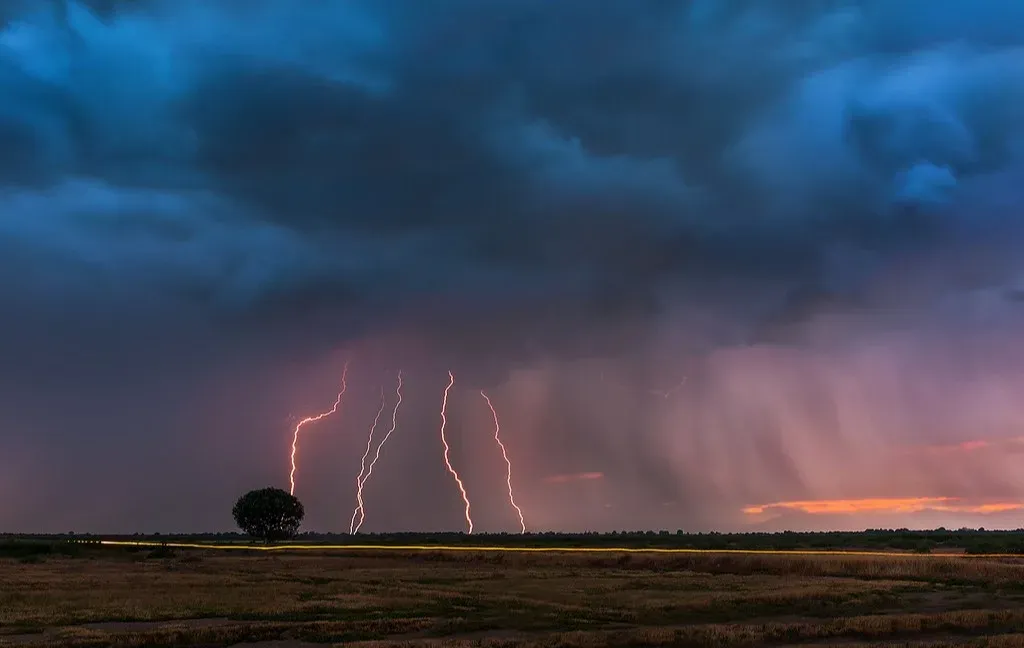
- Four lightning bolts hitting open ground beside a lone tree on a flat field under a dark storm cloud. Photo: Nick-K (Nikos Koutoulas) / Flickr (cropped) (source), CC BY 2.0, resized.
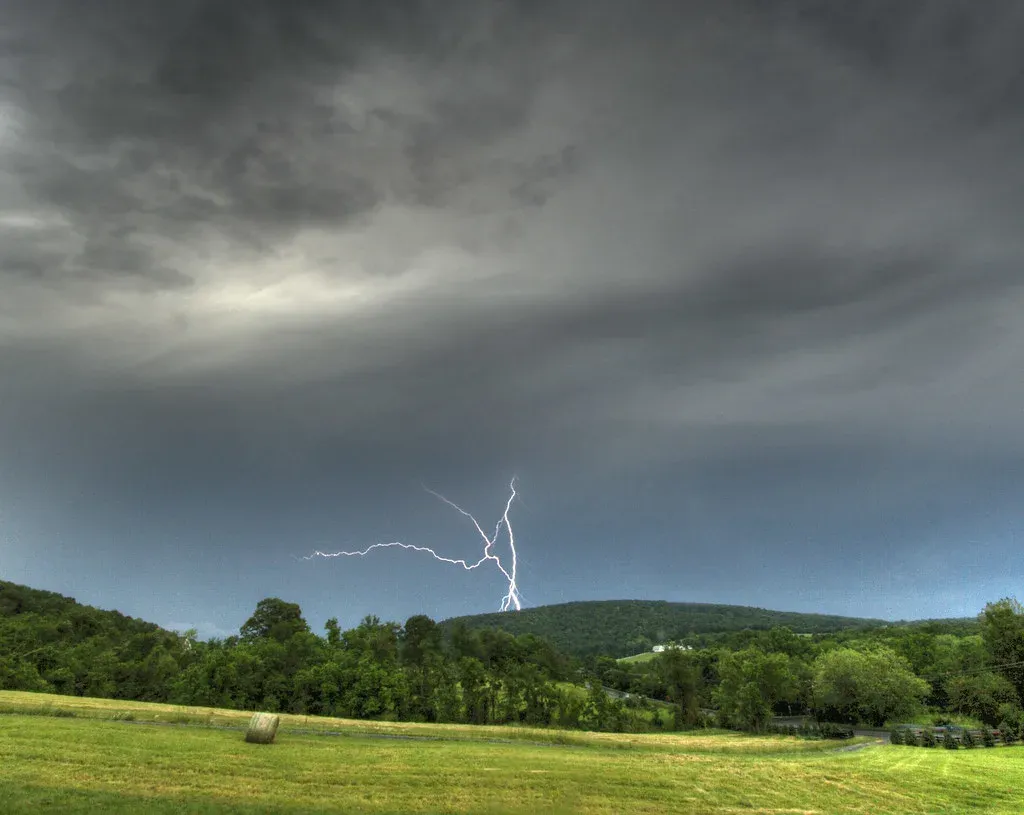
- A branching lightning bolt hitting a wooded hillside beyond a mown hay field with a round bale. Photo: kcdsTM / Flickr (source), CC BY 2.0, resized.