Cow Struck by Lightning: How Livestock Get Killed and How to Protect Barns, Fences and Herds
By Site Safe Lightning Protection 6 min read
When a cow is struck by lightning, it’s often not a direct hit. The National Weather Service says ground current, the electricity that spreads along the surface after a strike, kills many farm animals every year. Cattle and horses are especially exposed because of the long span between their front and back legs. Add charged wire fences and herds bunched under a lone tree, and one strike can drop several animals at once.
You can’t lightning-proof a pasture. You can cut the odds: ground fences properly, keep shelters and barns protected, and know what to document if you do lose animals.
How lightning kills livestock
There are four common ways, and only one is a direct strike.
1. Ground current. When lightning hits the ground or something on it, the current spreads along the surface rather than straight down, per the NWS. An animal standing with its front feet closer to the strike than its back feet has a voltage difference across its body. The farther apart the feet, the bigger the difference, which is why the NWS singles out farm animals.
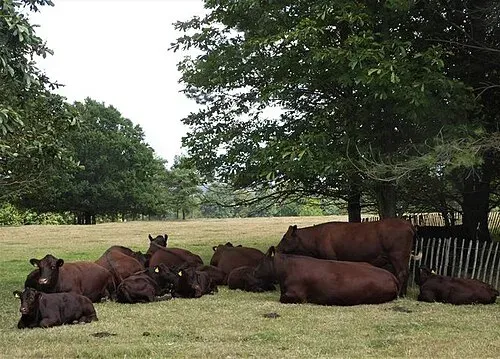
2. Trees. Extension Foundation guidance warns that livestock standing under a tree can be killed by a direct strike to the tree or by contact with the charged soil around it. Rutgers’ pasture advisory adds that the more surface roots a tree has, the more danger to animals crowded around it, and it names cottonwoods, oaks, maples, poplars, gums and pines as higher-risk species.
3. Fences and metal. Extension Foundation guidance says lightning can travel up to 2 miles along an ungrounded wire fence. Rutgers notes that animals crowded against a fence or with their heads through metal gates become part of the path to ground. Metal water troughs in crowded pens add to the risk.
4. Direct strike. An animal standing alone on open high ground is the tallest thing around. The NWS says height, a pointed shape and isolation decide where lightning strikes.
Fence lines: the cheapest fix
Wire fences run for miles across open ground and pick up current from strikes far from the herd. Grounding them breaks up that path.
- Ground wire fences at intervals. Extension Foundation guidance is to ground fences every 150 ft using steel rods driven 5 to 10 ft deep.
- Electric fences need attention too. Rutgers says lightning follows electric fence wires to chargers and ground rods, recommends ground rods at least 5 ft into the ground, and suggests disconnecting chargers before severe storms.
- Watch where fences meet buildings. A fence attached to a barn can carry current right to the structure. That connection point should be considered in the barn’s protection design.
Pastures, trees and water
You can’t move every tree, but you can change where animals end up during storms:
- Fence animals away from lone trees in open pasture where practical. Extension Foundation guidance suggests evaluating whether shade trees used by livestock, and trees within 10 ft of structures such as silos, should get protection.
- Rutgers advises that animals shouldn’t be forced to crowd within 50 ft of water troughs during lightning storms because the enclosure is too small.
- Temporary shelters with metal gates and tarps should be grounded, or taken down when storms approach.
Barns and livestock buildings
A barn concentrates animals, feed, hay and equipment in one tall building, often far from a hydrant. NFPA’s report Lightning Fires and Lightning Strikes (2010) estimated that from 2004 to 2008, US fire departments responded to an average of 50 lightning fires a year in grain or livestock storage buildings and another 50 a year in agricultural properties.
A barn lightning protection system uses the same five parts as any building. Extension Foundation guidance spells out the farm version:
| Component | Farm-building guidance |
|---|---|
| Air terminals | Solid copper rods at least 3/8 in. diameter, or aluminum at least 1/2 in., spaced 20 to 25 ft apart depending on rod length |
| Conductors | Copper or aluminum, not a mix of the two, to avoid corrosion |
| Ground connections | At least two for most buildings, using copper-clad steel or solid copper rods driven at least 8 ft |
| Bonding | Branch conductors tying metal objects to the system to prevent side flashes |
| Surge protection | Arresters where electrical service enters the building |
NFPA 780 is the national standard for the design. In the 2023 edition, it addresses concrete tanks and silos, metal towers and tanks, and facilities that handle combustible dust, which is relevant to grain handling. It also includes an annex on protection for livestock in fields, informational guidance aimed at exactly this problem.
Metal barns and pole buildings
A metal roof doesn’t attract lightning; the NWS says metal makes no difference to where lightning strikes. But a metal building still needs a path to ground that doesn’t run through stalls, stanchions or waterers. In animal areas, ask the designer where the ground electrodes will sit relative to where animals stand and gather, and how gates, stanchions and metal waterers will be bonded. Those details decide whether current spreads under the herd or away from it.
If you lose an animal: what to document
Veterinarian Dr. Ken McMillan, writing in DTN Progressive Farmer, says physical signs on the carcass or in the surroundings are thought to be present in more than 90% of lightning deaths. Look for:
- Linear singe marks, especially on the inside of the legs.
- Damage to a nearby tree or fence post, or disturbed ground.
- No signs of struggle (death from lightning is almost always instantaneous).
His advice: for insured animals, take photos at the site before moving the animal, and get a necropsy by your veterinarian or a state diagnostic lab soon after death. Findings such as poorly clotted blood and hemorrhages help confirm the cause.
USDA help. The Farm Service Agency’s Livestock Indemnity Program lists lightning among eligible adverse weather events. Producers have to file a notice of loss with their local FSA office within 30 calendar days of when the loss is apparent. Check the current program rules with your county office.
A quick ranch and farm checklist
- Are wire fences grounded at regular intervals, especially where they run across open high ground?
- Are electric fence chargers protected, and do you disconnect them before big storms?
- Do animals have a lone tree they crowd under? Can you fence it off during storm season?
- Does the barn have a complete lightning protection system with at least two grounds?
- Are gates, stanchions and metal waterers inside the barn bonded?
- Is there surge protection where power enters the barn and shop?
- Do you have a camera and a vet’s number ready to document a loss?
Protecting agricultural buildings
Site Safe Lightning Protection works on agricultural facilities as well as homes and commercial buildings. If you have a barn, shop, pole building or livestock facility you want protected or inspected, contact Site Safe Lightning Protection to talk through your site. See our commercial lightning protection page for larger buildings, our residential services for farmhouses and outbuildings, or contact us.
Talk to Site Safe Lightning Protection about your property.
Frequently asked questions
What happens if a cow gets struck by lightning?
Death is usually instant. Often it isn't a direct hit at all: ground current, a charged fence or a strike to a nearby tree is enough, because cattle have a long span between their front and back legs.
Why are cows killed by lightning so often?
The NWS says ground current kills many farm animals each year because their long leg span puts a larger voltage across their bodies. Herds also bunch together under trees or along fences, so one strike can kill several animals.
How do you protect livestock from lightning?
Ground wire fences at intervals, keep animals from crowding under lone trees and around metal troughs during storms, and protect barns and shelters with a complete lightning protection system. Extension guidance suggests grounding fences every 150 ft.
How can you tell if an animal was killed by lightning?
Look for singe marks, especially on the inside of the legs, damage to nearby trees or fence posts, and disturbed ground. A veterinarian's necropsy soon after death helps confirm it, which matters for insurance and USDA claims.
Does USDA pay for livestock killed by lightning?
The Farm Service Agency's Livestock Indemnity Program lists lightning as an eligible adverse weather event. A notice of loss must be filed within 30 calendar days of when the loss is apparent.
Sources
- National Weather Service: Lightning Science: Ground Current
- Safety, Health and Wellness in Agriculture (Extension Foundation): Lightning Protection Systems
- Rutgers Plant & Pest Advisory: Lightning strike awareness for pasture producers (Melissa Bravo, June 6, 2021)
- DTN Progressive Farmer: Lightning Strikes Common Cause of Cattle Deaths (Dr. Ken McMillan, June 24, 2024)
- USDA Farm Service Agency: Livestock Indemnity Program fact sheet (2023)
- NFPA: Lightning Fires and Lightning Strikes (Ben Evarts, December 2010)
- NFPA 780, Standard for the Installation of Lightning Protection Systems, 2023 edition (NFPA document page, free read-only access)
- National Weather Service: Lightning Myths
Image credits
- Herd of cattle lying under a large tree in a pasture, the situation where a cow struck by lightning or ground current is most likely. Photo: pam fray / geograph.org.uk via Wikimedia Commons (source), CC BY-SA 2.0, resized.
- Dairy cattle grazing in a fenced pasture near Wendell, Idaho. Photo: USDA / Kirsten Strough (source), Public domain (US gov).