Floating Roof Tanks and Lightning: Shunts, Seals and API RP 545
By Site Safe Lightning Protection 6 min read
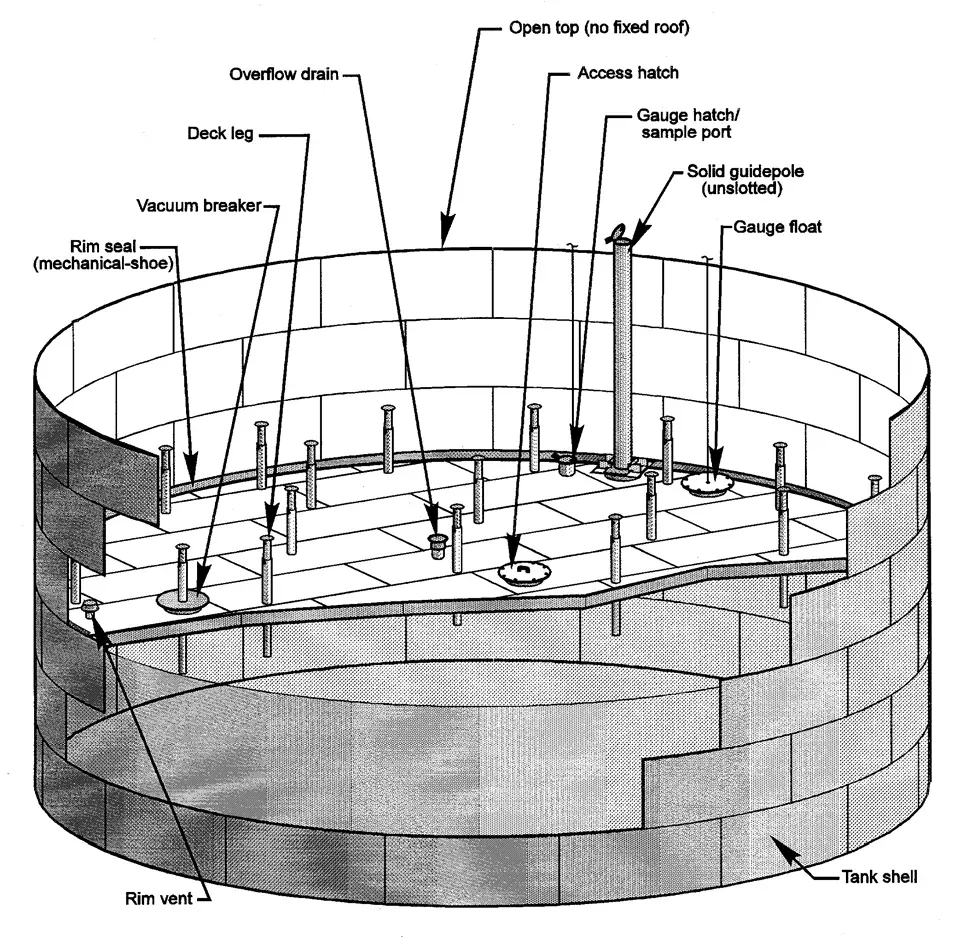
A floating roof tank is a storage tank whose roof sits on the liquid and rises and falls with it, sealed to the shell by a rim seal. That design cuts evaporative losses. It also leaves a moving metal roof that touches the shell only through sliding contacts, with vapor in the seal gap. When lightning hits, current has to cross that gap, and vapor in the rim seal area can ignite. An industry study found that 52 of 55 rim seal fires were caused by lightning.
This article covers the two main types of floating roof tank, why lightning causes so much trouble with them, what the American Petroleum Institute’s RP 545 recommended, and what operators can check.
External vs internal floating roof tanks
The EPA’s AP-42 emissions guide (Chapter 7.1) describes the main designs:
| Type | How it’s built | Lightning exposure |
|---|---|---|
| External floating roof (EFR) | Open-top steel shell. The deck (pontoon or double-deck welded steel) floats on the liquid with a rim seal against the shell | Highest. The roof and rim seal are open to the sky |
| Internal floating roof (IFR) | A fixed roof on top, plus a floating deck inside. Often aluminum, frequently a non-contact deck on pontoons | Lower for the deck, since the fixed roof takes the strike. Circulation vents and shell-to-roof paths still matter |
| Domed external floating roof | An EFR retrofitted with a fixed (usually aluminum dome) roof | Similar to an IFR |
In every type, AP-42 notes, the rim seal slides against the tank wall as the roof moves, and some annular space remains between the seal and the wall. That sliding contact and that vapor space are where the lightning problem lives.
How lightning starts a rim seal fire
When lightning hits a tank, or nearby, current flows between the floating roof and the shell. The roof isn’t welded to the shell. It connects through whatever happens to be touching: shunts, seal parts, the gauge pole, the rolling ladder. Each of those is a point where current can jump an air gap.
Joseph Lanzoni’s 2009 paper on petroleum storage tank lightning safety reports two findings from the test program behind API RP 545:
- When lightning current passes through shunts at the roof-shell interface, they arc under all conditions. That held whether the shunts were clean or dirty, new or old, well-maintained or neglected.
- It’s the slow, long-duration component of the lightning flash, not the initial fast spike, that ignites flammable vapor.
Put those together and the problem is clear. A flammable mixture sits in the rim seal space, and the roof-to-shell contacts are certain to spark when current crosses them.
The fire record
The same paper cites:
- A review of tank fires reported in the media worldwide from 1951 to 2003 that found about one-third of 480 tank fire incidents were attributed to lightning.
- A study sponsored by 16 oil companies that found 52 of 55 rim seal fires were caused by lightning and concluded that lightning is the most common ignition source.
- Lightning-caused floating roof tank fires in Wynnewood, Oklahoma (2007) and Kansas City (2008), the latter burning for three days.
What shunts are, and why they’re not enough
Shunts are spring-tensioned metal strips bolted to the edge of the floating roof and bent to press against the shell. They’re meant to give lightning current a path from roof to shell. NFPA 780, as described in the 2009 paper, required them above the seal at intervals of no more than 3 meters (10 feet) around the roof.
The problems are physical. Wax, crude residue, rust and paint on the shell wall raise the contact resistance. If the shell is painted inside, the paint insulates the shell from the shunts. Out-of-round shells and roof drift pull shunts away from the wall. A 2025 LEC article sums it up: shunts depend on spring pressure for contact, and even new, well-maintained shunts can arc under lightning conditions.
What API RP 545 recommended
API published RP 545, Recommended Practice for Lightning Protection of Aboveground Storage Tanks for Flammable or Combustible Liquids, in 2009, after the research program above. As summarized in the Lanzoni paper, it made three recommendations for floating roof tanks:
| Recommendation | Detail | Practical status |
|---|---|---|
| 1. Submerged shunts | Shunts between roof and shell every 10 ft (3 m), submerged at least 1 ft (0.3 m) below the liquid. Remove above-seal shunts | Seen as difficult and costly to retrofit |
| 2. Insulate seal components | Electrically insulate seal assembly parts (springs, scissor assemblies, seal membranes) and gauge and guide poles from the roof, rated 1 kV or more | Seen as difficult and costly to retrofit |
| 3. Bypass conductors | Conductors between roof and shell no more than every 30 m (100 ft) around the circumference, as short as possible, evenly spaced, max 0.03 ohm end to end, long enough for full roof travel | Described as relatively easy and inexpensive to install |
The logic of number 3 is that bypass conductors carry the slow, long-duration current that causes ignition, so it doesn’t arc through the shunts and seal.
Is API RP 545 still current?
API has since withdrawn RP 545. GlobalSpec’s standards listing and a 2025 LEC article both describe it as withdrawn. The LEC article reports that the submerged-shunt and insulation recommendations were considered impractical and expensive. The bypass conductor approach carries on in NFPA 780. If your company standard still references API RP 545, check with your engineering group which document now governs. NFPA 780 is in its 2026 edition, which also revised Annex N on concerns with nonmetallic tanks.
Floating roof tank lightning inspection checklist
- Bypass conductors: present, the right count for the circumference, intact, long enough for full roof travel, and connections tight
- Shunts: contact with the shell, corrosion, missing or bent shunts, buildup on the shell wall
- Rim seal: condition of primary and secondary seals, gaps, signs of past scorching
- Gauge and guide poles, rolling ladder: bonded or isolated as the design intends, with no loose contact points
- Shell grounding: tank connected to the grounding system, with ground connections at grade intact and tested
- Roof drains and deck fittings: no new metal paths added during maintenance
- After any strike or roof work: a documented check before the tank returns to normal service
The North Dakota Industrial Commission’s 2019 lightning protection scoping study gives operators wider background on lightning, static, grounding and bonding standards and lightning-related spill incidents at production and saltwater disposal sites.
Fixed-roof tanks and production sites
If your site runs fixed-roof tanks instead, the ignition points are thief hatches, vents and piping connections. We cover those in tank battery lightning protection. For the broader oilfield picture, see how lightning protection systems prevent explosions and equipment damage in oilfields.
Talk to us about your tanks
Site Safe Lightning Protection works on lightning protection systems and inspections for oil and gas facilities, commercial buildings and homes. If you operate floating roof or fixed-roof tanks and want the lightning protection and bonding reviewed, contact Site Safe Lightning Protection, or see our oil and gas lightning protection page.
Talk to Site Safe Lightning Protection about your property.
Frequently asked questions
What is a floating roof tank?
A storage tank whose roof floats on the stored liquid and rises and falls with it, sealed to the shell by a rim seal. It reduces evaporative losses. External floating roof tanks are open-topped. Internal floating roof tanks have a fixed roof over the floating deck.
What is the difference between an internal and external floating roof tank?
An external floating roof sits in an open-top tank exposed to weather. An internal floating roof floats under a permanent fixed roof. The fixed roof takes direct strikes, so the floating deck is less exposed.
Why do floating roof tanks catch fire from lightning?
Lightning current crossing from the floating roof to the shell arcs at shunts and seal contacts, and vapor in the rim seal space can ignite. An industry study found that 52 of 55 rim seal fires were caused by lightning.
What is API RP 545?
API's 2009 Recommended Practice for Lightning Protection of Aboveground Storage Tanks for Flammable or Combustible Liquids. It recommended submerged shunts, insulated seal components and bypass conductors. API has since withdrawn it, but bypass conductors remain common practice and carry on in NFPA 780.
How far apart are shunts on a floating roof tank?
NFPA 780 has called for shunts at intervals of no more than 10 feet (3 meters) around the roof perimeter. API RP 545 recommended bypass conductors no more than every 100 feet (30 meters). Check the current edition of NFPA 780 and your company standard.
Sources
- AP-42 Chapter 7.1, Liquid Storage Tanks (US EPA, 10/2024)
- Improving Lightning Safety of Petroleum Storage Tanks (J. Lanzoni, Lightning Eliminators & Consultants, October 2009)
- API 545: Why Bypass Conductors for Floating Roof Tanks Still Matter (Lightning Eliminators & Consultants, September 2025)
- API RP 545, Recommended Practice for Lightning Protection of Aboveground Storage Tanks for Flammable or Combustible Liquids (GlobalSpec listing)
- NFPA 780, Standard for the Installation of Lightning Protection Systems, 2026 Edition (description)
- Lightning Protection Scoping Study, Final Report (EERC / North Dakota Industrial Commission, 2019)
Image credits
- Labeled cutaway diagram of a double-deck external floating roof tank showing the rim seal, roof legs and vents. Photo: U.S. EPA, AP 42, Chapter 7: Liquid Storage Tanks, via Wikimedia Commons (source), Public domain (US gov).