Church Struck by Lightning: Why Steeples Get Hit and Why Partial Systems Fail
By Site Safe Lightning Protection 6 min read
When a church is struck by lightning, the damage usually starts high and hidden: in the steeple, or in the wood framing of the attic above the sanctuary. By the time someone sees smoke, the fire has often had a head start. A complete lightning protection system gives the strike a planned path to ground instead. A rod on the steeple alone does not.
The news results for this search tell the same story again and again. In June 2026, KWCH reported a church in Cheyenne County that was struck by lightning and burned to the ground. What those stories don’t tell you is why churches are exposed and what a congregation can do about it. That’s what this article covers.
Why churches get struck
The National Weather Service is clear that height, a pointed shape and isolation decide where lightning hits. Metal doesn’t attract it. A steeple checks all three boxes. In a small town or a rural crossroads, the church is often the tallest thing for a mile.
The building type adds to the problem. Many churches have:
- Large attics with exposed wood trusses or heavy timber over the sanctuary.
- No sprinklers, and sometimes no fire detection in the attic or steeple.
- Long stretches when nobody is inside, so a smoldering fire overnight goes unnoticed.
- Older wiring and added sound, lighting and broadcast equipment that surges can reach.
What NFPA fire data shows for places of worship
The National Fire Protection Association’s report Lightning Fires and Lightning Strikes (Ben Evarts, December 2010) estimated that US fire departments responded to an average of 24,600 lightning-started fires a year from 2004 to 2008.
Within non-home structures, places of worship and funeral properties accounted for an average of 80 lightning fires a year. That’s only 4% of non-home lightning structure fires, but those fires caused about $13 million a year in direct property damage, or 14% of the non-home total. In plain terms: churches don’t burn from lightning often, but when they do, the losses are large.
The same report includes case studies that read like a list of what goes wrong:
- Texas: a motorist saw flames above the sanctuary of a one-story, wood-framed church during an overnight storm. The building had no detection or suppression system. Investigators found the fire started in the attic, and the roof collapsed. Losses were estimated at $600,000.
- Florida: lightning struck a church in two places and sent a surge through the wiring, melting one of three main breaker boxes and igniting roof trusses in several spots. Damage was estimated at $1.3 million.
- Iowa: lightning hit the steeple of a historic wood church and ignited shingles and framing. The building was destroyed.
- Virginia: lightning struck a 200-foot steeple and traveled along the ridge of the metal roof, igniting the rafters below.
Notice the pattern: attic and steeple ignition, surges through wiring, and no early warning.
Why a steeple-only rod isn’t enough
Plenty of older churches have a single rod or cross on the steeple with one cable running down. It looks like protection. It usually isn’t.
The Lightning Protection Institute says steeple-only grounding doesn’t typically protect the entire structure, that partial systems don’t comply with NFPA 780, and that a partial installation could be more dangerous than none at all. The reason is simple. Lightning that hits the main roof ridge, a gable or a chimney has no designed path. And a single down conductor carrying a strike past wiring, piping and organ pipes can side-flash into them if they aren’t bonded.
A complete system has five parts working together: strike termination devices, conductors, bonding, grounding and surge protection. LPI describes all of them as necessary for an effective system.
What a complete church system includes
NFPA 780 covers churches under its general requirements, with a section for masts, spires and flagpoles (2023 edition). In practice, a church design usually covers:
| Area | What goes there | Why |
|---|---|---|
| Steeple, spire, cross | Air terminal(s) at the top, with the cross or finial integrated where possible | The most likely strike point |
| Main roof ridges and gables | Air terminals at no more than 20 ft spacing (25 ft for terminals 24 in. or taller), per NFPA 780 (2023) | Strikes don’t only hit the steeple |
| Chimneys, bell towers, vents | Terminals per NFPA 780 (2023) | Projections are strike points |
| Down conductors | At least two paths to ground for most buildings (per Extension guidance), routed on the exterior or concealed | Splits the current and reduces side-flash risk |
| Grounding | Ground electrodes at each down conductor | Gives the current somewhere to go |
| Bonding | Electrical service ground, water and gas piping, metal roofing, HVAC | Stops arcing to metal inside the building |
| Surge protection | At electrical and communication service entrances (NFPA 780, 2023) | Protects wiring and equipment and reduces fire risk from surges |
Historic buildings and appearance
Trustees often worry that a system will spoil a historic façade. It doesn’t have to. NFPA 780 (2023) has a section on concealed systems, and conductors can run inside walls, in attics, or behind downspouts. New copper is reddish but darkens or develops a green patina as it ages, according to ECLE, which helps it blend with masonry and slate. Aluminum is lighter in color but has limits: NFPA 780 bars it from being embedded in masonry or used where it stays wet (Section 4.3.3), and it can’t go against copper roofing or flashing (Section 4.2.4). Copper can’t go against aluminum (Section 4.2.3). On a building with copper flashing and stone walls, the designer will usually choose copper.
If the building is on a historic register, bring the preservation reviewer in early. Concealed routes are easier to plan before the work than to fix after.
Checklist for trustees and facility committees
Walk through this once a year, and again after any roof work:
- Do we have a lightning protection system at all, or only a rod on the steeple?
- Is there documentation: drawings, a UL Master Label or LPI-IP certificate, or an inspection report? UL certificates expire after five years or sooner when the roof or system changes.
- Are air terminals upright and attached, and are cables continuous from roof to ground? Look for loose clips, broken cables and terminals knocked over by roofers.
- Has anything been added to the roof since the system went in: a new HVAC unit, antennas, a sound system mast, solar panels?
- Are the ground connections visible and intact, or have they been buried under new landscaping or paving?
- Is there surge protection at the electrical service and on phone, internet and alarm lines?
- Is there smoke detection in the attic and steeple? Lightning fires often start where nobody looks.
- Does the church’s insurer require or credit a lightning protection system? Ask.
Our article on common problems found during lightning protection inspections shows what an inspector typically finds on older systems.
Get your church’s system checked
If your church has an older steeple rod, no system at all, or a roofing project coming up, contact Site Safe Lightning Protection. We can inspect what’s there, explain what a complete system would include, and work around the appearance of the building. See our commercial lightning protection services or reach out directly.
Talk to Site Safe Lightning Protection about your property.
Frequently asked questions
Why do churches get struck by lightning so often?
Steeples are tall, pointed and often isolated, which are the factors the National Weather Service says control where lightning strikes. Many churches are the tallest structure in their neighborhood.
Is a lightning rod on the steeple enough to protect a church?
No. The Lightning Protection Institute says steeple-only grounding doesn't typically protect the whole structure and partial systems don't comply with NFPA 780. Ridges, gables and chimneys need strike termination too, along with bonding, grounding and surge protection.
How much damage does lightning do to churches?
NFPA estimated that from 2004 to 2008, places of worship and funeral properties averaged 80 lightning fires a year with about $13 million in direct property damage annually, 14% of non-home lightning fire damage.
Can a lightning protection system be hidden on a historic church?
Often, yes. NFPA 780 includes requirements for concealed systems, and conductors can be routed inside walls and attics or behind downspouts. Strike termination devices still have to be on the roof and steeple.
What should a church do after a lightning strike?
Call the fire department if there's any sign of smoke, and have the attic and steeple checked even if nothing is visible. Then have the lightning protection system and electrical system inspected before the building is used again.
Sources
- NFPA: Lightning Fires and Lightning Strikes (Ben Evarts, December 2010)
- Lightning Protection Institute: Are churches attracting more lightning than sinners? (March 21, 2017)
- NFPA 780, Standard for the Installation of Lightning Protection Systems, 2023 edition (NFPA document page, free read-only access)
- National Weather Service: Lightning Myths
- UL: Lightning Protection Certificate Services (client brochure, PDF)
- KWCH: Church struck by lightning, burns to the ground in Cheyenne County (June 9, 2026)
- Safety, Health and Wellness in Agriculture (Extension Foundation): Lightning Protection Systems
- East Coast Lightning Equipment: Lightning Protection System Elements (materials and appearance)
Image credits
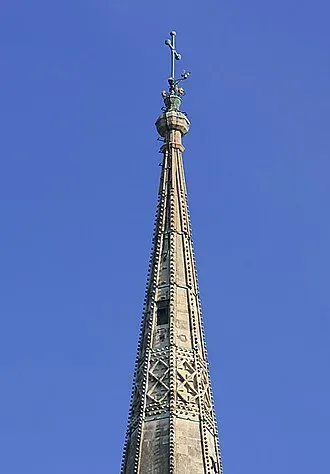
- Top of the stone spire of Salisbury Cathedral, a tall church steeple exposed to lightning. Photo: Peter Facey / geograph.org.uk via Wikimedia Commons (source), CC BY-SA 2.0, resized.