Positive Lightning: Why It Hits Harder and Why the High Plains Get More of It
By Site Safe Lightning Protection 7 min read
Positive lightning is a cloud-to-ground flash that carries positive charge down from the top of a thunderstorm. Most lightning comes from the negatively charged lower part of the cloud. Positive strikes start higher up, often in the flat anvil, and NOAA says they make up less than 5% of all strikes (NOAA JetStream).
They’re rare, but they’re the big ones. NOAA says a positive strike’s peak charge and potential can be up to ten times greater than a negative strike’s, with peaks of as much as 300,000 amps and a billion volts. The flash lasts longer, and it can land well away from the rain.
Positive vs negative lightning
| Negative cloud-to-ground | Positive cloud-to-ground | |
|---|---|---|
| Share of strikes | Most of them | Less than 5% (NOAA) |
| Where it starts | Lower, negatively charged part of the cloud | Upper part of the storm or the cirrus anvil |
| Strokes per flash | Typically two or more | Usually one (NWS) |
| Current and charge | About 30,000 amps and 15 coulombs for an average bolt (Wikipedia) | Large ones up to 120,000 amps and 350 coulombs, with peaks reported up to 400,000 amps |
| Continuing current | About 20% of negative discharges | All positive discharges (USDA Forest Service) |
| When it’s most common | Most storms, most of the time | Dissipating stage of a storm, and winter storms (NOAA) |
The numbers in the current and charge row come from different sources and aren’t fixed limits. What they agree on is the pattern. NSSL’s lightning FAQ sums it up: positive lightning’s peak current is often stronger, its flash duration is typically longer, and its peak charge can be much greater than a negative strike’s (NSSL).
Continuing current is the current that keeps flowing in the channel after the main stroke. The Forest Service ties fire starts to it, and says every positive discharge has it.
Two other habits set positive lightning apart. It can be the main type of cloud-to-ground lightning in the winter months (NOAA JetStream). It is also a major source of sprites, brief flashes high above large thunderstorms. NOAA puts sprites at 25 to 45 miles up.
Why positive lightning strikes so far from the storm
A positive flash starts in the upper part of the storm or the anvil, so it can come down a long way from the rain shaft.
The two NWS pages on the subject give different distances. The JetStream version says many positive strikes land more than 25 miles from the precipitation (NOAA JetStream). The older NWS training page says more than 10 miles, where thunder may not even be heard (NWS). Both make the same point for anyone outside: if you can hear thunder, you are close enough to be struck.
NSSL also describes the “bolt from the blue,” a flash that comes out of the side of the cloud and has been documented traveling several miles away from it (NSSL).
Timing matters as much as distance. NOAA says positive flashes can dominate in the dissipating stage, near the end of a storm, when it’s tempting to head back outside. Our lightning safety rules cover when it’s reasonable to go back out.
Where positive lightning is common: the High Plains
Fewer than 1 in 20 strikes is positive, but the share is much higher in some places. Researchers at Colorado State University summarized the climatology this way: the highest fractions of positive cloud-to-ground lightning lie in a corridor from eastern Colorado and western Kansas northeast into Minnesota (Tessendorf and Rutledge, CSU).
That corridor was the reason for STEPS, a 2000 field study of storms in eastern Colorado and western Kansas. The CSU team found that the positive region was usually centered in northeastern Colorado and northwestern Kansas, along the state line, with negative lightning dominating on either side. Storms that produced mostly positive ground flashes were also more likely to turn severe:
| Storm type in STEPS | Share that became severe |
|---|---|
| Predominantly positive cloud-to-ground | 53% (47% because of large hail) |
| Predominantly negative cloud-to-ground | 14% |
| Initially positive storms | 42% |
| Initially negative storms | 28% |
A University of Arizona and Vaisala team filmed lightning with high-speed video on the plains of eastern Colorado, western Kansas and western Nebraska in 2005. They recorded 204 positive flashes and 103 negative ones, about two positive for every negative, which they called an unexpectedly large number (Fleenor et al.). Only 9 of the 204 positive flashes had a second stroke. In their Arizona campaigns, by contrast, only about 3% of flashes were positive.
One caution if you look at strike maps. The same team discarded positive detection-network reports of 20,000 amps or less from their storm maps, because many of those weak “positive” reports on the plains are likely cloud pulses that never touched the ground. A map full of small positive dots overstates how many positive strikes reached the ground.
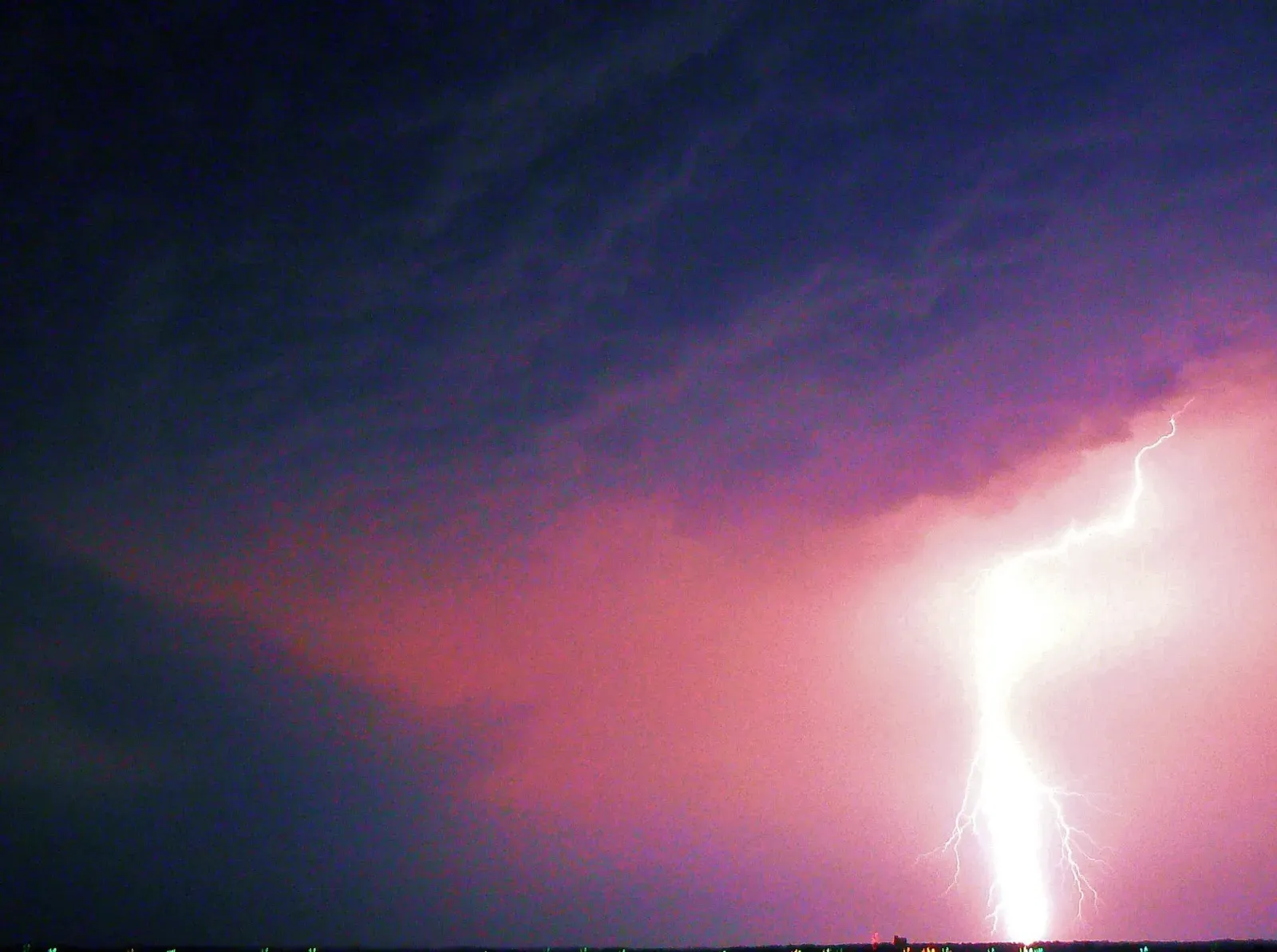
For Colorado property owners, this is mostly an eastern plains story: ranches, farms, oil and gas leases and towns east of the Front Range. Our post on what lightning carries in volts and amps puts the current figures in context.
Positive lightning and fires
The Forest Service’s fire weather program says lightning fires are started by strikes that have a continuing current, and that ignition depends on how long the current lasts and what fuel it hits (USDA Forest Service). The same page says every positive discharge has a continuing current and only about one in five negative discharges does.
NSSL says the longer-duration current is thought to make positive lightning more likely to ignite fires (NSSL). NOAA goes further: positive flashes are believed to be responsible for a large percentage of forest fires and power line damage (NOAA JetStream).
What positive lightning means for a building
A lightning protection system doesn’t choose polarity. Air terminals, conductors, bonding and grounding give any strike a low-resistance path to earth, positive or negative. What changes with a positive flash is the dose: more charge, often in a single long stroke with continuing current behind it.
That makes the size of the metal at the strike point matter. The Lightning Protection Institute’s reroofing specification only lets metallic bodies 3/16 inch thick or more serve as strike termination devices without adding air terminals (LPI). Thinner metal gets its own air terminals.
Positive flashes also have a habit of setting off upward lightning from tall towers and buildings, which Wikipedia’s summary of the research notes (Wikipedia). Our post on whether lightning comes from the ground covers what that looks like and why tall structures see it most.
For owners on the eastern plains, the practical list is short:
- Don’t skip protection because a storm usually passes to the north or south. Positive strikes can land far from the core.
- Have older systems checked for loose connections and damaged conductors.
- Bond metal that people touch or that runs into the building, such as fences, gas lines and antenna masts, so a strike doesn’t jump between them.
Talking to someone about your property
If your home, barn or business sits out where positive lightning is common, contact Site Safe Lightning Protection. We design and install lightning protection systems for homes, commercial buildings and oil and gas facilities, and inspect existing ones. Our residential lightning protection page shows what a home system includes, or you can contact Site Safe Lightning Protection to talk through your site.
Talk to Site Safe Lightning Protection about your property.
Frequently asked questions
What is positive lightning?
A cloud-to-ground flash that lowers positive charge to the ground. It usually starts in the upper part of the storm or the anvil cloud, where positive charge collects, instead of the lower, negatively charged part that produces most strikes.
How rare is a positive lightning strike?
NOAA puts positive lightning at less than 5% of all strikes. The share is much higher in some places and seasons. It can be the main type of cloud-to-ground lightning in winter and late in a storm's life, and researchers have measured a high share on the High Plains of eastern Colorado, western Kansas and Nebraska.
Is positive lightning more dangerous than negative lightning?
NSSL says it may be considered more dangerous because its peak current is often stronger, its flash duration is typically longer and its peak charge can be much greater. NOAA says peak charge and potential can be up to ten times greater than a negative strike, and that positive flashes are believed to cause a large share of forest fires and power line damage.
How far from a storm can positive lightning strike?
The two NWS pages on positive lightning give different figures: one says many strikes land more than 10 miles away, the other more than 25 miles from the rain. Either way, if you can hear thunder you are close enough to be struck.
Can a lightning protection system handle positive lightning?
Air terminals, conductors, bonding and grounding carry a strike to earth whatever its polarity. Positive flashes bring more charge and a longer current, so sound connections and properly sized components matter. The LPI reroofing specification only lets metal 3/16 inch or thicker serve as a strike point without added air terminals.
Sources
- NOAA JetStream: The Positive and Negative Side of Lightning
- National Weather Service (Houston/Galveston training page): The Positive and Negative Side of Lightning
- NOAA National Severe Storms Laboratory: Lightning FAQ
- Wikipedia: Lightning (positive and negative lightning)
- Tessendorf and Rutledge (Colorado State University): Cloud-to-ground lightning behavior of convective cells observed during STEPS, 22nd Conference on Severe Local Storms, AMS (2004)
- Fleenor, Biagi, Cummins, Krider and Kehoe (University of Arizona / Vaisala): Characteristics of cloud-to-ground lightning in warm-season thunderstorms, AMS 88th Annual Meeting (2008)
- USDA Forest Service Wildland Fire Assessment System: Lightning Ignition Efficiency (2002, archived)
- Lightning Protection Institute: Reroofing Projects, Specification for Lightning Protection System
Image credits
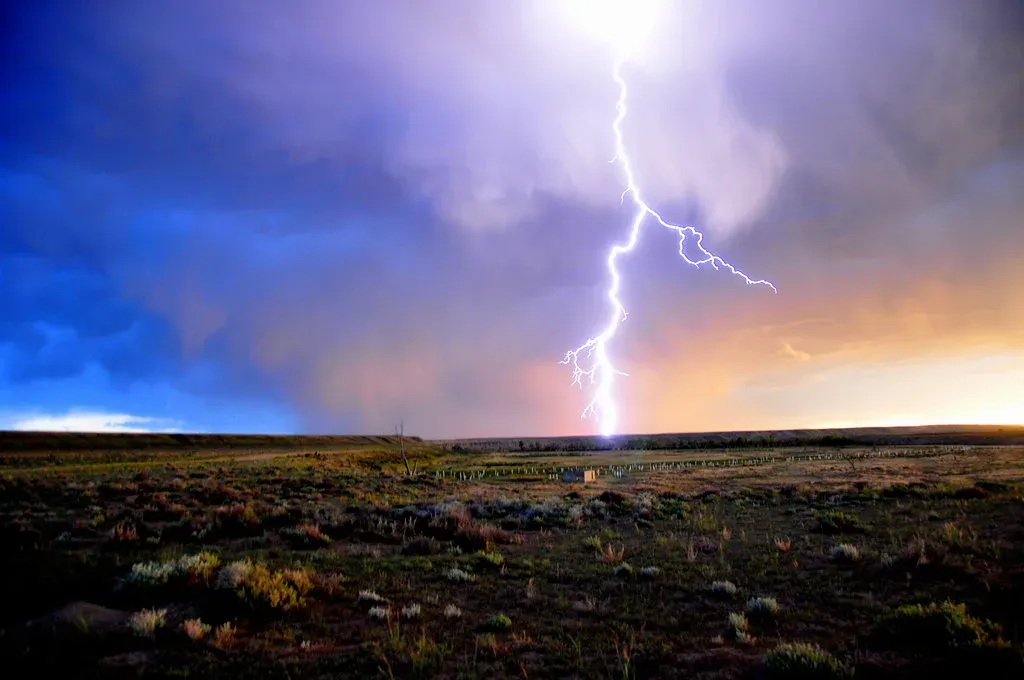
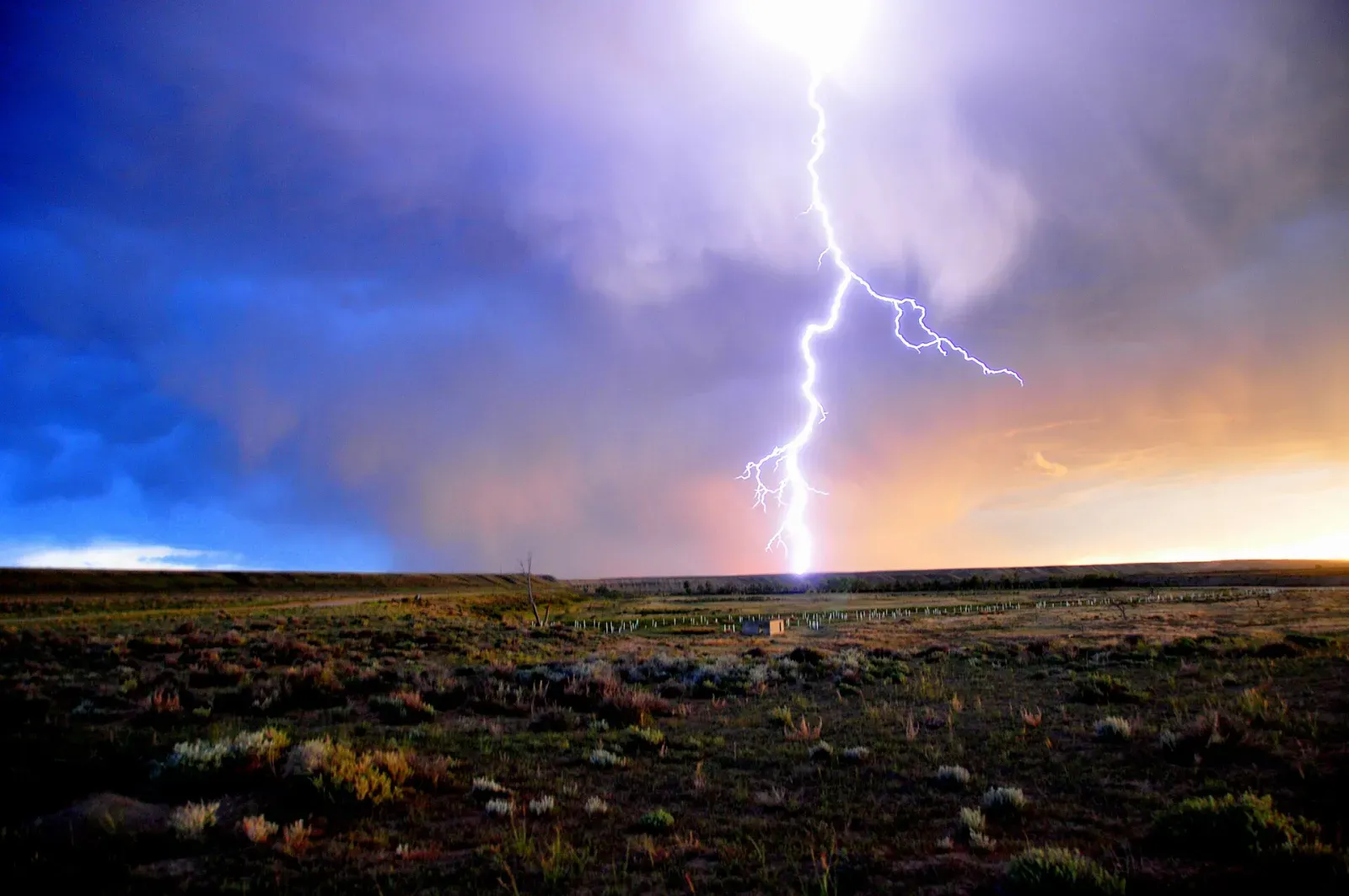
- A single lightning bolt hitting a flat sagebrush plain under a purple and orange storm sky at sunset. Photo: USFWS Mountain-Prairie / Wikimedia Commons (source), Public domain (US gov).
- A thick, very bright lightning channel reaching the ground under a dark storm base at night in Nebraska. Photo: MONGO / Wikimedia Commons (source), Public domain.